
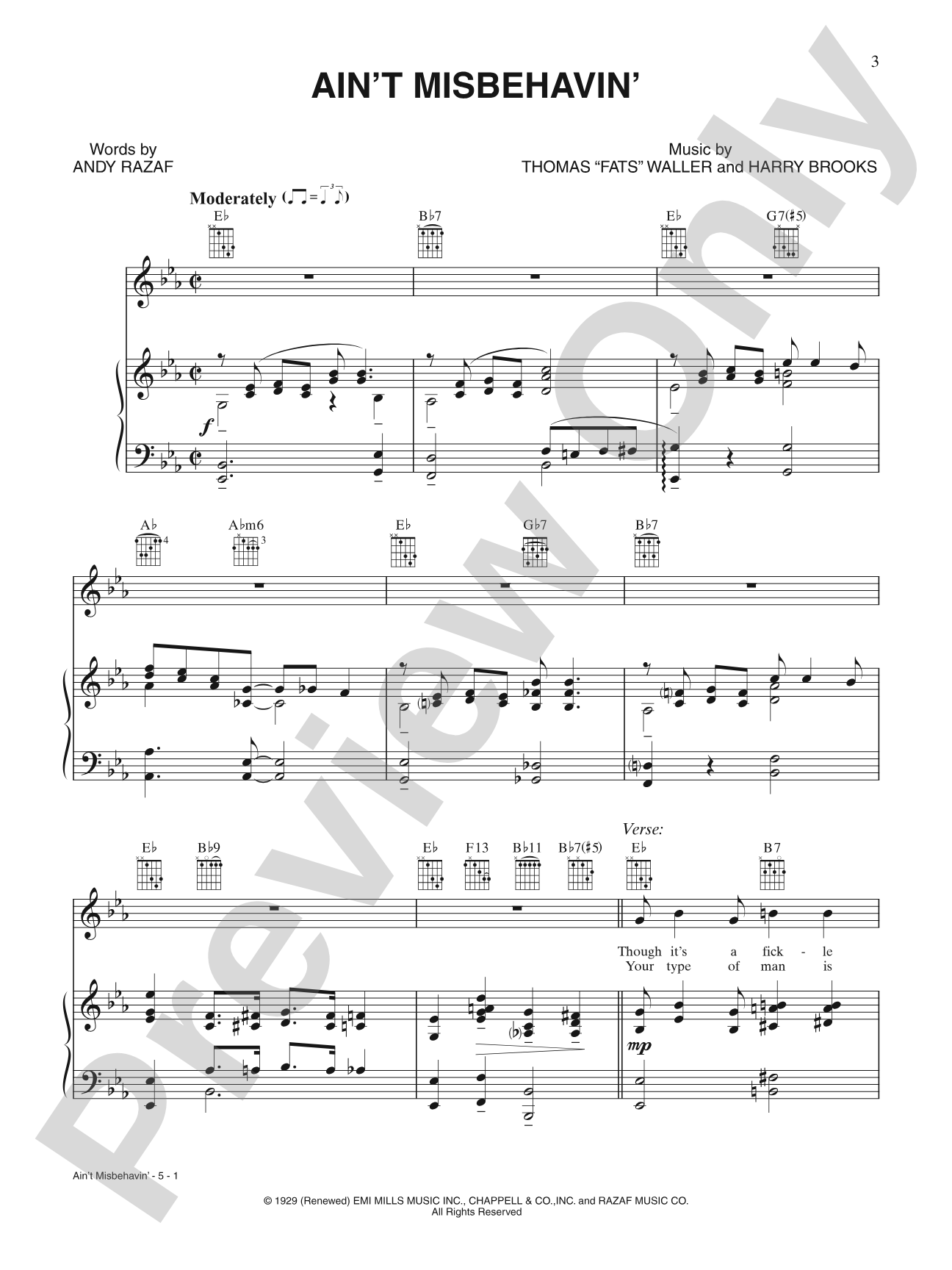

Ain't Misbehavin': Piano/Vocal/Chords
20 Great American Songbook and Jazz Favorites
Item: 00-PS-0015568
$4.99
Pickup currently not available
Related Items
Laura: Piano/Vocal/Chords |
$4.99
|
View | |
The Shadow of Your Smile: Piano/Vocal/Chords |
$4.99
|
View | |
I'm in the Mood for Love: Piano/Vocal/Chords |
$4.99
|
View | |
Moonlight Serenade: Piano/Vocal/Chords |
$4.99
|
View | |
Blue Moon: Piano/Vocal/Chords |
$4.99
|
View | |
I Put a Spell on You: Piano/Vocal/Chords |
$4.99
|
View | |
My Man: Piano/Vocal/Chords |
$4.99
|
View | |
Over the Rainbow: Piano/Vocal/Chords |
$4.99
|
View | |
Straighten Up and Fly Right: Piano/Vocal/Chords |
$4.99
|
View | |
Don't Sit Under the Apple Tree (With Anyone Else But Me): Piano/Vocal/Chords |
$4.99
|
View | |
Top-Requested Standards Sheet Music: Piano/Vocal/Guitar Book |
$14.99
|
View |
Description
The crowd-pleasing standards in this sheet music collection belong in every musician's repertoire. This songbook contains 20 piano/vocal arrangements of classic songs that are guaranteed to delight audiences of all ages. Complete lyrics and chord symbols are included. Titles: Ain't Misbehavin' * At Last * Blue Moon * Don't Get Around Much Anymore * Don't Sit Under the Apple Tree * I Put a Spell on You * I'm in the Mood for Love * Laura * Misty * Moonlight Serenade * My Man * Theme from New York, New York * Orange Colored Sky * Over the Rainbow * The Pink Panther * The Shadow of Your Smile * Straighten Up and Fly Right * Take Five * What a Wonderful World * Whatever Lola Wants.


Ain't Misbehavin': Piano/Vocal/Chords isn't in MakeMusic Cloud just yet...but it could be. Let us know you'd like to see it, and you'll help shape what comes next. In the meantime, start a free trial and dive into thousands of interactive titles your students can play along with today.
Request This Title
Tell us you want it.
Start Your Free Trial
Explore everything that's ready to play right now.
Sample Audio
No sample audio found.
Sample Video
No sample videos found.
Additional Details
Series:
Top-Requested Sheet Music
Publisher:
Alfred Music
Page Count:
80
SKU:
00-PS-0015568
More about this title
About the Composer: Thomas "Fats" Waller
Thomas "Fats" Waller (1904-1943) was a pianist, organist, singer, and composer who shaped the sound of American jazz and popular music. His prolific output spanned stride piano technique, swing standards, and infectious vocal performances that made him one of the most recorded artists of the 1930s and early 1940s.
Waller's harmonic sophistication and rhythmic vitality influenced generations of musicians across genres. His collaborations with lyricist Harry Brooks produced some of the Great American Songbook's most enduring tunes, and his ability to balance technical mastery with genuine entertainment made him a natural choice for any ensemble seeking authentic swing era repertoire.
Why we love this
This collection captures the essence of what makes the Great American Songbook so teachable: strong melodies, accessible chord changes, and built-in audience appeal that crosses every demographic. The 20 selections span jazz standards, Hollywood themes, and novelty tunes, giving you flexibility to program by mood, difficulty, or historical period without reaching for multiple sources.
What to expect
Elegant, relaxed, and irresistibly groovy. These standards capture a moment in American musical history when sophistication and fun went hand in hand, delivering that sophisticated-yet-approachable quality that makes these songs perform so well at recitals, cabarets, and community events. The arrangements respect the original spirit while giving you room to bring your own interpretation.
Who it's for
Pianists and singer-pianists working in jazz or standards settings, music theater performers building their repertoire, and accompanists who need reliable, singable arrangements of evergreen material. This collection also suits educators looking to introduce students to swing-era harmony and authentic swing rhythm in a performance-ready format.
How to get the most out of it
- Anchor the left hand stride patterns or walking bass figures that anchor these arrangements; they're essential to the swing feel rather than mere accompaniment.
- Respect the chord symbols as harmonic guides rather than fixed voicings; adjust upper extensions and inversions based on your comfort level and the room's acoustics.
- Phrase lyrics conversationally, treating the melody as speech first and then shaping it musically, which is how these songs were meant to feel.
- Balance vocalist and pianist as equal partners; these arrangements work best when both parts breathe together and react to dynamic shifts.
How to use it
Select groups of three or four to create a themed jazz or standards set within a larger concert; "At Last," "Misty," and "The Shadow of Your Smile" pair naturally as a romantic set, while "Take Five," "Orange Colored Sky," and "Straighten Up and Fly Right" offer lighter mood. Individual songs also work as cabaret material, audition repertoire, or classroom examples of authentic jazz voicing and phrasing.
Skills your students will build
- Reading and playing swing rhythms and syncopation
- Interpreting chord symbols with voice-leading and jazz voicings
- Coordinating melodic phrasing between voice and piano accompaniment
- Understanding stride piano and walking bass patterns in an applied context
- Developing interpretive choices within a standard harmonic framework