
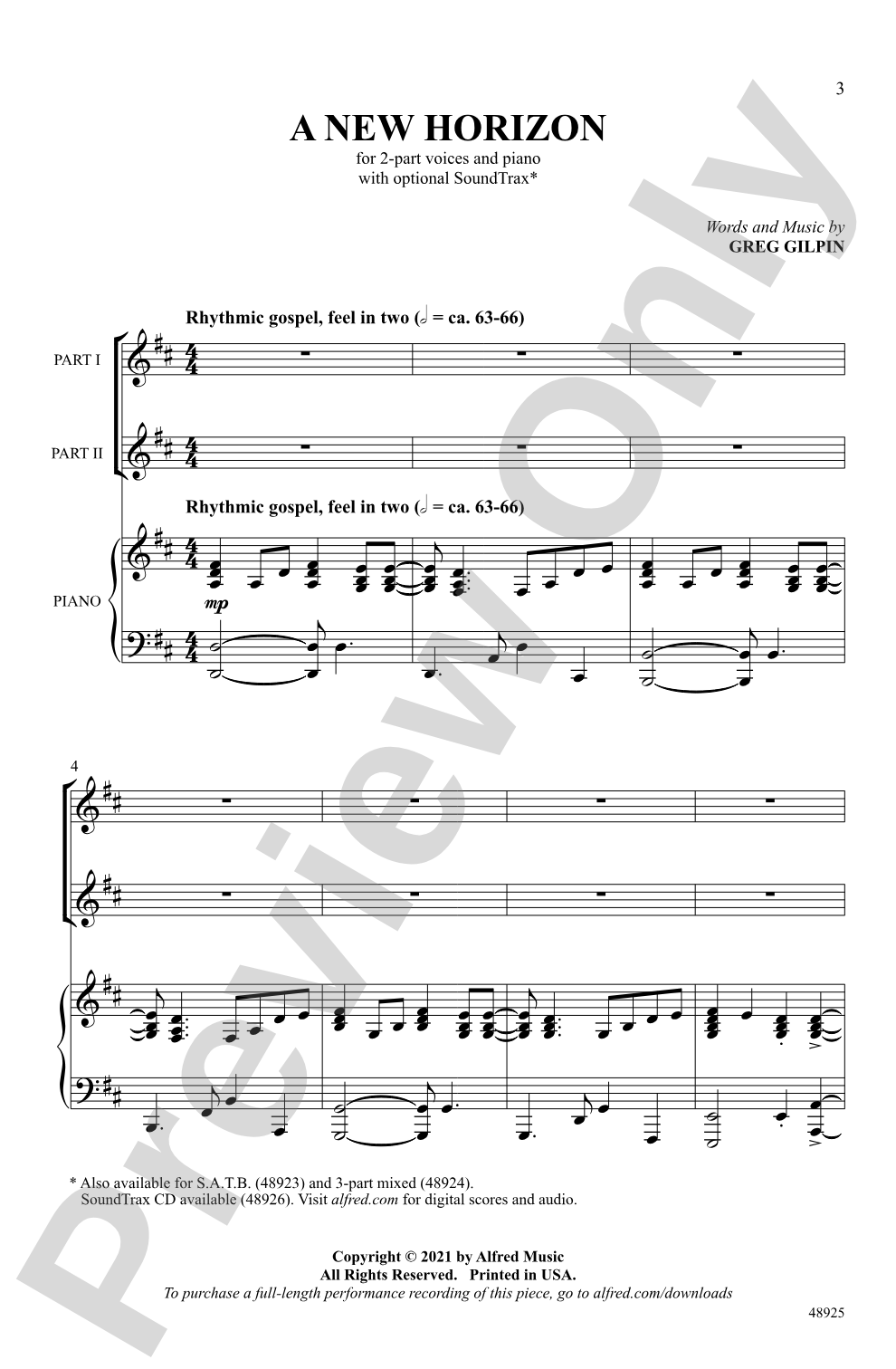

A New Horizon: 2-Part Choral Octavo
Words and music by Greg Gilpin
Item: 00-PO-0006705
$2.20
Minimum order quantity: 20 copies
Pickup currently not available
Related Items
A New Horizon: SoundTrax Digital Audio Download |
$29.99
|
View | |
A New Horizon: SATB Choral Octavo |
$2.20
|
View | |
A New Horizon: 3-Part Mixed Choral Octavo |
$2.20
|
View | |
A New Horizon: SATB Choral Octavo |
$2.20
|
View | |
A New Horizon: 3-Part Mixed Choral Octavo |
$2.20
|
View | |
A New Horizon: 2-Part Choral Octavo |
$2.20
|
View | |
A New Horizon: Choral SoundTrax CD |
$29.99
|
View |
Description
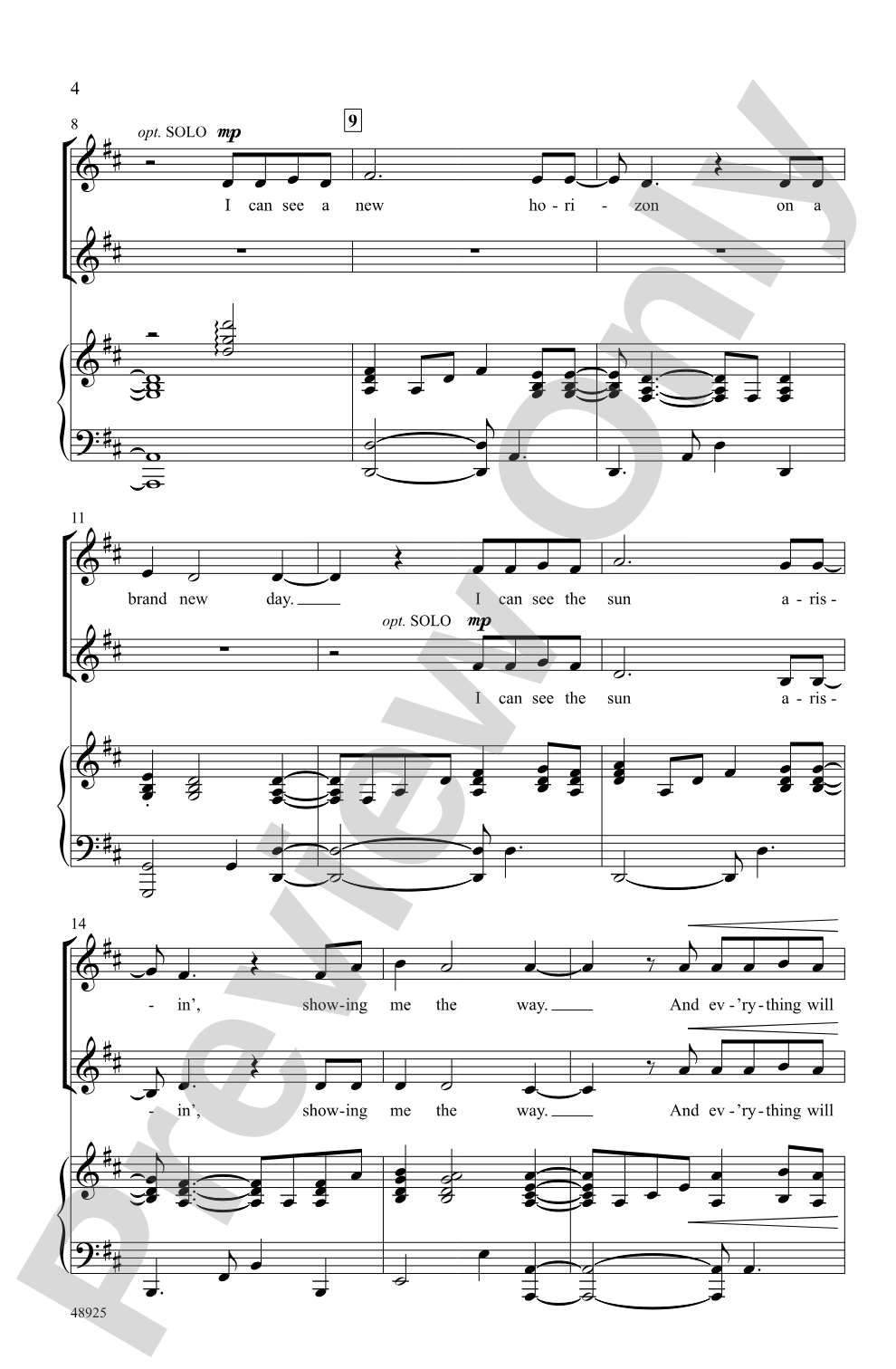
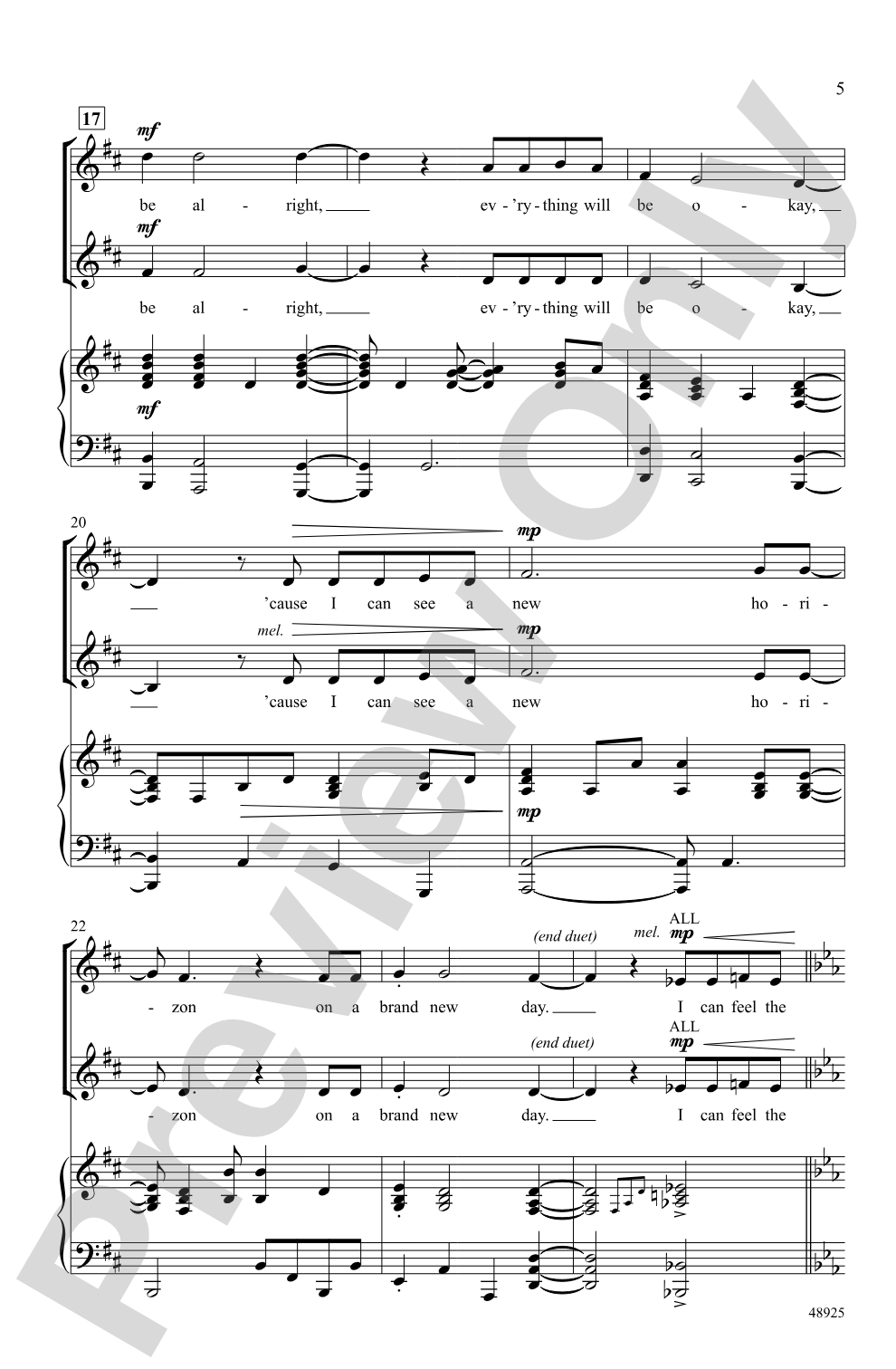
Carefully placed staccatos and well-chosen chord inversions illuminate the gospel style of this original anthem of hope. It's a perfect pep talk or pick-me-up theme song for whenever your program needs a lift. A solo voice becomes a duet before all the singers join in and grow with intensity. Several ascending key changes raise spirits, ensuring that the uplifting message resonates. "Everything will be alright, everything will be okay, 'cause I can see a new horizon on a brand new day." If you don't perform with the kickin' SoundTrax accompaniment, be sure to add a groovin' drummer and riffing organ of your own. We dare you (and your audience) not to clap along!


A New Horizon: 2-Part Choral Octavo isn't in MakeMusic Cloud just yet...but it could be. Let us know you'd like to see it, and you'll help shape what comes next. In the meantime, start a free trial and dive into thousands of interactive titles your students can play along with today.
Request This Title
Tell us you want it.
Start Your Free Trial
Explore everything that's ready to play right now.
Sample Audio
1
Audio File
--:--
0:00
0:00
Sample Video
Additional Details
Series:
Alfred Choral Designs
Publisher:
Alfred Music
Page Count:
16
SKU:
00-PO-0006705
More about this title
About the Composer: Greg Gilpin

Greg Gilpin has established himself as a composer and conductor whose work reaches audiences across North America, Europe, and Australia. His scores have been performed at Carnegie Hall, Lincoln Center, the Sydney Opera House, and Royal Festival Hall, among other premier venues. As Director of Educational Choral Publications for Shawnee Press, Gilpin brings both creative vision and publishing expertise to the choral world. He holds membership in ACDA, NAfME, and Phi Mu Alpha Sinfonia.
Beyond music, Gilpin has diversified his career as a certified financial coach and professional organizer, founding Maestro Organizing and appearing on network television. In 2021, he composed the award-winning score for the short film "Rosie's Rescue" and collaborated with opera singer Angela Brown on a contemporary arrangement of "What Child is This?" premiered by the Indianapolis Symphonic Choir. An ASCAP award recipient, Gilpin continues to teach, compose, and conduct as the music world reopens.
Why we love this
Gilpin's gospel-inflected writing style creates genuine momentum without sacrificing musicality. The structural arc from solo to duet to full ensemble mirrors the emotional journey of the text, and the ascending key changes feel earned rather than gimmicky. Your singers will feel the lift they're singing about, and your audience won't be able to resist moving along.
What to expect
Warm, propulsive, and genuinely hopeful. The gospel influences give the piece a conversational quality that audiences recognize immediately, while the carefully placed staccatos and chord inversions keep the sound crisp and intentional. By the final key change, the piece radiates optimism that feels hard-earned rather than manufactured.
Who it's for
Directors programming graduation, pep rallies, or any concert that needs an emotional boost with substance. The 2-part voicing makes it accessible for younger choirs or smaller programs while remaining engaging for experienced singers who appreciate the harmonic and rhythmic sophistication.
How to get the most out of it
- Nail the rhythmic precision of those staccatos in rehearsal; they're what gives the gospel style its snap and energy, so isolate them as a specific focus before blending them into the full texture.
- Work the solo-to-duet-to-ensemble progression deliberately so each transition feels like a genuine building moment rather than a sudden shift in texture.
- If you're using the recorded accompaniment, let your rhythm section listen to it first and then recreate the feel with live drums and organ to suit your specific performance space and ensemble sound.
- Encourage your singers to feel the forward motion through each key change; these aren't static moments but opportunities to grow the intensity and vocal energy together.
How to use it
Program this as a closer on a concert program where you need to send the audience out feeling lifted. It works equally well at graduation ceremonies, awards assemblies, or any occasion where your singers need to deliver a message of encouragement. The approachable melodic content and built-in energy make it an ideal anchor for a choral set that might include both reflective and celebratory pieces.
Skills your students will build
- Executing rhythmic precision with staccato articulation in a gospel idiom
- Singing through ascending key changes while maintaining vocal energy and control
- Blending two-part voicing while listening to harmonic movement created by chord inversions
- Interpreting stylistic nuance (gospel groove, rhythmic feel) from written notation
- Building ensemble cohesion as the texture expands from solo to full choir