
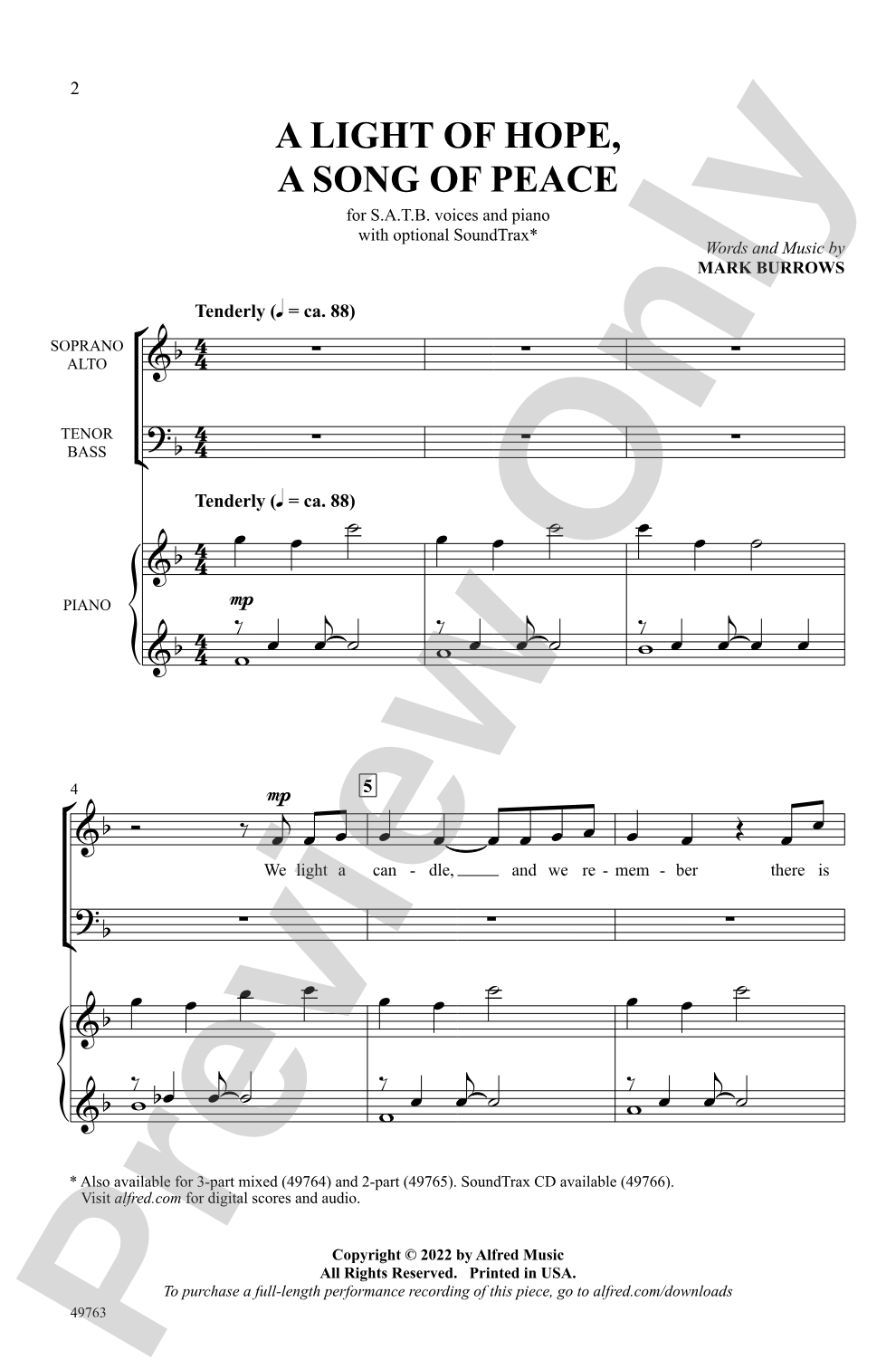
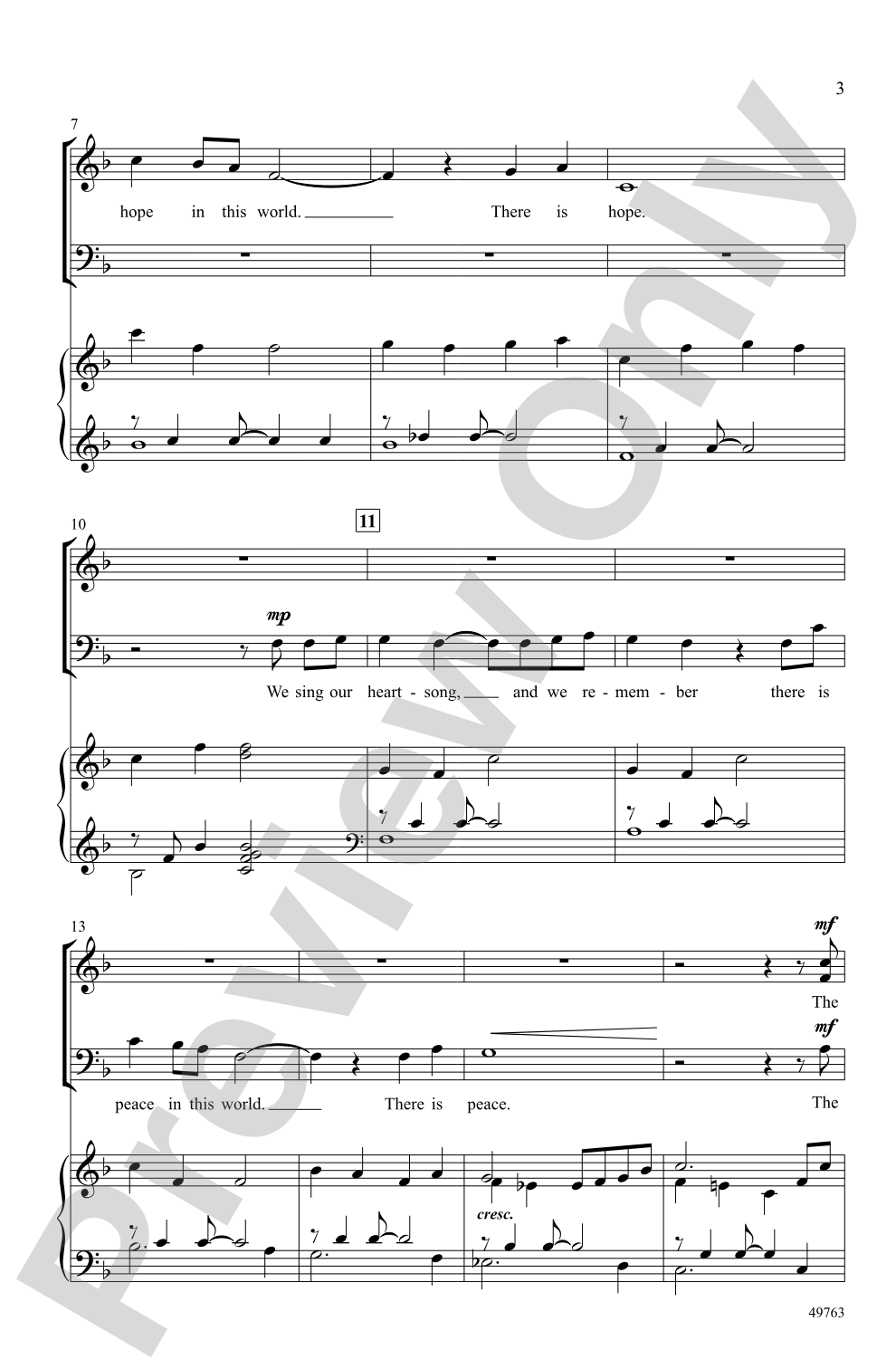

A Light of Hope, A Song of Peace: SATB Choral Octavo
Words and music by Mark Burrows
Item: 00-PO-0006854
$2.05
Minimum order quantity: 20 copies
Pickup currently not available
Related Items
A Light of Hope, A Song of Peace: SoundTrax Digital Audio Download |
$29.99
|
View | |
A Light of Hope, A Song of Peace: 3-Part Mixed Choral Octavo |
$2.05
|
View | |
A Light of Hope, A Song of Peace: 2-Part Choral Octavo |
$2.05
|
View | |
A Light of Hope, A Song of Peace: SATB Choral Octavo |
$2.05
|
View | |
A Light of Hope, A Song of Peace: 3-Part Mixed Choral Octavo |
$2.05
|
View | |
A Light of Hope, A Song of Peace: 2-Part Choral Octavo |
$2.05
|
View | |
A Light of Hope, A Song of Peace: Choral Octavo SoundTrax CD |
$29.99
|
View |
Description
When considering various winter holidays, what is the common thread? "A candle and a song." Beautiful in its simplicity, here's a quiet celebration crafted to resonate universally. Mark's delicate melody and sweet sonorities float effortlessly over a flowing piano accompaniment. With readable rhythms, easy to learn notes, and sensible vocal ranges, it's intentionally uncomplicated so that the message of the text will clearly speak. Hushed and heartfelt, a memorable moment. This title is available in MakeMusic Cloud.


A Light of Hope, A Song of Peace: SATB Choral Octavo isn't in MakeMusic Cloud just yet...but it could be. Let us know you'd like to see it, and you'll help shape what comes next. In the meantime, start a free trial and dive into thousands of interactive titles your students can play along with today.
Request This Title
Tell us you want it.
Start Your Free Trial
Explore everything that's ready to play right now.
Sample Audio
1
Audio File
--:--
0:00
0:00
Sample Video
1 / 2
Additional Details
Series:
Alfred Choral Designs
Publisher:
Alfred Music
Page Count:
8
SKU:
00-PO-0006854
More about this title
About the Composer: Mark Burrows
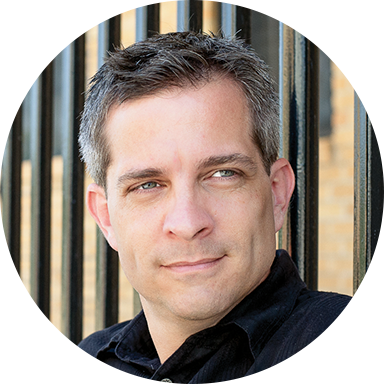
Mark Burrows combines active work as a composer and conductor with deep roots in music education. His compositions appear on state and festival lists across the country, and he fields multiple commissions annually from ensembles spanning children's choirs through adult and intergenerational groups. He earned his undergraduate degree in music education from Southern Methodist University and completed graduate studies in conducting at Texas Christian University.
Based in Fort Worth, Texas, Burrows currently directs children's ministries at FUMC while maintaining an active composing practice. His music is published by major houses and reflects his understanding of what different ensembles need to make music together successfully.
Why we love this
Burrows writes with genuine restraint here. Rather than piling on harmonic complexity or extended ranges to impress, he trusts a simple melody and transparent sonorities to carry the emotional weight. The result feels like something your choir will actually want to sing again and again, and audiences will remember long after the holiday passes.
What to expect
Hushed and meditative, like a moment of quiet reflection. The piece creates space rather than fills it, allowing the text about hope and peace to land clearly without musical distraction. It feels both timely and timeless.
Who it's for
Directors seeking a universal winter offering that works for developing choirs and doesn't demand advanced musicianship. The readable rhythms, accessible note patterns, and sensible ranges make this particularly valuable for groups that include less experienced singers alongside stronger voices.
How to get the most out of it
- Keep the dynamic level soft throughout; the piece gains its power from intimacy, not volume. Resist the urge to swell into phrases.
- Shape phrases by following the natural breathing points in the text rather than musical bar lines. This reinforces the message and keeps the flow conversational.
- Balance the piano accompaniment so it supports without overwhelming. The flowing texture is meant to frame the voices, not compete with them.
- Pay attention to vowel consistency across the sections, especially in the sustained passages. Blend matters more here than precision of attack.
How to use it
Program this as a quiet turning point in a winter concert, perhaps after something more energetic. It works beautifully as a segue between secular and sacred selections, or as a standalone moment of unity when programming for diverse audiences. Its brevity and contemplative nature make it ideal for use in non-traditional settings like community gatherings or multi-faith observances.
Skills your students will build
- Singing with sustained, quiet dynamics over multiple phrases
- Text-driven phrasing and breath placement
- Four-part SATB balance and blend in accessible ranges
- Sensitivity to accompaniment texture and how to support rather than fight it