
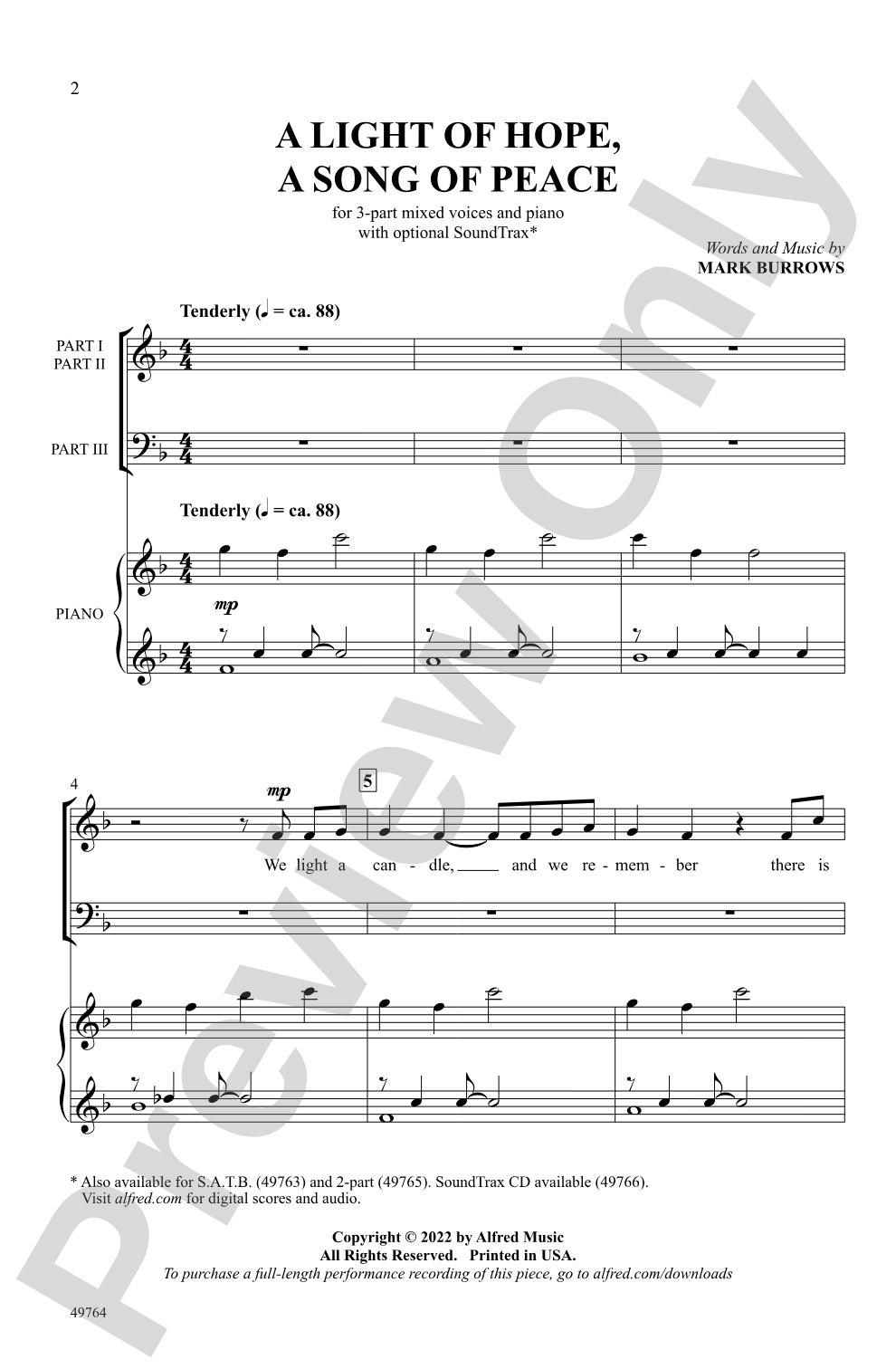

A Light of Hope, A Song of Peace: 3-Part Mixed Choral Octavo
Words and music by Mark Burrows
Item: 00-PO-0006855
$2.05
Minimum order quantity: 20 copies
Pickup currently not available
Related Items
A Light of Hope, A Song of Peace: SoundTrax Digital Audio Download |
$29.99
|
View | |
A Light of Hope, A Song of Peace: SATB Choral Octavo |
$2.05
|
View | |
A Light of Hope, A Song of Peace: 2-Part Choral Octavo |
$2.05
|
View | |
A Light of Hope, A Song of Peace: SATB Choral Octavo |
$2.05
|
View | |
A Light of Hope, A Song of Peace: 3-Part Mixed Choral Octavo |
$2.05
|
View | |
A Light of Hope, A Song of Peace: 2-Part Choral Octavo |
$2.05
|
View | |
A Light of Hope, A Song of Peace: Choral Octavo SoundTrax CD |
$29.99
|
View |
Description
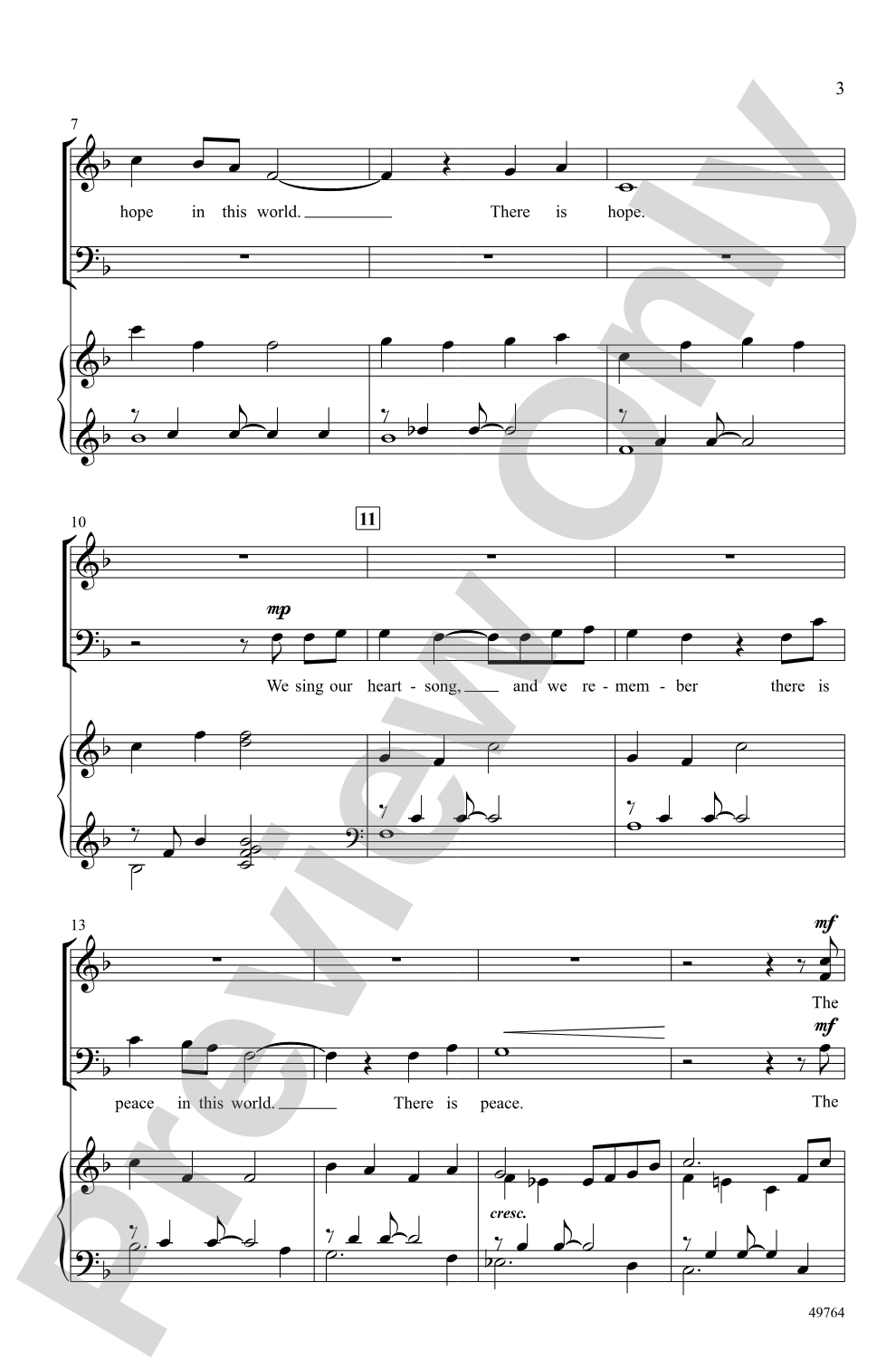
When considering various winter holidays, what is the common thread? "A candle and a song." Beautiful in its simplicity, here's a quiet celebration crafted to resonate universally. Mark's delicate melody and sweet sonorities float effortlessly over a flowing piano accompaniment. With readable rhythms, easy to learn notes, and sensible vocal ranges, it's intentionally uncomplicated so that the message of the text will clearly speak. Hushed and heartfelt, a memorable moment. This title is available in MakeMusic Cloud.


A Light of Hope, A Song of Peace: 3-Part Mixed Choral Octavo isn't in MakeMusic Cloud just yet...but it could be. Let us know you'd like to see it, and you'll help shape what comes next. In the meantime, start a free trial and dive into thousands of interactive titles your students can play along with today.
Request This Title
Tell us you want it.
Start Your Free Trial
Explore everything that's ready to play right now.
Sample Audio
1
Audio File
--:--
0:00
0:00
Sample Video
1 / 2
Additional Details
Series:
Alfred Choral Designs
Publisher:
Alfred Music
Page Count:
8
SKU:
00-PO-0006855
More about this title
About the Composer: Mark Burrows

Mark Burrows brings together his experience as a composer, conductor, and music educator to create works that serve choirs across age groups and skill levels. His catalog appears regularly on state and festival competition lists, and he receives commissions annually from children's ensembles, adult choirs, and intergenerational festival groups. He holds a bachelor's degree in music education from Southern Methodist University and a master's degree in conducting from Texas Christian University.
Based in Fort Worth, Texas, Burrows currently directs children's ministries at FUMC, where he continues to develop music that meets singers where they are while delivering meaningful artistic experiences.
Why we love this
Burrows crafts a meditation on universal winter themes without forcing sectarian language, making this genuinely programmable across different community and school contexts. The vocal writing respects the limits of younger or less experienced singers while the piano part remains musically substantive, so the piece doesn't feel watered down for either section. The restraint of the arrangement and the clarity of the text allow the work's emotional core to land quietly and authentically.
What to expect
The piece settles into a quiet, almost candlelit intimacy. The gentle melody and flowing accompaniment create a sense of calm reflection rather than festive celebration, anchoring listeners in a moment of shared hope. There's an unhurried, meditative quality that feels genuine and unforced.
Who it's for
This octavo works for school choirs seeking accessible winter repertoire, community choirs looking to program something meaningful without high technical demands, and churches or interfaith organizations wanting a gentle seasonal piece. It's sized appropriately for young or developing singers who benefit from straightforward rhythms and reasonable ranges.
How to get the most out of it
- Let the sustained notes in the piano accompaniment breathe; resist the urge to hurry through passages where the voices rest. The accompaniment carries the harmonic weight.
- Shape each phrase toward its natural resting point rather than emphasizing individual notes. The melody's beauty emerges from long-line thinking.
- Encourage singers to listen inward; this piece rewards intimacy over volume. A smaller, more focused dynamic range will deepen the hushed quality.
- Balance the three parts so no single voice dominates. SAB writing here asks each section to function as a color layer rather than a lead voice.
How to use it
Place this near the end of a winter concert as a reflective interlude between more energetic pieces, or open a program with it to establish a contemplative tone. It pairs well with other secular winter selections that emphasize light and community over specific holidays, and works especially effectively in December programming when audiences appreciate a brief, heartfelt moment of stillness.
Skills your students will build
- Sustaining long melodic lines across phrases without losing focus
- Balancing three-part harmony where no part dominates the texture
- Interpreting dynamic nuance in a quiet dynamic range (pp to mp)
- Following a piano accompaniment that moves independently from the vocal line