
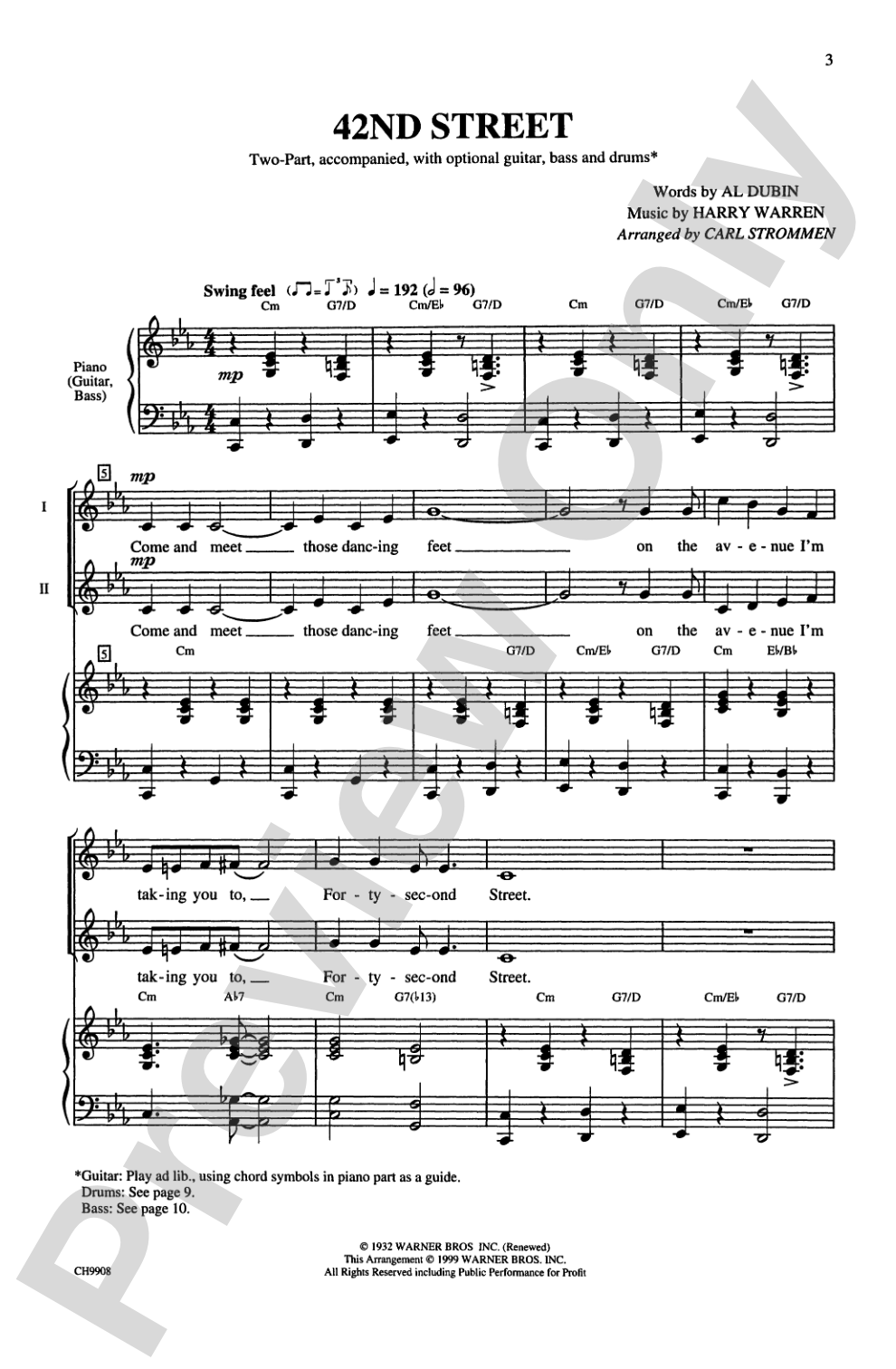
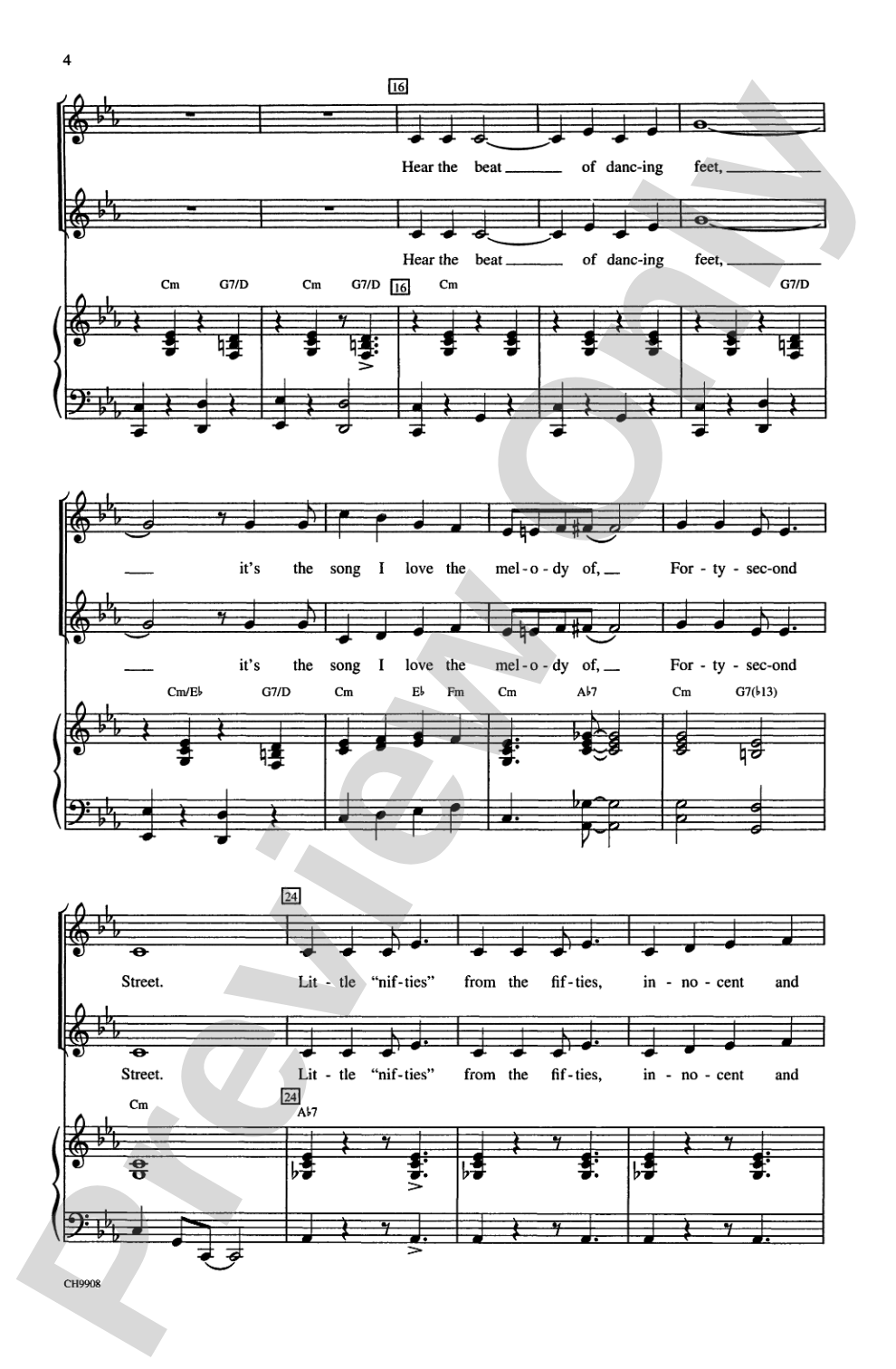

42nd Street: 2-Part Choral Octavo
Words by Al Dubin, music by Harry Warren / arr. Carl Strommen
Item: 00-PO-0004736
$2.25
Minimum order quantity: 20 copies
Pickup currently not available
Related Items
42nd Street: SATB Choral Octavo |
$2.25
|
View | |
42nd Street: 3-Part Mixed Choral Octavo |
$2.25
|
View | |
42nd Street: SATB Choral Octavo |
$2.25
|
View | |
42nd Street: 3-Part Mixed Choral Octavo |
$2.25
|
View | |
42nd Street: Choral Octavo SoundTrax CD |
$22.95
|
View | |
42nd Street: 2-Part Choral Octavo |
$2.25
|
View | |
42nd Street: Choral Octavo SoundTrax CD |
$27.99
|
View |
Description
Harry Warren was one of the great songwriters of the 30s. Classic movie buffs will recall the scene of Dick Powell and Ruby Keeler tap dancing on the top of a taxi cab in the movie version of "Forty Second Street." A fantastic Strommen arrangement!


42nd Street: 2-Part Choral Octavo isn't in MakeMusic Cloud just yet...but it could be. Let us know you'd like to see it, and you'll help shape what comes next. In the meantime, start a free trial and dive into thousands of interactive titles your students can play along with today.
Request This Title
Tell us you want it.
Start Your Free Trial
Explore everything that's ready to play right now.
Sample Audio
No sample audio found.
Sample Video
No sample videos found.
Additional Details
Series:
Alfred Archive Edition: Alfred Pop Choral Series
Publisher:
Alfred Music
Page Count:
12
SKU:
00-PO-0004736
More about this title
About the Composer: Harry Warren
Harry Warren (1893-1981) was a prolific composer who defined the sound of 1930s musical theater and Hollywood. He wrote over 800 songs during his career, earning multiple Academy Award nominations for his film scores. Warren's melodies are distinguished by their singability and emotional directness, qualities that have kept his work in active repertoire for nearly a century.
Warren's output ranged from intimate ballads to elaborate production numbers, and his orchestrations influenced generations of songwriters. He collaborated with top lyricists including Al Dubin and Mack Gordon, creating standards that remain accessible to singers of all levels. His work for film gave his compositions natural storytelling momentum, making them ideal for choral arrangement.
Why we love this
Carl Strommen's arrangement captures the energy and glamour of Warren's original without overwhelming a developing 2-part choir. The stripped-down voicing lets the melody shine while the recorded accompaniment provides full orchestral context, giving singers a genuine sense of the 1930s production number they're performing.
What to expect
The arrangement radiates the optimism and theatrical swagger of early Hollywood, with bright harmonies and a propulsive rhythm that invites movement. Singers will feel the iconic tap-dancing scene come alive through the music, and audiences will recognize the era immediately.
Who it's for
Directors programming concert pops or variety shows will find this octavo engaging for treble-focused or mixed 2-part choirs. The accessible range and straightforward vocal writing make it suitable for middle school through adult community choirs, particularly those seeking recognizable, energetic material from the American songbook.
How to get the most out of it
- Lean into the rhythmic drive of the accompaniment recording; the groove of the arrangement depends on crisp articulation from the choir rather than dragging through any phrase.
- Use the recorded accompaniment to establish tempo and style, then gradually shift focus to blending vowels across both parts once the singers are secure with their pitches.
- Balance the two vocal lines so that neither part dominates; even when one line carries the main melody, both should feel equally present.
- Keep the energy consistent from top to bottom of the page; this arrangement works only when momentum never stalls, even during sustained notes.
How to use it
This works beautifully as an upbeat closing number or as part of a vintage Hollywood or 1930s-themed concert. Pair it with other standards from the era or contrast it with modern pop arrangements to highlight how singable great songwriting remains across decades.
Skills your students will build
- Maintaining rhythmic precision in a 2-part texture
- Singing with style and character (theatrical interpretation)
- Blending two independent vocal lines without losing individual line clarity
- Tracking melody and harmonic support roles