
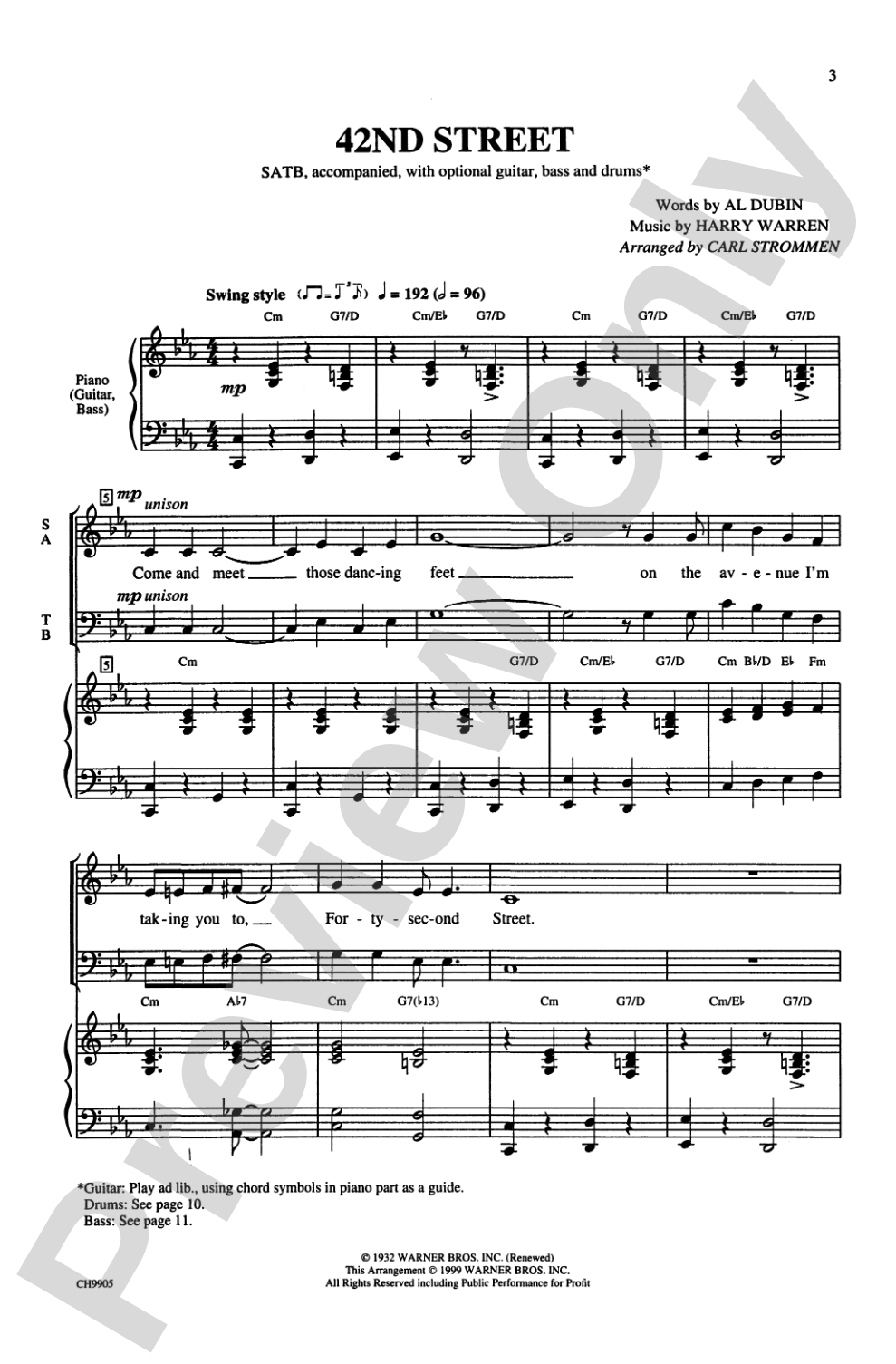
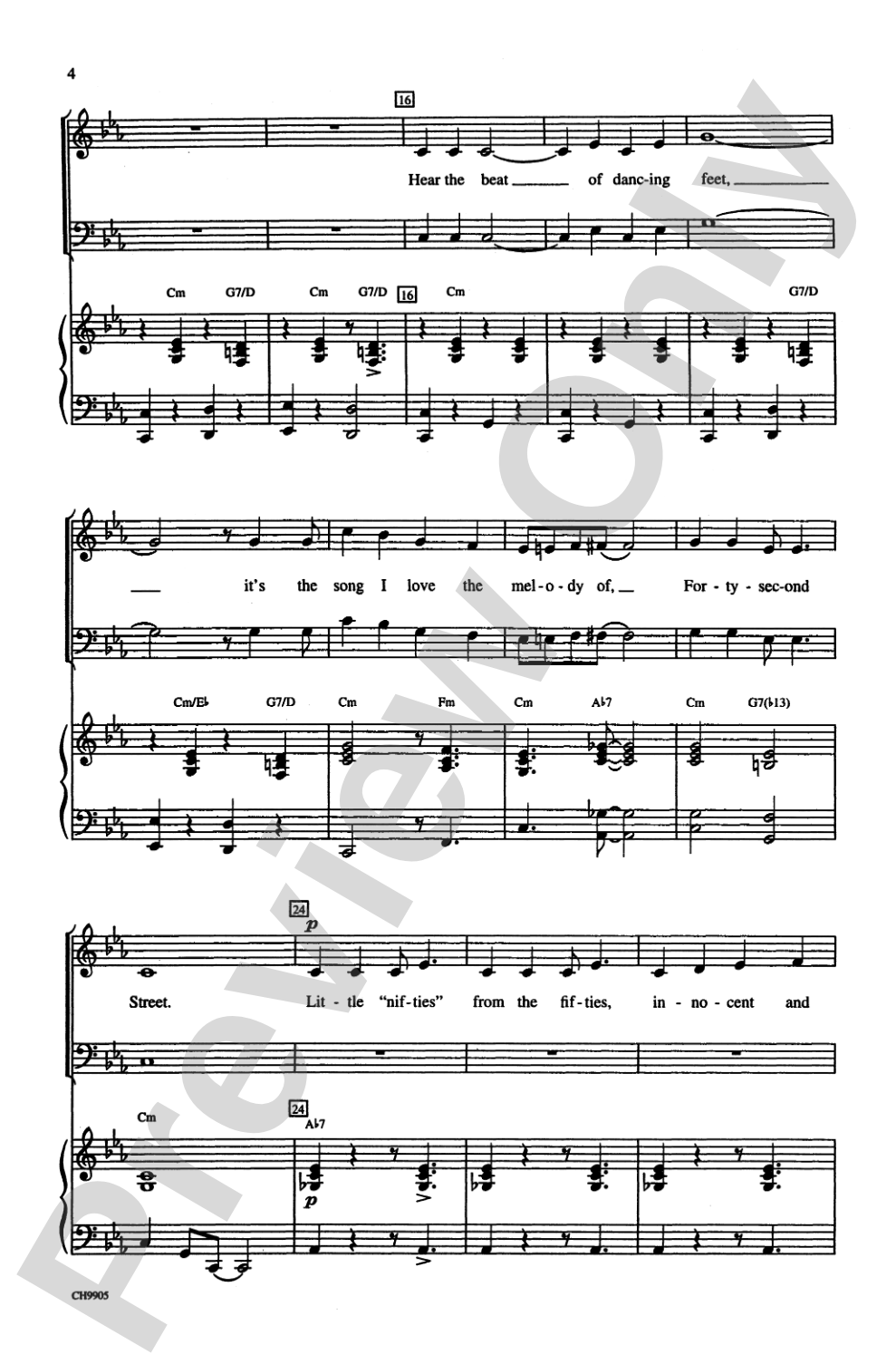

42nd Street: SATB Choral Octavo
Words by Al Dubin, music by Harry Warren / arr. Carl Strommen
Item: 00-PO-0004734
$2.25
Minimum order quantity: 20 copies
Pickup currently not available
Related Items
42nd Street: 3-Part Mixed Choral Octavo |
$2.25
|
View | |
42nd Street: 2-Part Choral Octavo |
$2.25
|
View | |
42nd Street: SATB Choral Octavo |
$2.25
|
View | |
42nd Street: 3-Part Mixed Choral Octavo |
$2.25
|
View | |
42nd Street: Choral Octavo SoundTrax CD |
$22.95
|
View | |
42nd Street: 2-Part Choral Octavo |
$2.25
|
View | |
42nd Street: Choral Octavo SoundTrax CD |
$27.99
|
View |
Description
Harry Warren was one of the great songwriters of the 30s. Classic movie buffs will recall the scene of Dick Powell and Ruby Keeler tap dancing on the top of a taxi cab in the movie version of "Forty Second Street." A fantastic Strommen arrangement!


42nd Street: SATB Choral Octavo isn't in MakeMusic Cloud just yet...but it could be. Let us know you'd like to see it, and you'll help shape what comes next. In the meantime, start a free trial and dive into thousands of interactive titles your students can play along with today.
Request This Title
Tell us you want it.
Start Your Free Trial
Explore everything that's ready to play right now.
Sample Audio
No sample audio found.
Sample Video
No sample videos found.
Additional Details
Series:
Alfred Archive Edition: Alfred Pop Choral Series
Publisher:
Alfred Music
Page Count:
12
SKU:
00-PO-0004734
More about this title
About the Composer: Harry Warren
Harry Warren (1893-1981) was a prolific composer who defined the sound of 1930s popular music and film. Working alongside some of the era's finest lyricists, Warren created melodies that balanced sophisticated harmonic language with immediate memorability, a rare skill that made him one of Hollywood's most sought-after composers during the Golden Age of film musicals.
Why we love this
Strommen's arrangement captures the swagger and polish of the original while keeping the vocal writing entirely singable for community and school choirs. The piece trades on genuine melodic charm rather than flashiness, making it equally rewarding in a concert setting and in a program that celebrates American songwriting tradition.
What to expect
Smooth, urbane, and unmistakably American. The piece captures that moment when tap dancing and close harmony felt like the height of sophistication, with enough harmonic color to engage musicians without stepping into complexity.
Who it's for
This octavo works for choirs seeking a genuine Golden Age film standard that audiences recognize and singers enjoy. It suits ensembles with solid blend and basic harmonic awareness, from community choirs to advanced high school and college programs.
How to get the most out of it
- Emphasize the rhythmic precision of the supporting voices. The arrangement thrives when the harmonic foundation stays locked and steady, allowing the melody to float clearly above.
- Bring out the jazz-inflected harmonies without oversinging them. Warren's chords carry sophistication that doesn't require force.
- Make strategic use of the recorded accompaniment in rehearsal to establish the groove and help singers feel the era and style authentically.
How to use it
Program this as a standalone showcase for your choir's ability to handle jazz-influenced harmony and period style, or pair it with other 1930s-40s repertoire for a concert exploring American song. Its movie heritage also makes it a natural fit for gala programs and benefit concerts where recognizable standards draw donors.
Skills your students will build
- Singing jazz-influenced harmony and chromatic voice leading
- Understanding and executing period style in American popular song
- Balancing melody and accompaniment roles within four-part texture
- Responding to recorded accompaniment while maintaining ensemble independence