
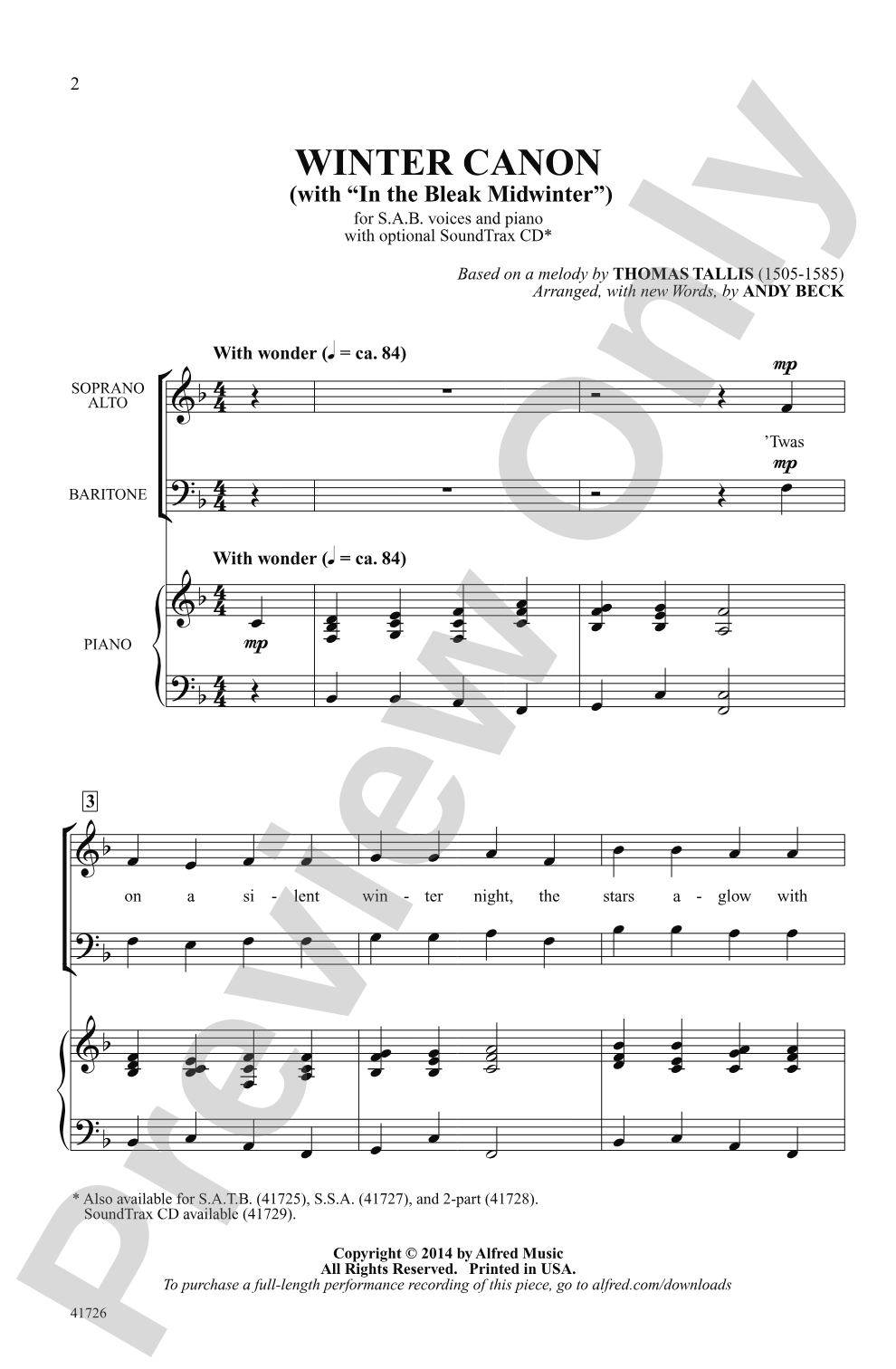

Winter Canon: SAB Choral Octavo
(with "In the Bleak Midwinter")
Based on a melody by Thomas Tallis / arr., with new words, by Andy Beck
Item: 00-PO-0001884

$2.05
Minimum order quantity: 20 copies
Pickup currently not available
Related Items
Winter Canon: SoundTrax Digital Audio Download |
$27.99
|
View | |
Winter Canon: SATB Choral Octavo |
$2.05
|
View | |
Winter Canon: SSA Choral Octavo |
$1.85
|
View | |
Winter Canon: 2-Part Choral Octavo |
$2.05
|
View | |
Winter Canon: SATB Choral Octavo |
$2.05
|
View | |
Winter Canon: SAB Choral Octavo |
$2.50
|
View | |
Winter Canon: SSA Choral Octavo |
$1.85
|
View | |
Winter Canon: 2-Part Choral Octavo |
$2.05
|
View | |
Winter Canon: Choral Octavo SoundTrax CD |
$27.99
|
View |
Description
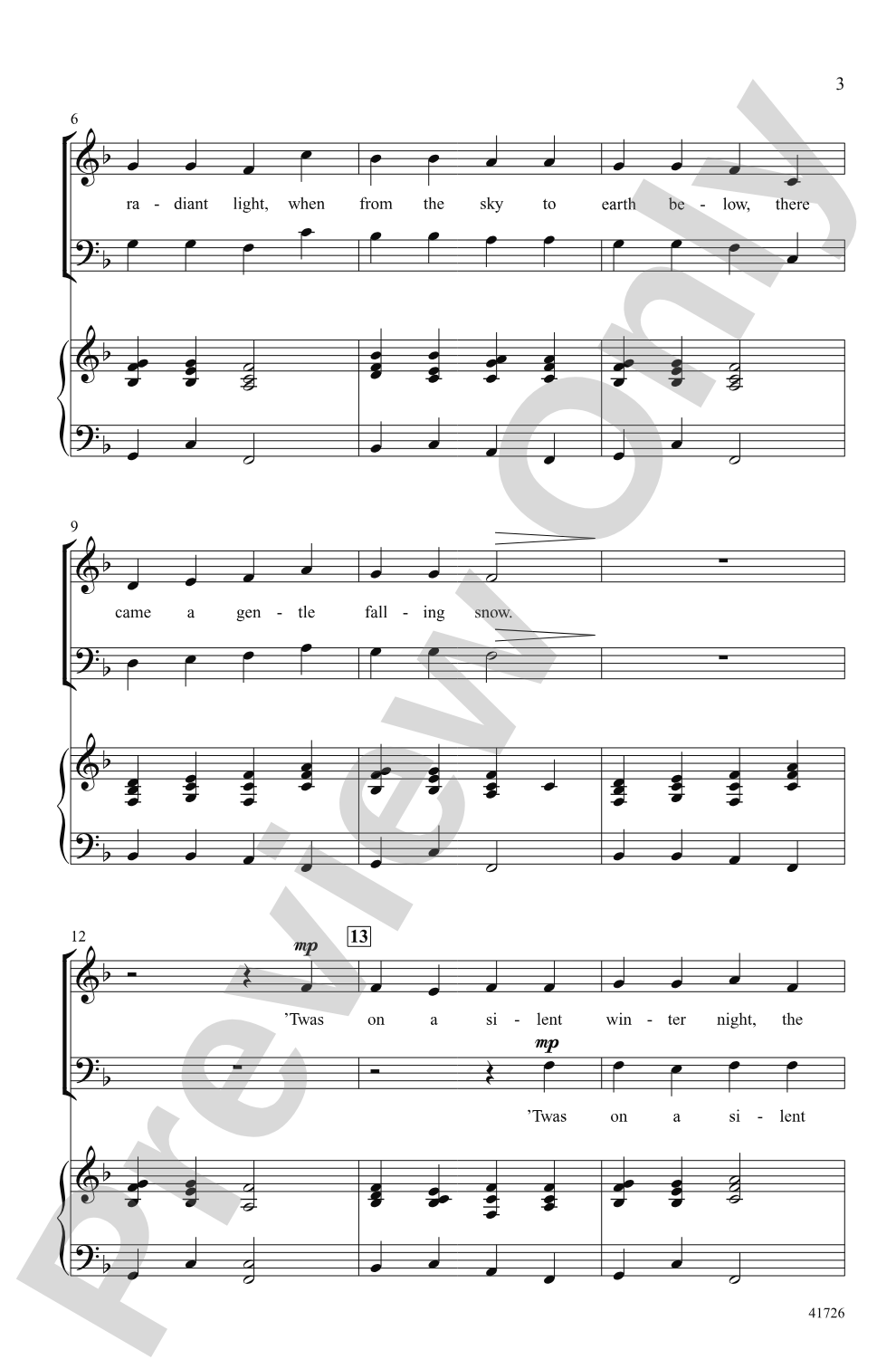
Sung in unison, two, three, and eventually four-part round, this beautiful melody was penned by sixteenth century master of polyphony Thomas Tallis. An excellent teaching piece, the lyrical tune (set with an original winter text) sits so well in the voice. As a special touch, phrases from "In the Bleak Midwinter" are artfully woven throughout.


Don't just read it, hear it, play along with it, and watch your students grow with it. In MakeMusic Cloud, Winter Canon: SAB Choral Octavo comes alive with professional accompaniment, adjustable tempo, and built-in practice tools that turn solo practice into real progress.
Open in the Player
Jump straight in and assign it today.
Start Your Free Trial
Open this title and explore the full library in minutes.
Sample Audio
1
Audio File
--:--
0:00
0:00
Sample Video
Additional Details
Series:
Alfred Choral Designs
Publisher:
Alfred Music
Page Count:
12
SKU:
00-PO-0001884
More about this title
About the Composer: Thomas Tallis
Thomas Tallis (c. 1505-1585) shaped English choral music during one of its most transformative periods. Working through the reigns of Henry VIII, Edward VI, Mary I, and Elizabeth I, he mastered both Latin sacred polyphony and English anthem writing, creating a catalog that balanced technical sophistication with singability. His gift for clear melodic lines that interlock seamlessly made him a model for generations of composers and remains a foundation of choral pedagogy.
Tallis's ability to write music that sounds effortless but rewards careful listening explains why his work endures in rehearsal rooms. Directors return to his pieces repeatedly because they teach voice independence, blend, and intonation without feeling like academic exercises. His melodies sit naturally in the voice, a principle that resonates just as strongly today as it did in Tudor England.
Why we love this
Andy Beck's arrangement honors Tallis's gift for vocal writing while making the piece accessible to singers at multiple levels. The gradual build from unison through four-part round structure gives every voice something satisfying to sing, and the weaving of "In the Bleak Midwinter" phrases creates a sophisticated musical texture that audiences hear as both familiar and fresh.
What to expect
Austere yet warm, this piece carries the clarity of Renaissance polyphony while the winter text and references to "In the Bleak Midwinter" give it a contemplative, slightly melancholic character. As voices enter and overlap, the sound deepens from simple transparency into rich harmony, creating a journey that feels both inevitable and gently surprising.
Who it's for
This piece works beautifully in choirs with singers at the developing level who are ready to manage multiple independent lines. It's ideal for groups that mix experienced singers with newer ensemble members, since unison and two-part sections allow less secure singers to anchor themselves before tackling four-part texture. Winter concerts, holiday programs, and early-season repertoire all benefit from its blend of accessibility and musical substance.
How to get the most out of it
- Establish a steady tempo during the unison section and hold it through the round entries; resist the urge to rush as voices accumulate, as this will blur the staggered entrances.
- Balance inner parts carefully during the two and three-part sections; these voices often carry harmonic foundation that shouldn't disappear beneath the melody.
- Practice each voice part separately before combining, paying particular attention to how the "In the Bleak Midwinter" phrases sit rhythmically within Tallis's original melody.
- Shape phrases through the text rather than mechanical dynamics; the winter imagery should inform your phrasing choices and help singers maintain musical line.
How to use it
Program this as an opening or closing piece in a winter or holiday concert, where its quiet dignity provides a strong framing gesture. It pairs well alongside other Renaissance choral works or creates an elegant transition between more energetic secular fare and sacred repertoire. Consider using it early in the season as a teaching tool for voice independence before tackling larger ensemble projects.
Skills your students will build
- Singing independent melodic lines within a round structure
- Maintaining phrase shape while listening to other vocal lines
- Blending and balancing SAB voicing with clear diction
- Understanding and performing Renaissance-influenced harmonic progression
- Recognizing and interpreting thematic material across multiple voice parts