
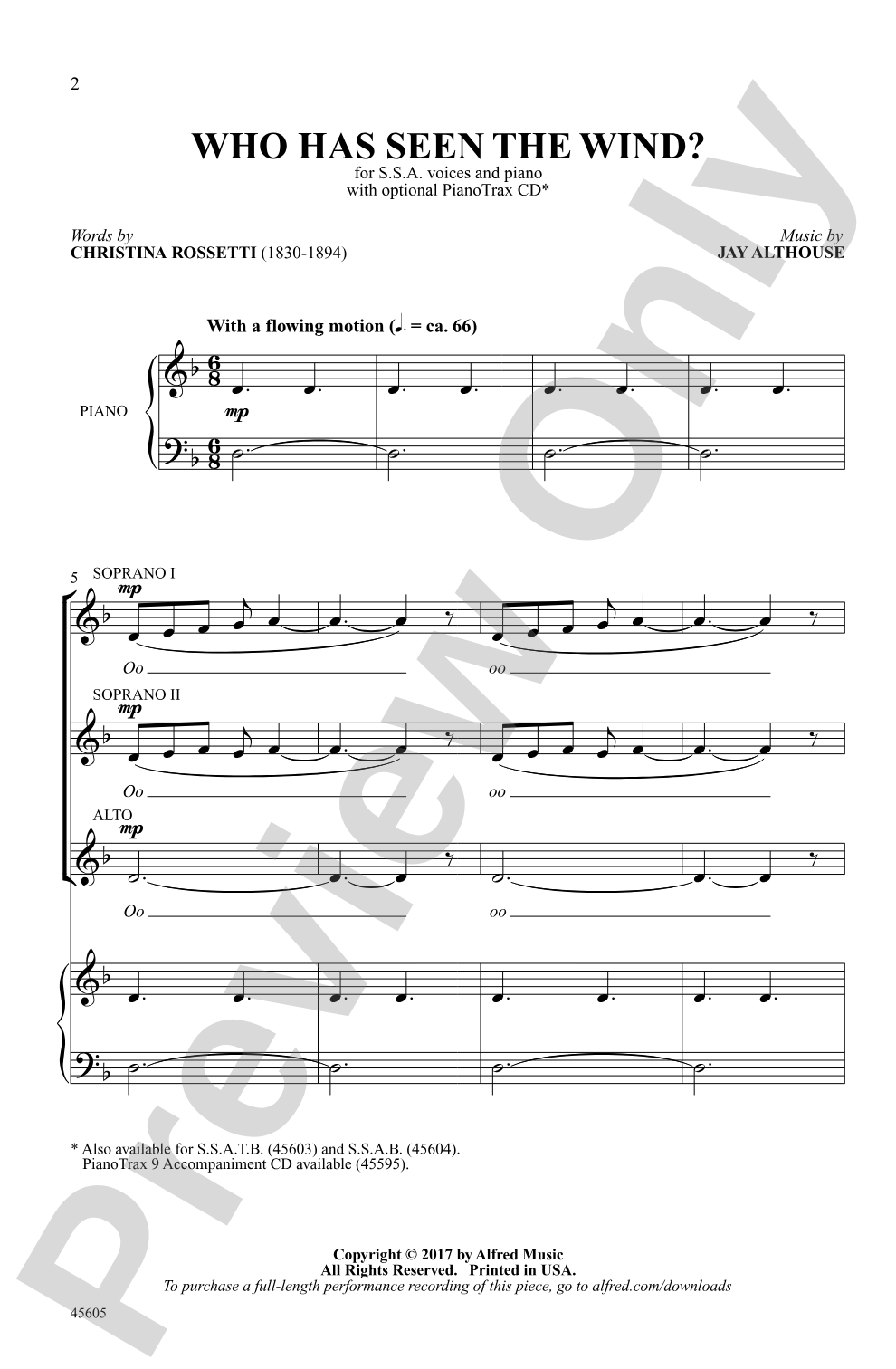
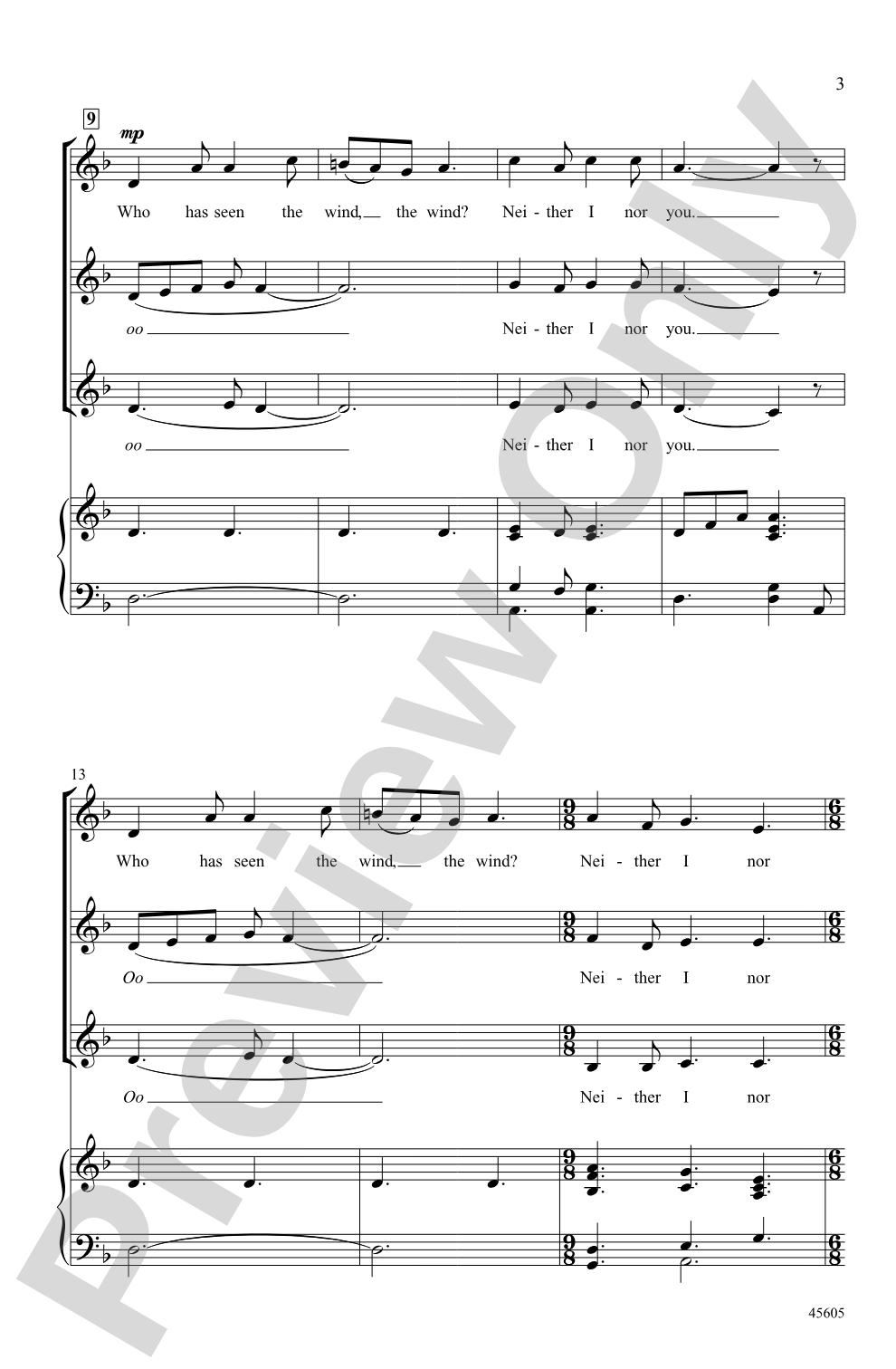
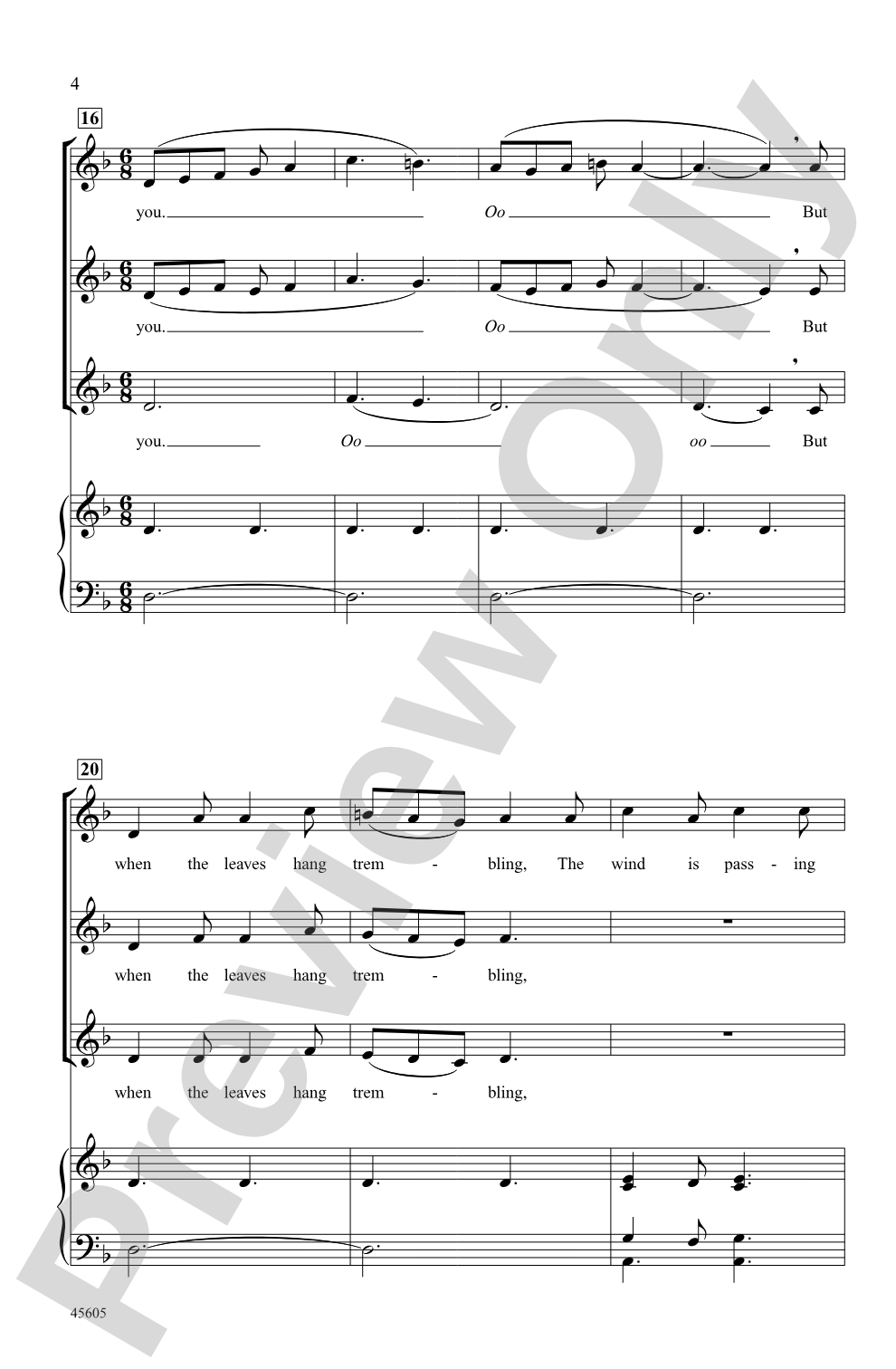

Who Has Seen the Wind?: SSA Choral Octavo
Words by Christina Rossetti, music by Jay Althouse
Item: 00-PO-0005500
$2.05
Minimum order quantity: 20 copies
Pickup currently not available
Related Items
Who Has Seen the Wind?: PianoTrax Digital Download |
$9.99
|
View | |
Who Has Seen the Wind?: SSATB Choral Octavo |
$1.90
|
View | |
Who Has Seen the Wind?: SSAB Choral Octavo |
$1.90
|
View | |
Who Has Seen the Wind?: SSATB Choral Octavo |
$1.90
|
View | |
Who Has Seen the Wind?: SSAB Choral Octavo |
$1.90
|
View | |
Who Has Seen the Wind?: SSA Choral Octavo |
$2.05
|
View |
Description
This text-driven setting of Rossetti's treasured poem is top-tier. A well-developed choral interlude sounds like swirling winds with round vowels and captivating harmonies to spare. Most notably, Jay's masterful text painting weaves the sound of the breeze throughout. Artful. Haunting.


Who Has Seen the Wind?: SSA Choral Octavo isn't in MakeMusic Cloud just yet...but it could be. Let us know you'd like to see it, and you'll help shape what comes next. In the meantime, start a free trial and dive into thousands of interactive titles your students can play along with today.
Request This Title
Tell us you want it.
Start Your Free Trial
Explore everything that's ready to play right now.
Sample Audio
1
Audio File
--:--
0:00
0:00
Sample Video
No sample videos found.
Additional Details
Series:
Alfred Choral Designs
Publisher:
Alfred Music
Page Count:
12
SKU:
00-PO-0005500
More about this title
About the Composer: Jay Althouse

Jay Althouse studied music education and music at Indiana University of Pennsylvania, where he later received the Distinguished Alumni award. His career in music spans both administration and composition; he spent eight years managing rights and licenses for a major educational publisher and served on the Executive Board of the Music Publishers Association of America. As a composer, he has created more than 800 works for choirs across all levels, establishing himself as a prolific voice in choral music performed throughout the English-speaking world.
Althouse's contributions extend beyond composition into pedagogy and collaboration. He has co-written children's musicals with his wife Sally K. Albrecht, compiled vocal solo collections including Folk Songs for Solo Singers, and authored practical classroom resources such as Ready to Read Music and Sixty Music Quizzes. His work earned him recognition as a writer member of ASCAP and multiple ASCAP Special Awards. He served on the board of the North Carolina Master Chorale and continues to support the Folk Art Society of America as a member of its National Advisory Board.
Why we love this
Althouse's text painting transforms Rossetti's meditation into something genuinely visceral. The well-developed choral interlude captures the physical sensation of wind through vowel color and harmonic movement, creating an experience that feels as much visual as it is sonic. Programming this piece elevates a concert with literary sophistication and memorable artistry without demanding extreme vocal ranges or technical demands.
What to expect
The piece inhabits the space between nature and introspection. Haunting harmonies and artful voice leading create an atmosphere of quiet mystery, while the swirling interlude brings kinetic energy that evokes wind without ever becoming literal or overly descriptive.
Who it's for
This piece fits SSA choirs seeking repertoire that honors strong poetic texts and rewards singers with musically expressive material. It works equally well in concert settings and competitive festivals, offering literary depth alongside musical substance.
How to get the most out of it
- Shape the vowels with intention during the interlude; rounded vowels will amplify the swirling quality and create the acoustic effect of moving air.
- Listen carefully to the harmonic transitions and ensure each voice enters cleanly so the text painting remains transparent rather than clouded.
- Balance the literary text with the musical moment; allow silence and space to give weight to Rossetti's words before moving into the instrumental sections.
How to use it
This octavo pairs beautifully with other nature-inspired or poetic repertoire in a concert devoted to text and atmosphere. It also stands alone as a compelling festival selection where musical craftsmanship and literary elegance carry equal weight.
Skills your students will build
- Text painting and interpretive choices in response to poetic language
- Blend and vowel awareness across phrase lengths
- Harmonic listening and voice independence within close-position writing
- Expressive phrasing that honors both word and music