
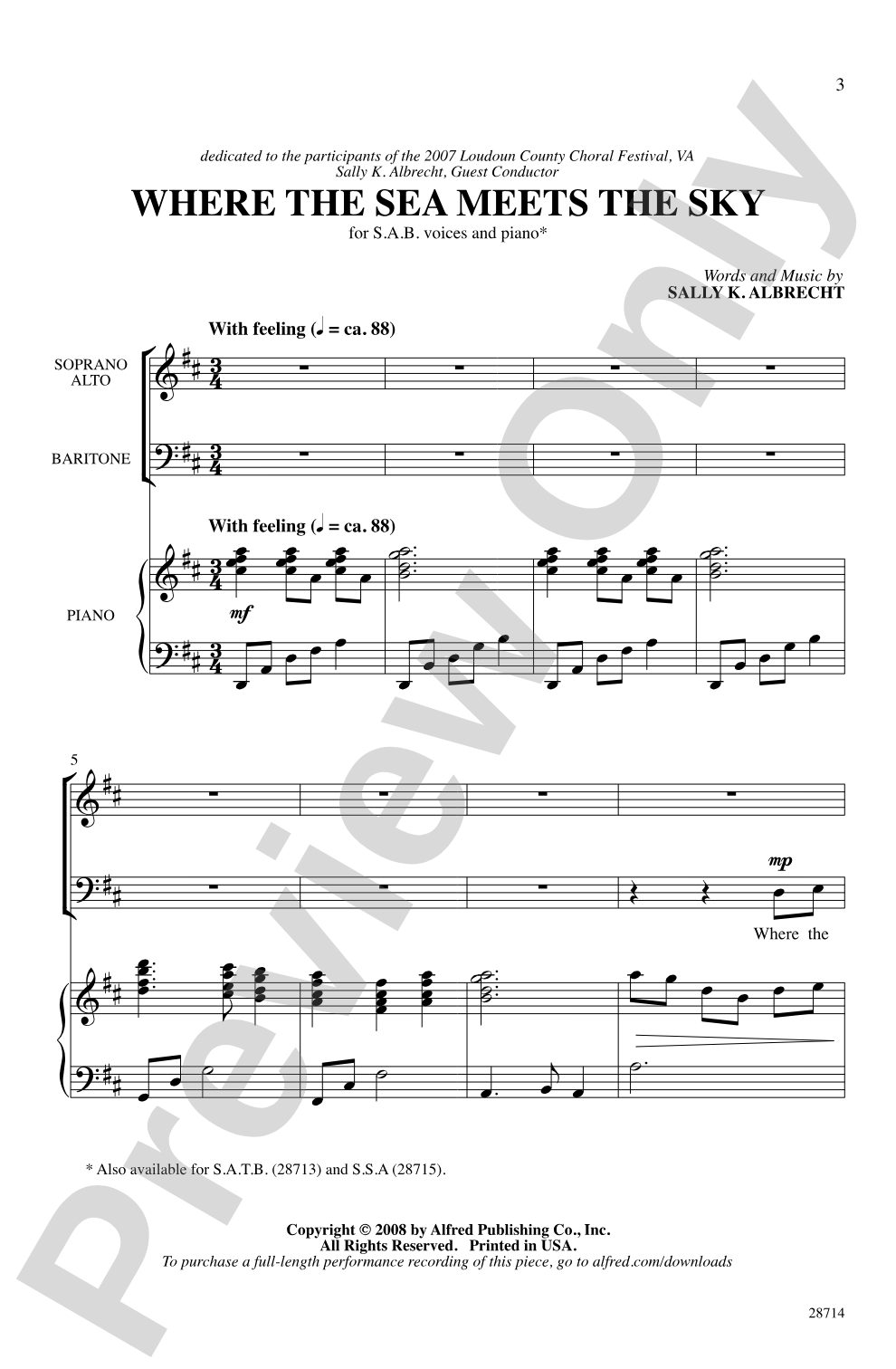
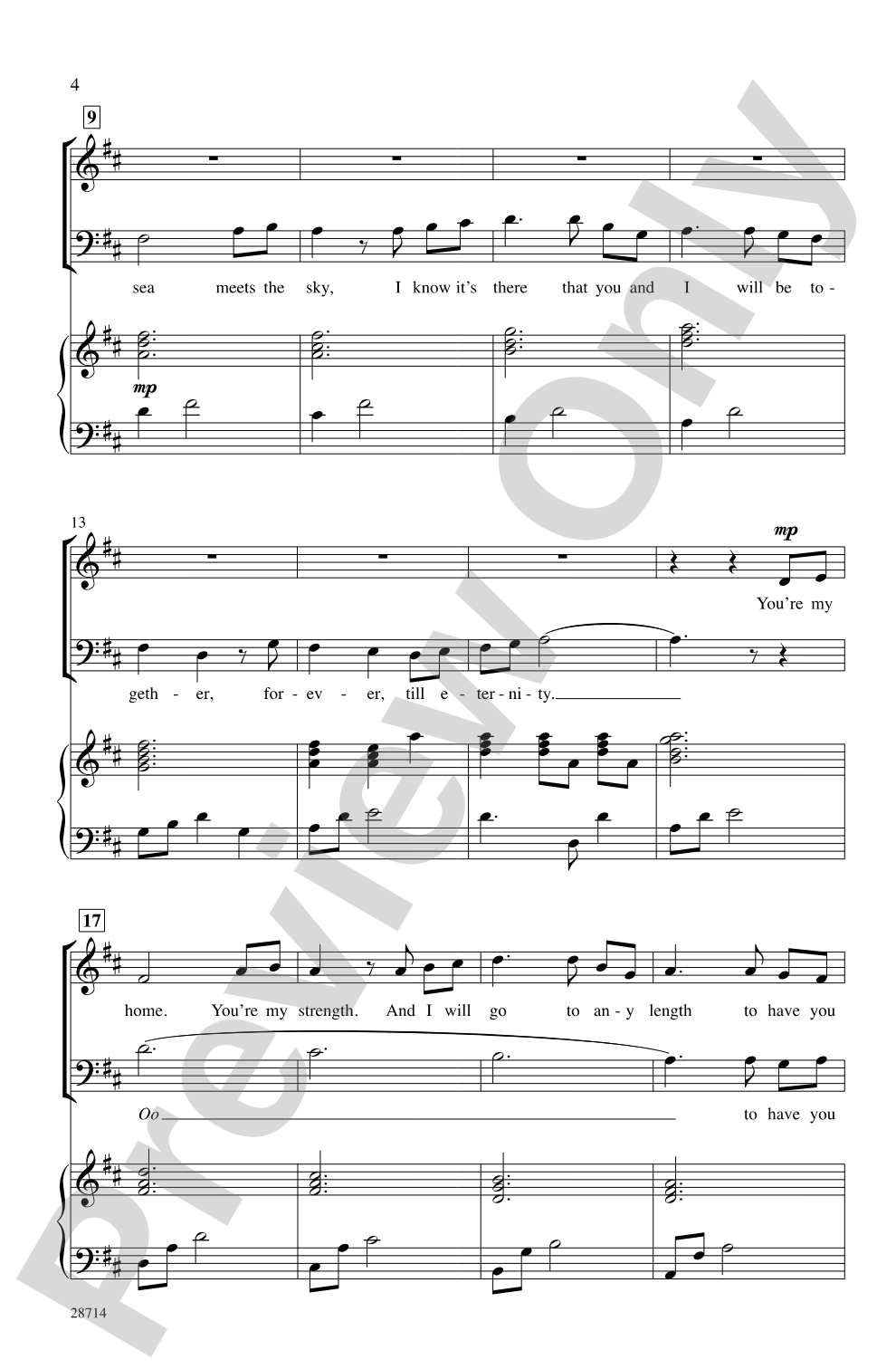

Where the Sea Meets the Sky: SAB Choral Octavo
Words and music by Sally K. Albrecht
Item: 00-PO-0000545
$1.75
Minimum order quantity: 20 copies
Pickup currently not available
Related Items
Where the Sea Meets the Sky: SATB Choral Octavo |
$1.75
|
View | |
Where the Sea Meets the Sky: SSA Choral Octavo |
$1.75
|
View | |
Where the Sea Meets the Sky: SATB Choral Octavo |
$1.75
|
View | |
Where the Sea Meets the Sky: SAB Choral Octavo |
$1.75
|
View | |
Where the Sea Meets the Sky: SSA Choral Octavo |
$1.75
|
View |
Description
Written in the style of a folk song, this exquisite original choral captures the essence of a tender love that lasts forever. "Where the sea meets the sky, I know it's there that you and I will be together, forever, till eternity." Touching, haunting, captivating.


Where the Sea Meets the Sky: SAB Choral Octavo isn't in MakeMusic Cloud just yet...but it could be. Let us know you'd like to see it, and you'll help shape what comes next. In the meantime, start a free trial and dive into thousands of interactive titles your students can play along with today.
Request This Title
Tell us you want it.
Start Your Free Trial
Explore everything that's ready to play right now.
Sample Audio
1
Audio File
--:--
0:00
0:00
Sample Video
No sample videos found.
Additional Details
Series:
Alfred Choral Designs
Publisher:
Alfred Music
Page Count:
12
SKU:
00-PO-0000545
More about this title
About the Composer: Sally K. Albrecht
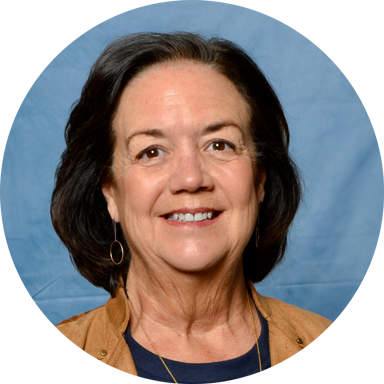
Sally K. Albrecht brings three decades of experience in choral publishing and education to her compositional voice. As Director of School Choral, Vocal, and Elementary Publications for Alfred Music, she shaped the landscape of accessible choral literature while earning consistent recognition from ASCAP since 1987. Her catalog now exceeds 600 published choral works, supplemented by 75 songbooks and musicals that serve choirs at every level.
Beyond the page, Albrecht has conducted honor choirs at prestigious venues including Lincoln Center, Carnegie Hall, and The Kennedy Center, and has taught music at Oakland University, Jersey City State College, and Meredith College. She holds degrees from Rollins College (B.A. in Music and Theater, 1976), the University of Miami (M.A. in Drama, 1977; M.M. in Accompanying, 1979), and is a recipient of the 2021 Distinguished Alumna Award from both institutions. She makes her home in North Carolina with her husband, composer and arranger Jay Althouse.
Why we love this
Albrecht writes with restraint and emotional intelligence, trusting the simplicity of folk idiom to carry profound feeling. The lyric itself becomes the anchor; singers and listeners alike feel the weight of those final words, and the music never oversells the moment. This is the kind of piece that lingers in a concert, one audiences remember not because it dazzled them but because it moved them.
What to expect
Tender and unhurried, like watching the horizon where water and sky dissolve into one another. The melody carries the longing of a folk ballad, haunting in its simplicity, while the arrangement honors that restraint rather than embellishing it. By the final cadence, the piece has accumulated an aching sincerity.
Who it's for
SAB choirs seeking repertoire that bridges folk authenticity with contemporary arrangement will find this piece rewarding. It works equally well for developing ensembles building confidence in three-part writing and experienced choirs drawn to literature with emotional depth and programmatic purpose.
How to get the most out of it
- Let the text breathe. The refrain "Where the sea meets the sky" works best when sung with space around it, allowing the image to settle before the next phrase enters.
- Balance treble and lower voices carefully during the tutti sections; SAB writing can mask middle voices if rehearsal focuses only on the outer parts.
- Consider how you'll shape the dynamics from start to finish. Folk-style pieces often benefit from building gradually toward the final statement rather than dynamic changes driven by formal sectional contrast.
How to use it
Pair this with other folk-inspired literature to create a thematic concert section, or position it as the emotional centerpiece of a mixed program where it can stand alone and breathe. Its intimacy makes it ideal for spring concerts, commemorative events, or any program where tenderness and reflection fit the occasion.
Skills your students will build
- Singing in three-part SAB voicing with independent melodic lines
- Shaping phrases in folk idiom without resorting to excessive dynamic contrast
- Balancing text clarity and musical line in ballad-style writing
- Creating ensemble cohesion across distributed parts (useful when treble and lower voices carry primary material)
- Communicating emotional intention through restraint rather than volume