
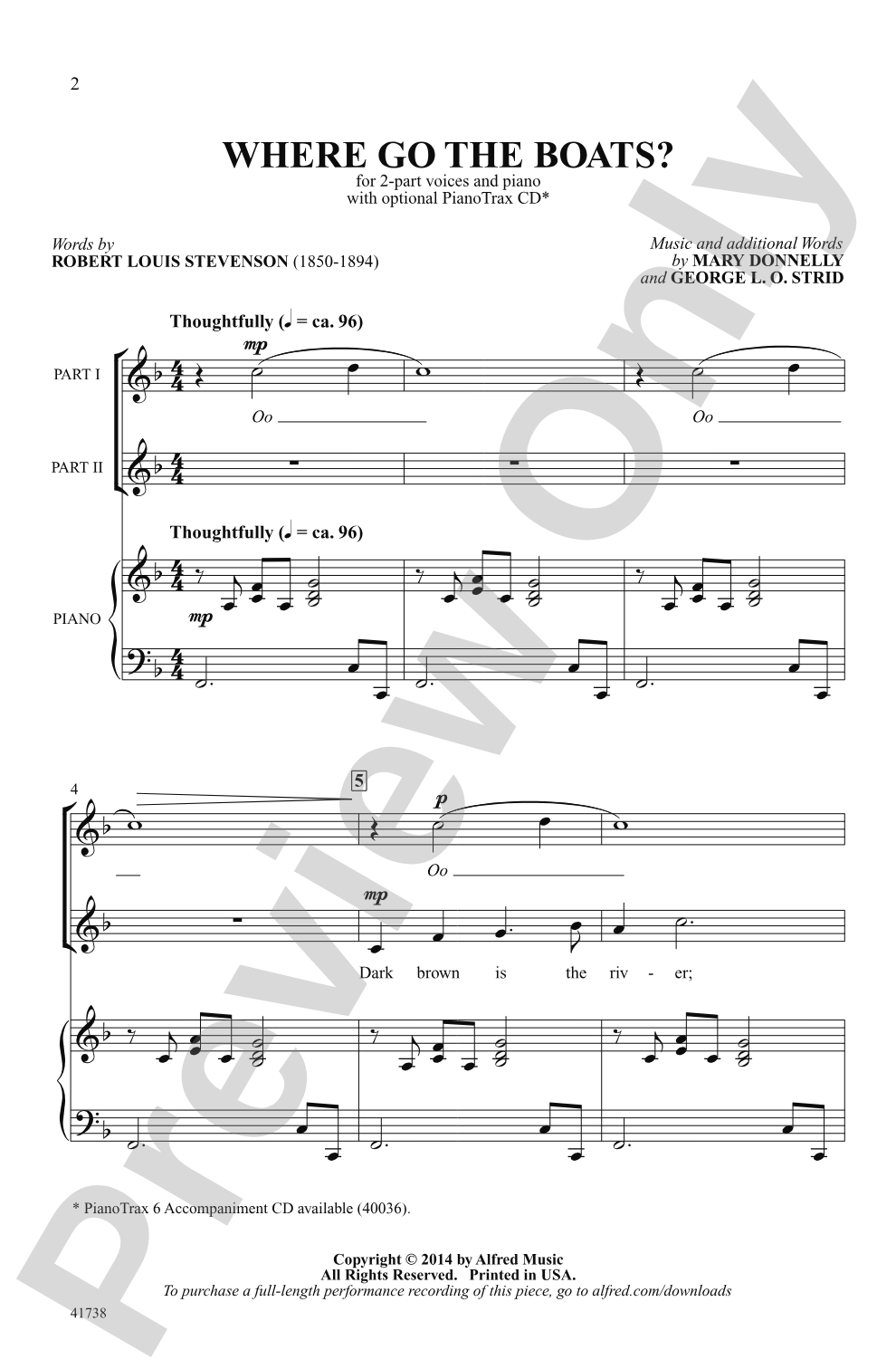

Where Go the Boats?: 2-Part Choral Octavo
Words by Robert Louis Stevenson, music and additional words by Mary Donnelly and George L. O. Strid
Item: 00-PO-0001892
$1.85
Minimum order quantity: 20 copies
Pickup currently not available
Description
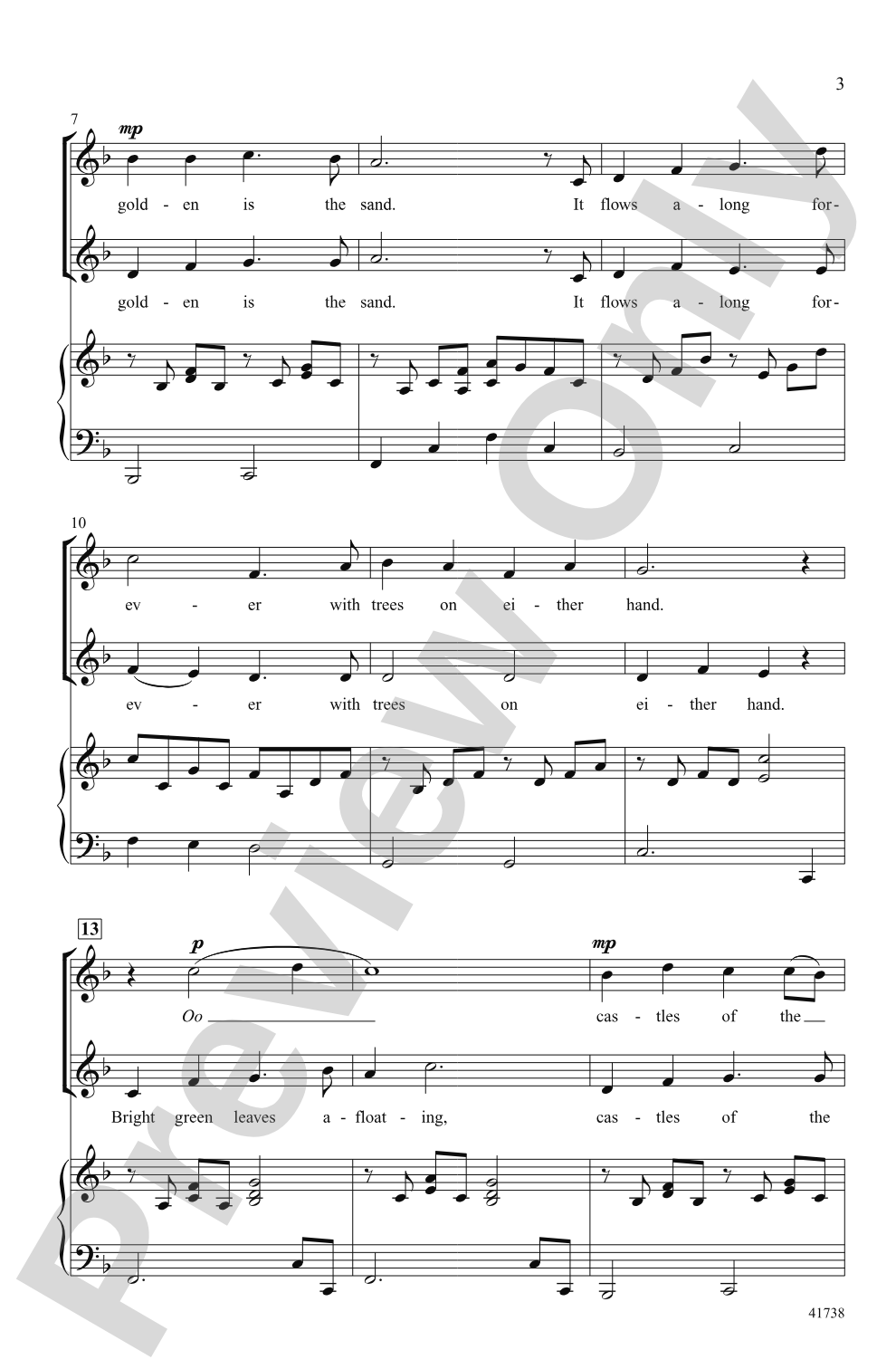
The singable tune of this winsome Stevenson setting is frequently traded between voice parts, affording each member of the choir an opportunity to sing both melody and harmony. A great choice for younger voices and a cross-curricular tie-in to A Child's Garden of Verses.


Where Go the Boats?: 2-Part Choral Octavo isn't in MakeMusic Cloud just yet...but it could be. Let us know you'd like to see it, and you'll help shape what comes next. In the meantime, start a free trial and dive into thousands of interactive titles your students can play along with today.
Request This Title
Tell us you want it.
Start Your Free Trial
Explore everything that's ready to play right now.
Sample Audio
1
Audio File
--:--
0:00
0:00
Sample Video
No sample videos found.
Additional Details
Series:
Alfred Choral Designs
Publisher:
Alfred Music
Page Count:
8
SKU:
00-PO-0001892
More about this title
About the Composer: Mary Donnelly
Mary Donnelly grew up in Reno, Nevada and studied English and French at the University of Nevada, Reno. During her undergraduate years, she founded two children's choruses, an experience that redirected her toward music education. She returned to graduate school at Lesley College in Cambridge, Massachusetts, where she focused on arts integration across the curriculum.
Donnelly spent three decades teaching general music and choir in the Washoe County schools, retiring after a fulfilling career in elementary and middle school classrooms. In 1985, she began collaborating with George Strid on a musical for Reading Week, launching a partnership that has produced over two hundred songs and twenty-five theatrical works. She remains active in ACDA, NEA, and ASCAP.
Why we love this
The melody genuinely passes between voice parts rather than staying locked in one part, which means every singer gets real melodic moments. It's the kind of piece that keeps younger singers engaged because they're not stuck on a supporting line for eight pages. The Stevenson text offers a natural entry point for classroom discussion about poetry and literature, making it genuinely useful beyond the concert stage.
What to expect
Winsome and flowing, with a tune that feels naturally singable from the first reading. The melody carries a reflective, almost wistful quality that matches Stevenson's poetic language about toy boats and imagination. There's lightness here without frivolity—the piece invites singers into a moment of genuine musical conversation.
Who it's for
This octavo works best with middle school or early high school choirs developing independence in two-part singing. Singers benefit from the frequent melody trades, which build confidence and musicality without overwhelming younger voices. It's especially valuable for programs seeking accessible repertoire that doubles as a literature connection.
How to get the most out of it
- Highlight the melody exchanges during rehearsal by having singers echo the phrase when it moves to their part, creating ownership of 'their' moment in the piece.
- Balance the two parts by thinking of them as equal voices rather than melody and accompaniment; each line should sing with the same commitment to tone and phrasing.
- Connect the text to the imagery in A Child's Garden of Verses during rehearsals so students understand the piece as literature set to music, not just notes on a page.
How to use it
Program this alongside other Stevenson settings or literature-based works for a thematic concert focusing on poetry and music. It pairs well in a spring concert featuring accessible two-part repertoire for younger ensembles, or use it as a contest piece where its tuneful character and clear structure appeal to adjudicators. The literary connection makes it ideal for interdisciplinary events with English departments.
Skills your students will build
- Reading and sustaining two independent melodic lines
- Trading melody and harmony between voice parts
- Connecting poetic text to musical phrasing and interpretation
- Building blend and balance in two-part voicing
- Sight-reading accessible but musically substantial literature