
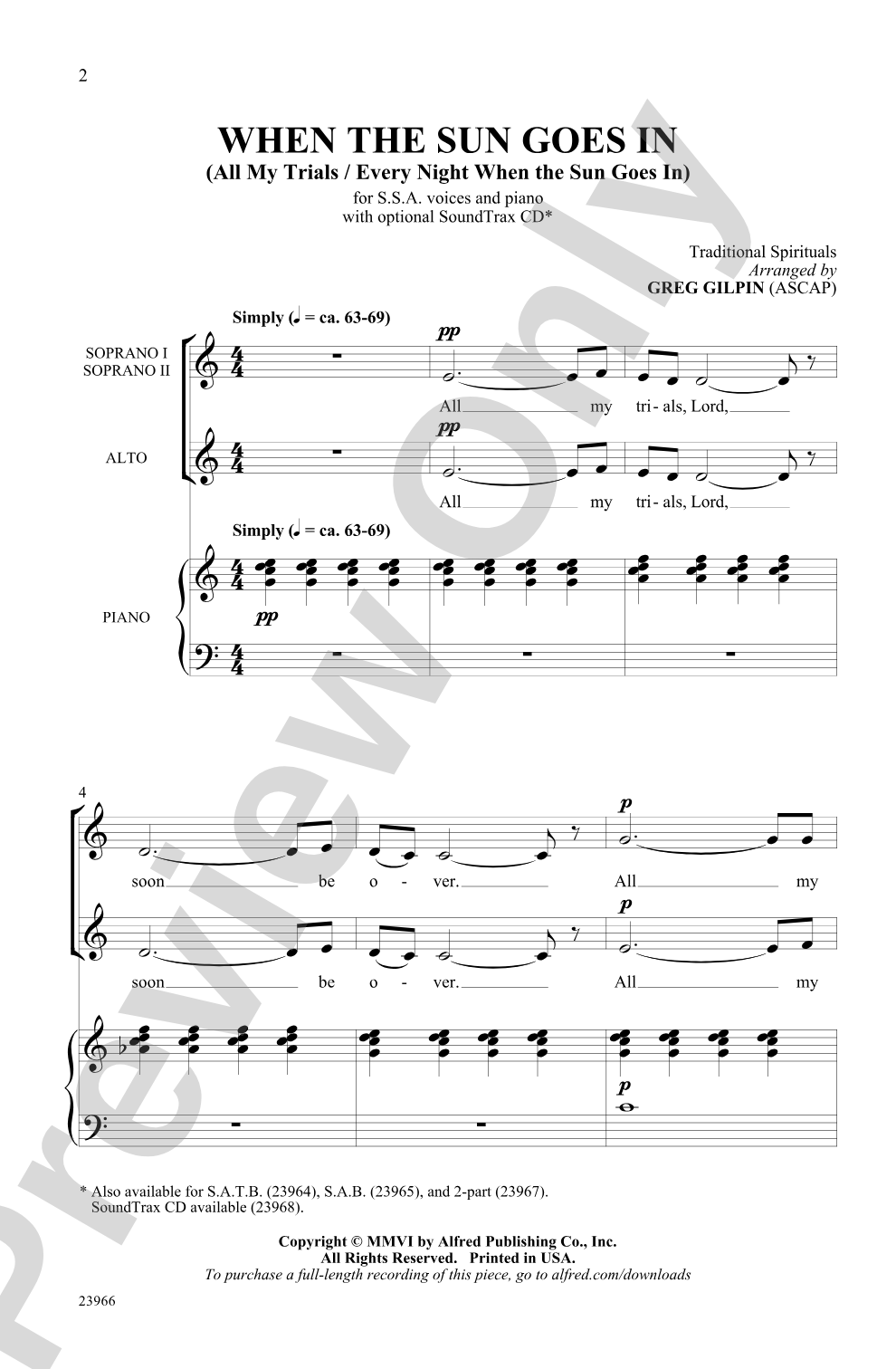
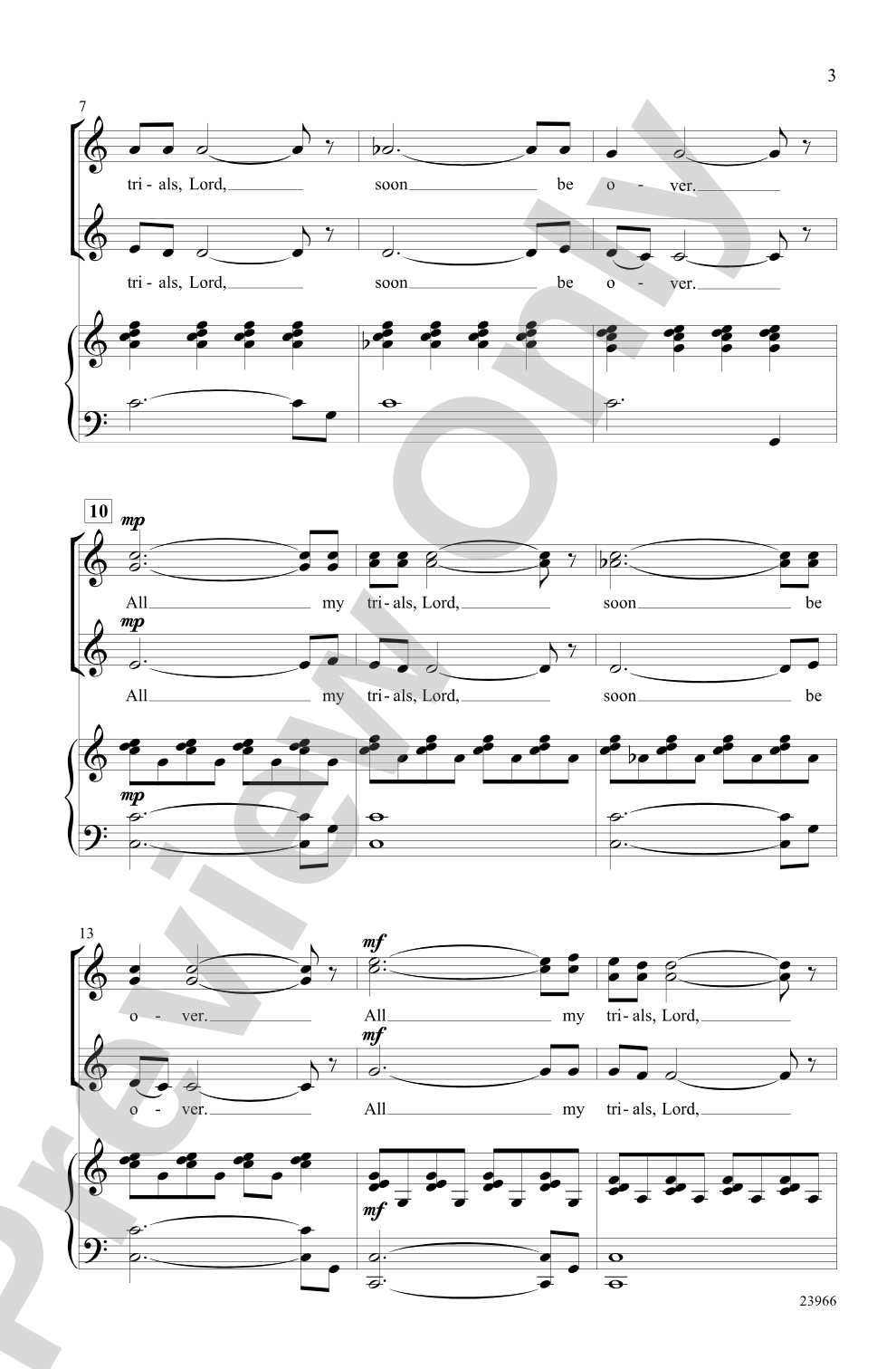

When the Sun Goes In: SSA Choral Octavo
All My Trials / Every Night When the Sun Goes In
Traditional Spirituals / arr. Greg Gilpin
Item: 00-PO-0000039
$1.65
Minimum order quantity: 20 copies
Pickup currently not available
Related Items
When the Sun Goes In: SoundTrax Digital Audio Download |
$22.95
|
View | |
When the Sun Goes In: SAB Choral Octavo |
$1.65
|
View | |
When the Sun Goes In: 2-Part Choral Octavo |
$1.65
|
View | |
When the Sun Goes In: SAB Choral Octavo |
$1.65
|
View | |
When the Sun Goes In: SSA Choral Octavo |
$1.65
|
View | |
When the Sun Goes In: 2-Part Choral Octavo |
$1.65
|
View | |
When the Sun Goes In: Choral Octavo SoundTrax CD |
$22.95
|
View |
Description
A sublime combination of "All My Trials" and "Every Night When the Sun Goes In," enjoyable and accessible for all choirs. A delicate piano accompaniment underscores the simple sustained vocal phrases that begin on unison pianissimo and grow to full harmonic beauty. A stunning spiritual setting!


When the Sun Goes In: SSA Choral Octavo isn't in MakeMusic Cloud just yet...but it could be. Let us know you'd like to see it, and you'll help shape what comes next. In the meantime, start a free trial and dive into thousands of interactive titles your students can play along with today.
Request This Title
Tell us you want it.
Start Your Free Trial
Explore everything that's ready to play right now.
Sample Audio
1
Audio File
--:--
0:00
0:00
Sample Video
No sample videos found.
Additional Details
Series:
Alfred Choral Designs
Publisher:
Alfred Music
Page Count:
8
SKU:
00-PO-0000039
More about this title
About the Arranger: Greg Gilpin

Greg Gilpin has established himself as one of America's most performed choral arrangers and composers, with conducting credits spanning Carnegie Hall, Lincoln Center, and the Ryman Auditorium. His work has taken him to premiere venues across the globe, including the Sydney Opera House, Royal Festival Hall in London, and Harpa Concert Hall in Reykjavik. As Director of Educational Choral Publications for Shawnee Press, he shapes the choral landscape for educators nationwide.
Beyond the concert hall, Gilpin is an active member of ACDA and NAfME, and has expanded his creative reach into film scoring and collaborative projects with renowned soloists. His arrangement of "What Child is This?" with soprano Angela Brown and the Indianapolis Symphonic Choir exemplifies his gift for reimagining beloved music with fresh sophistication.
Why we love this
Gilpin's arrangement strips away the familiar and lets these spiritual melodies breathe. The unison opening draws singers in with vulnerability before the harmonic landscape opens gradually, making this accessible enough for developing choirs while sophisticated enough to hold an audience's full attention from pianissimo to the final sustained chord.
What to expect
The opening feels almost like prayer, with voices finding their way together from silence. As the arrangement unfolds, a delicate emotional richness emerges without ever losing its meditative quality. The final effect is both intimate and transcendent, leaving listeners moved by something that feels simultaneously ancient and deeply present.
Who it's for
Any SSA or SSAA choir looking for a spiritually moving piece that doesn't demand advanced vocal technique but does require interpretive maturity. This works beautifully for high school ensembles, community choirs, and collegiate groups seeking repertoire that honors tradition while remaining accessible to audiences.
How to get the most out of it
- Balance the opening unison passages with absolute clarity; even at pianissimo, each word should land with intention before the harmony enters.
- Shape the dynamic arc gradually across the entire piece rather than jumping to forte in climactic sections; this arrangement rewards patient, sustained growth.
- Collaborate closely with your pianist during rehearsal to ensure the accompaniment sits underneath the voices without overwhelming the simplicity that makes this arrangement special.
- Prepare singers to hold sustained phrases without wavering in tone or pitch; this kind of exposed singing demands secure breath support and tonal focus.
How to use it
Place this in a spring or winter concert program as a moment of quiet reflection and spiritual depth. It pairs naturally with other spirituals or American folk traditions, or it can anchor a concert devoted to sacred choral literature. This is also ideal for a ceremony, memorial service, or community event where you want powerful emotional resonance without technical virtuosity.
Skills your students will build
- Singing sustained phrases with consistent tone and intonation in exposed unison passages
- Dynamic control at soft dynamic levels, especially pianissimo singing
- Blending treble voices across SSA/SSAA voicing while maintaining individual phrase clarity
- Interpreting spiritual tradition with authenticity and emotional depth
- Responding to subtle piano accompaniment without losing vocal independence