
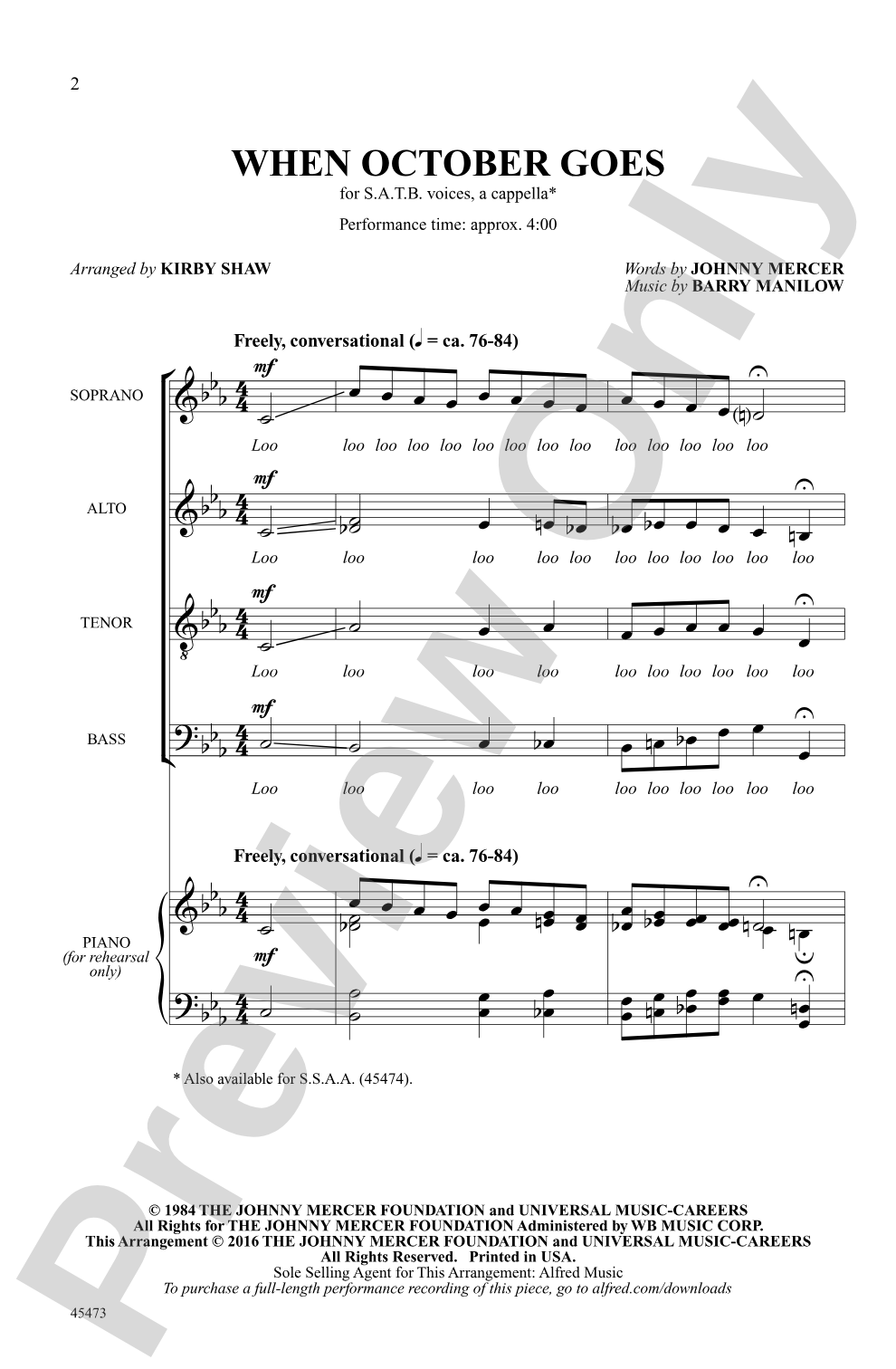
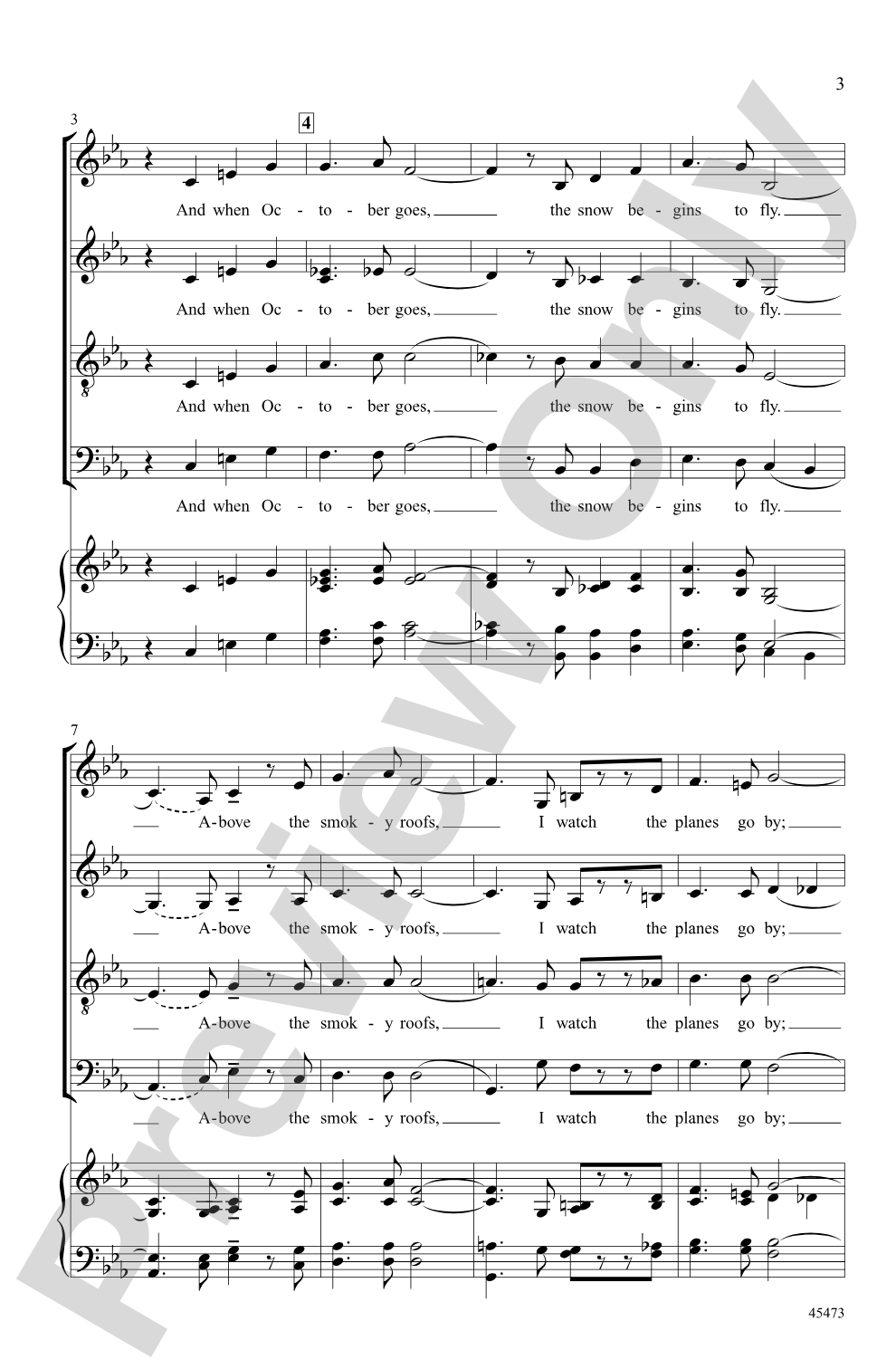

When October Goes: SATB, a cappella Choral Octavo
Words by Johnny Mercer, music by Barry Manilow / arr. Kirby Shaw
Item: 00-PO-0003712
$2.00
Minimum order quantity: 20 copies
One moment…
Description
"It doesn't matter much how old I grow, I hate to see October go." Unfinished Johnny Mercer lyrics (saved by Mercer's widow) combined with a melody from Barry Manilow resulted in one of 1985's most popular songs. With warm choral harmonies and impeccable voice leading, this is Kirby Shaw at his best!


When October Goes: SATB, a cappella Choral Octavo isn't in MakeMusic Cloud just yet...but it could be. Let us know you'd like to see it, and you'll help shape what comes next. In the meantime, start a free trial and dive into thousands of interactive titles your students can play along with today.
Request This Title
Tell us you want it.
Start Your Free Trial
Explore everything that's ready to play right now.
Sample Audio
1
Audio File
--:--
0:00
0:00
Sample Video
Additional Details
Series:
Alfred Pop Choral Series
Publisher:
Alfred Music
Page Count:
12
SKU:
00-PO-0003712
More about this title
About the Composer: Barry Manilow
Barry Manilow crafted some of the 1970s and 1980s most enduring pop melodies, bringing sophisticated arrangements and genuine emotional depth to popular song. His collaborations with lyricist Bruce Sussman and others produced standards that have become staples in choral and vocal music education, valued for their strong melodic lines and harmonic richness.
Manilow's work in pop music demonstrates how strong compositional craft and accessibility can coexist. His songs have found their way into choral literature because they reward both singers and listeners with memorable hooks, singable ranges, and arrangements that showcase ensemble blend.
Why we love this
Kirby Shaw's arrangement captures everything that makes this song resonate: warm, voice-leading that sits comfortably across all four parts, and a structure that keeps singers engaged without oversinging the material. It's a reminder that great pop songs arranged with care become vehicles for genuine musicianship, and this one delivers both polish and heart without requiring technical pyrotechnics.
What to expect
Nostalgic and bittersweet, yet never maudlin. The harmonic warmth creates an intimate quality even in full four-part texture, and the familiar melody anchors singers while the arrangement invites them to listen closely to how each voice contributes. There's a reflective elegance here that makes it feel more like a concert piece than a pop cover.
Who it's for
Choirs at the intermediate to advanced level who want contemporary pop repertoire that respects both the singers and the audience. This works especially well for ensembles comfortable with a cappella balance and eager to build arrangements that blend radio-friendly hooks with genuine musical substance.
How to get the most out of it
- Balance the melody line between sopranos and altos in verse sections where the tune passes between parts; the arrangement's sophistication lives in how Shaw distributes the primary voice.
- Approach phrase endings with gentle releases rather than emphatic cutoffs; the text and harmonic movement invite a softer, more introspective character.
- Shape sustained chords by moving slightly into them rather than landing static; a cappella singing benefits from imperceptible motion that keeps the blend alive.
- Rehearse with attention to vowel consistency across the chord, particularly on the most important harmonic moments; unified vowels will make Shaw's voice leading absolutely transparent.
How to use it
Pair this with other Shaw arrangements or carefully selected art songs to create a mixed program that shows range without fragmentation; its sophisticated pop sensibility bridges the gap between standard choral literature and contemporary styles. It also works as a concert closer or as a standalone feature that reminds audiences why great melodies endure.
Skills your students will build
- A cappella blend and intonation maintenance across sustained chord changes
- Phrase shaping and breath control in a contemporary harmonic context
- Awareness of voice leading and how individual lines contribute to overall harmonic color
- Stylistic interpretation of pop music arranged for serious ensemble performance