
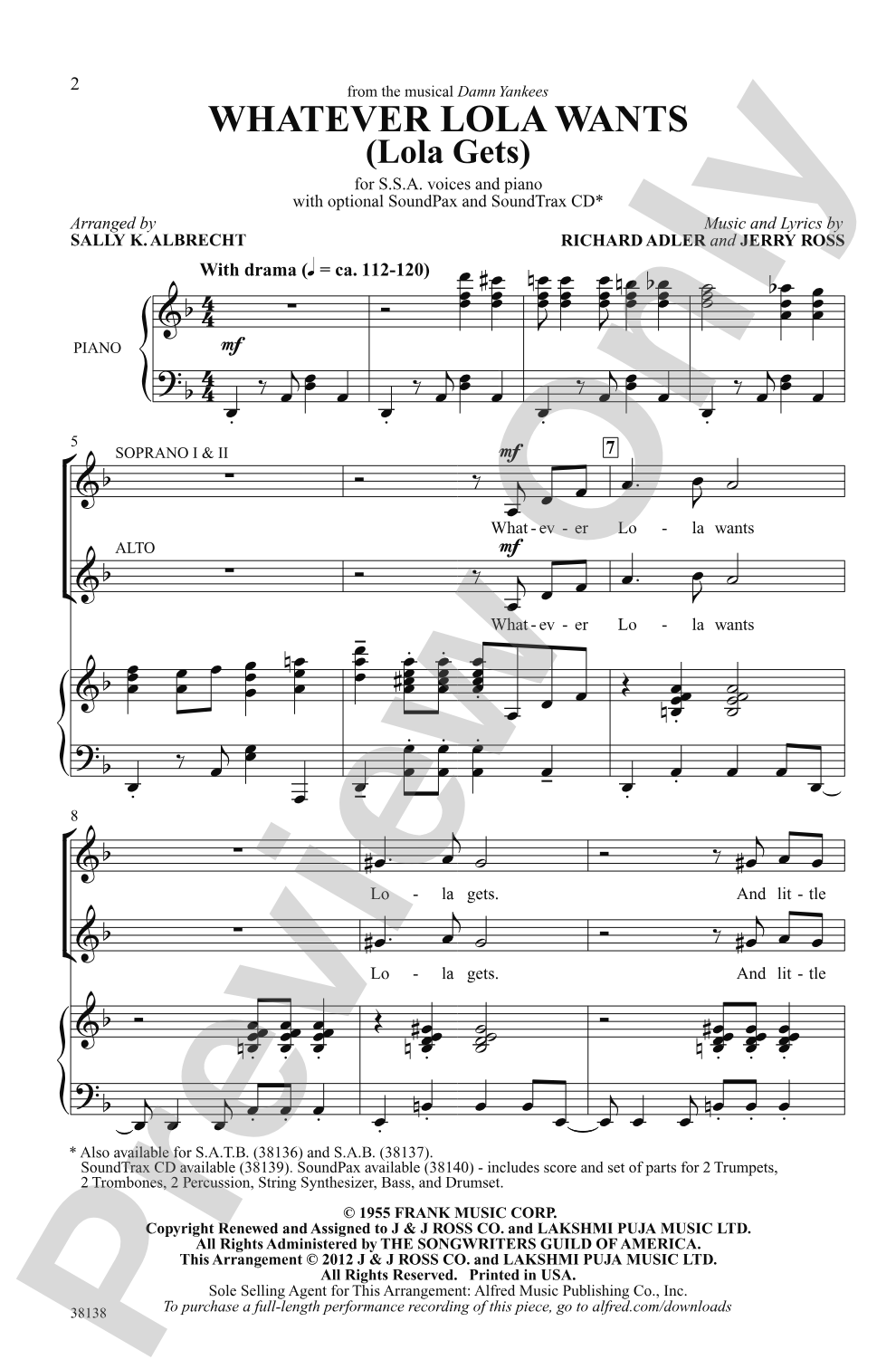
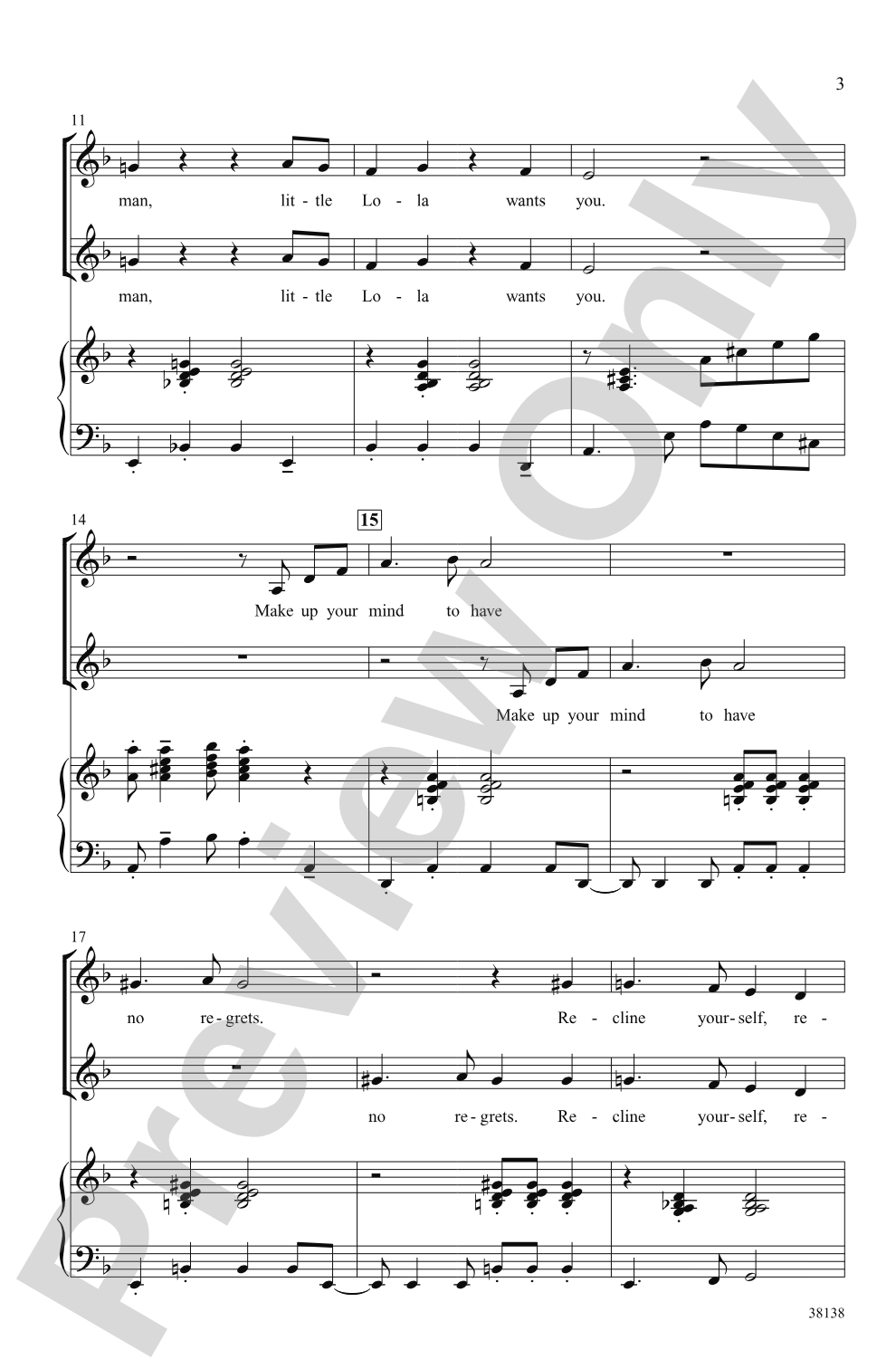

Whatever Lola Wants (Lola Gets) (from the musical Damn Yankees): SSA Choral Octavo
From the Musical Damn Yankees
Music and lyrics by Richard Adler and Jerry Ross / arr. Sally K. Albrecht
Item: 00-PO-0001413
$1.90
Minimum order quantity: 20 copies
One moment…
Related Items
Whatever Lola Wants (Lola Gets): SoundTrax Digital Audio Download |
$26.99
|
View | |
Whatever Lola Wants (Lola Gets) (from the musical Damn Yankees): SATB Choral Octavo |
$1.90
|
View | |
Whatever Lola Wants (Lola Gets) (from the musical Damn Yankees): SAB Choral Octavo |
$1.90
|
View | |
Whatever Lola Wants (Lola Gets): SATB Choral Octavo |
$1.90
|
View | |
Whatever Lola Wants (Lola Gets): SAB Choral Octavo |
$1.90
|
View | |
Whatever Lola Wants (Lola Gets): SSA Choral Octavo |
$1.90
|
View | |
Whatever Lola Wants (Lola Gets): Choral Octavo SoundTrax CD |
$26.99
|
View |
Description
Gwen Verdon made this sassy, saucy number a hit when Damn Yankees played on Broadway in 1955. Enjoy the "girls vs. guys" mixed arrangement, or let your ladies steal the show with the SSA version. Featured on Lift Me Up! choral movement DVD (00-38171).


Whatever Lola Wants (Lola Gets) (from the musical Damn Yankees): SSA Choral Octavo isn't in MakeMusic Cloud just yet...but it could be. Let us know you'd like to see it, and you'll help shape what comes next. In the meantime, start a free trial and dive into thousands of interactive titles your students can play along with today.
Request This Title
Tell us you want it.
Start Your Free Trial
Explore everything that's ready to play right now.
Sample Audio
1
Audio File
--:--
0:00
0:00
Sample Video
No sample videos found.
Additional Details
Series:
Alfred Pop Choral Series
Publisher:
Alfred Music
Page Count:
12
SKU:
00-PO-0001413
More about this title
About the Composer: Richard Adler
Richard Adler brought sophisticated songwriting to Broadway during the golden age of musical theater. His collaborations with Jerry Ross produced some of the most enduring standards of the 1950s, including the score for Damn Yankees, which won the Tony Award for Best Musical in 1956. Adler's gift for crafting melodies that were both memorable and dramatically purposeful made him a central figure in the development of the American musical.
Why we love this
Sally K. Albrecht's SSA arrangement captures the swagger and swagger of this 1950s showstopper while giving your treble choir a chance to claim its own version of Lola's unforgettable charm. The arrangement preserves the song's rhythmic drive and character-driven melody, making it equally effective as a solo feature for strong singers or a full ensemble moment. Its Broadway pedigree and built-in theatricality mean rehearsing it feels less like drilling exercises and more like mounting a scene.
What to expect
The piece radiates theatrical confidence and playful charm. You'll feel the 1950s glamour and sass in every phrase, with Lola's personality shining through the melody. There's a lightness and swagger to it that invites audiences to smile and tap their feet.
Who it's for
This arrangement works for SSA choirs with singers who enjoy character-driven material and can handle a brassy, confident musical personality. It suits choirs wanting Broadway repertoire that feels age-appropriate and dramatically engaging for middle school through adult ensembles.
How to get the most out of it
- Establish the swagger early: the rhythmic precision of the accompaniment depends on your singers locking into a relaxed but steady pocket, especially in the verses where syllabic clarity drives the attitude.
- Shape the melodic phrases with intention rather than mathematical evenness; Lola's confidence lives in conversational phrasing and slight rhythmic flexibility, not metronomic delivery.
- Layer the harmony gradually if you have the recorded accompaniment available, bringing in additional voice parts as the song builds so the sassy quality stays front and center.
- Commit fully to the character and storytelling; singers who treat this as a dramatic moment rather than simply a pretty song will unlock its infectious energy and audience connection.
How to use it
Pair this with other theatrical selections to build a Broadway-themed concert, or feature it as a show-stealing moment in a mixed-era choral program where you want something that lands with comedic and musical impact. The movement and staging options also make it an excellent choice for concert productions or choir tours where visual interest heightens audience engagement.
Skills your students will build
- Rhythmic precision in syncopated and driving accompaniment patterns
- Character-driven vocal expression and storytelling through melody
- Blend and balance across three voice parts in contemporary harmonic language
- Performance confidence and stage presence in solo-feature and ensemble contexts