
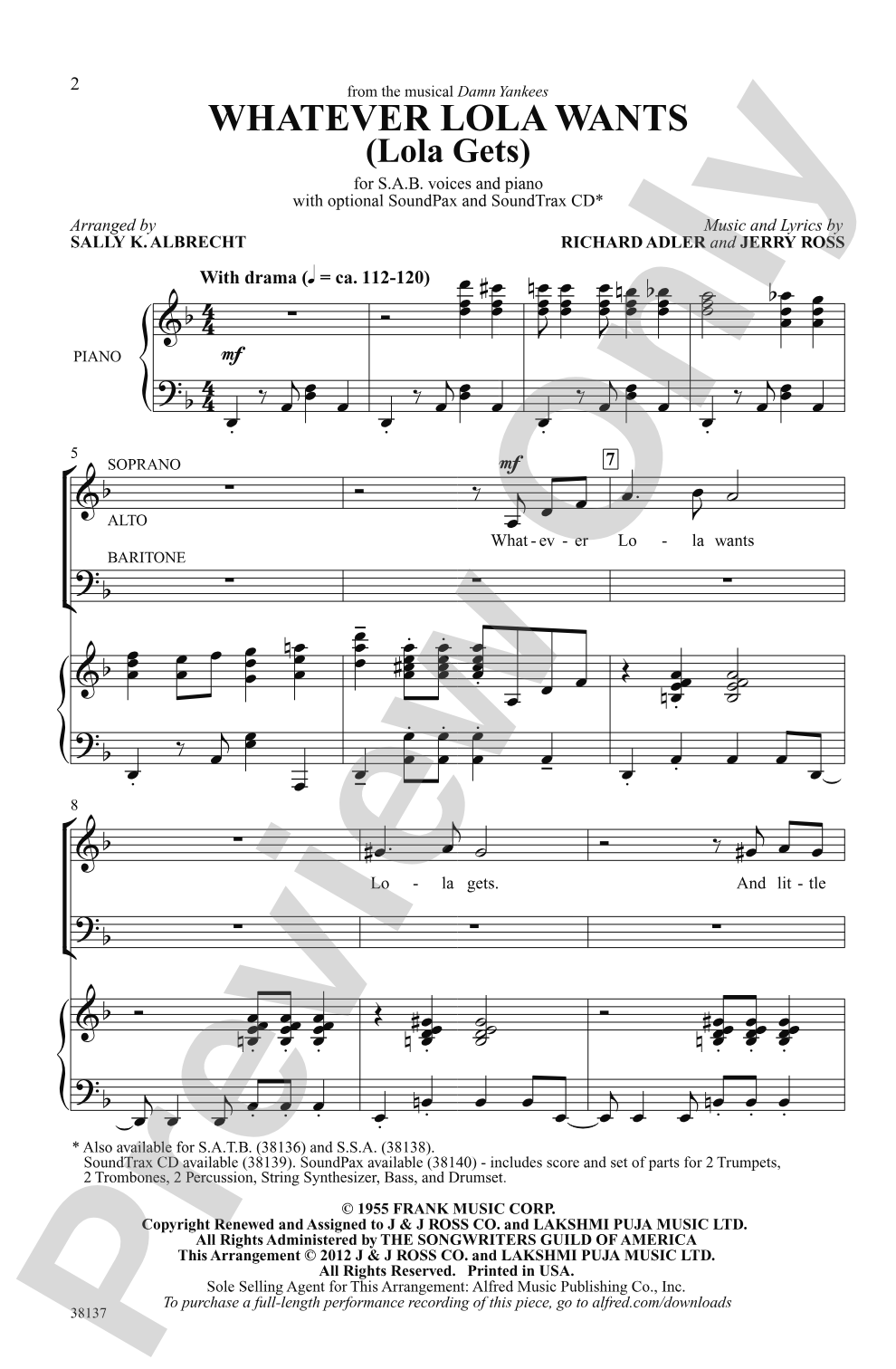
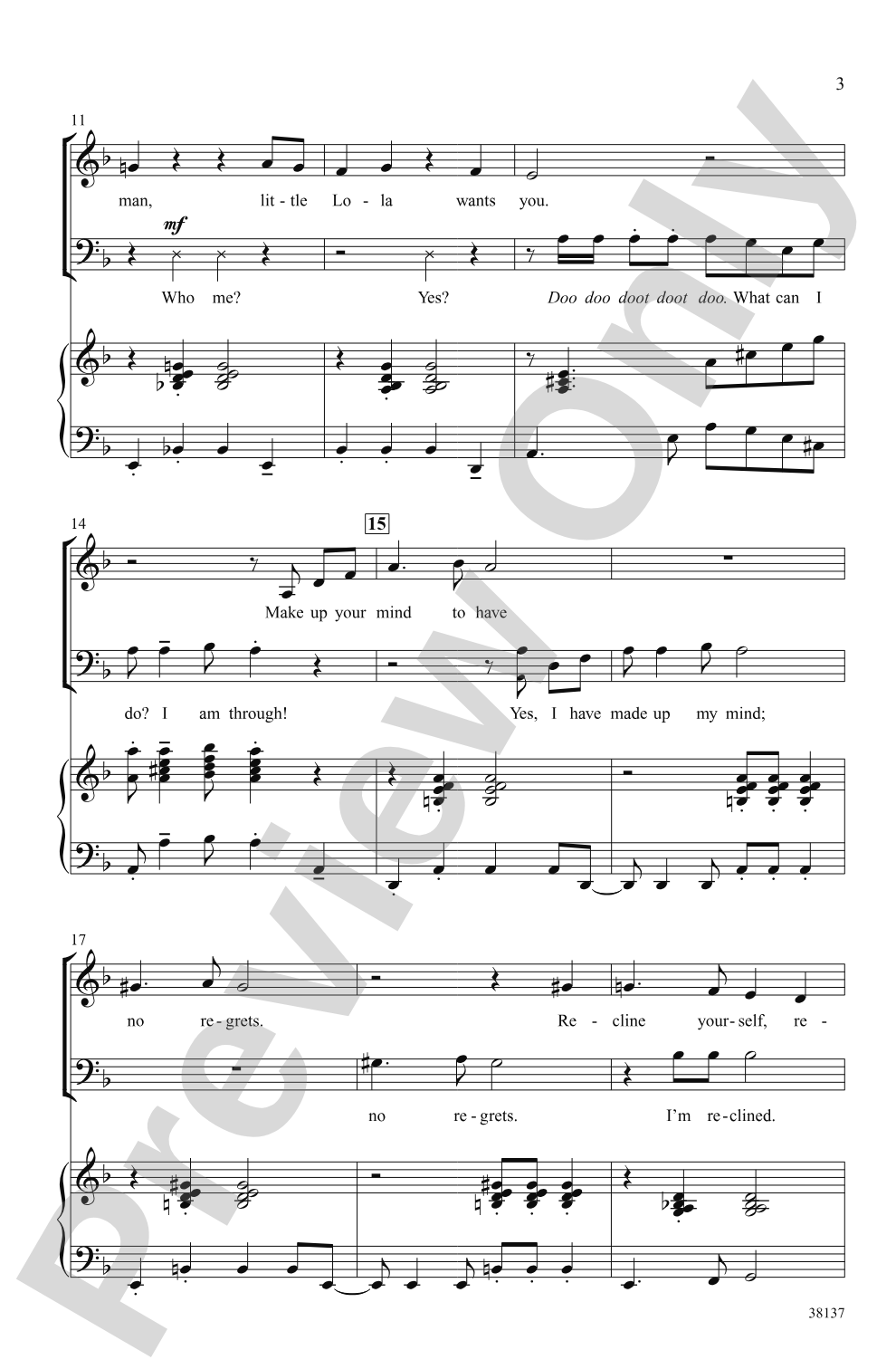

Whatever Lola Wants (Lola Gets) (from the musical Damn Yankees): SAB Choral Octavo
From the Musical Damn Yankees
Music and lyrics by Richard Adler and Jerry Ross / arr. Sally K. Albrecht
Item: 00-PO-0001412
$1.90
Minimum order quantity: 20 copies
One moment…
Related Items
Whatever Lola Wants (Lola Gets): SoundTrax Digital Audio Download |
$26.99
|
View | |
Whatever Lola Wants (Lola Gets) (from the musical Damn Yankees): SATB Choral Octavo |
$1.90
|
View | |
Whatever Lola Wants (Lola Gets) (from the musical Damn Yankees): SSA Choral Octavo |
$1.90
|
View | |
Whatever Lola Wants (Lola Gets): SATB Choral Octavo |
$1.90
|
View | |
Whatever Lola Wants (Lola Gets): SAB Choral Octavo |
$1.90
|
View | |
Whatever Lola Wants (Lola Gets): SSA Choral Octavo |
$1.90
|
View | |
Whatever Lola Wants (Lola Gets): Choral Octavo SoundTrax CD |
$26.99
|
View |
Description
Gwen Verdon made this sassy, saucy number a hit when Damn Yankees played on Broadway in 1955. Enjoy the "girls vs. guys" mixed arrangement, or let your ladies steal the show with the SSA version. Featured on Lift Me Up! choral movement DVD (00-38171).


Whatever Lola Wants (Lola Gets) (from the musical Damn Yankees): SAB Choral Octavo isn't in MakeMusic Cloud just yet...but it could be. Let us know you'd like to see it, and you'll help shape what comes next. In the meantime, start a free trial and dive into thousands of interactive titles your students can play along with today.
Request This Title
Tell us you want it.
Start Your Free Trial
Explore everything that's ready to play right now.
Sample Audio
1
Audio File
--:--
0:00
0:00
Sample Video
No sample videos found.
Additional Details
Series:
Alfred Pop Choral Series
Publisher:
Alfred Music
Page Count:
12
SKU:
00-PO-0001412
More about this title
About the Composer: Richard Adler
Richard Adler composed music for Broadway during the golden age of the American musical. Working alongside lyricist Jerry Ross, he created the scores for Damn Yankees (1955) and The Pajama Game (1954), both of which became defining works of 1950s musical theater. His melodies are direct, memorable, and built for theatrical storytelling rather than abstract complexity, making them enduring favorites in educational and community choral programs.
Adler's gift for writing character-driven songs meant that even secondary numbers like "Whatever Lola Wants" carry unmistakable personality. For choir directors, his work offers the rare combination of strong melodic lines, singable ranges, and built-in dramatic context that makes rehearsals engaging and performances feel theatrical without requiring elaborate staging.
Why we love this
Sally K. Albrecht's SAB arrangement captures the flirtation and sass of the original without requiring a full ensemble to pull off. The "girls vs. guys" dynamic creates natural sectional drama, and the piece is short enough to teach ensemble interplay without exhausting your rehearsal schedule. Directors love it because students immediately understand the character work involved and the piece sounds sophisticated even with modest vocal ranges.
What to expect
Confident seduction with a wink. The song pulses with theatrical energy and playful confidence, built on a blues-inflected foundation that feels modern even by today's standards. There's humor in the pursuit, bravado in the claim, and genuine chemistry when the vocal lines interweave.
Who it's for
SAB choirs with at least basic reading skills and moderate confidence in performance. The piece works well for mixed-voice ensembles seeking strong character material that doesn't require soloists or a large ensemble. It's equally suited to high school show choirs, community theater pit choirs, or competitive choral festivals looking for a confident, stylish number.
How to get the most out of it
- Clarify the dramatic stakes: the ladies are hunting, the guys are uncertain. This emotional asymmetry should inform phrasing and dynamics from the first rehearsal.
- Shape the melody with conversational lightness rather than classical legit singing. The Broadway style depends on clarity and personality over sustained vocal projection.
- Use the recorded accompaniment to lock the rhythmic groove early. This piece relies on a steady, danceable pulse, and the backing will help singers feel confident in the tempo.
- Explore how the SAB voicing creates harmonic tension when the sections sing simultaneously. Those moments of overlap deserve attention to balance and blend.
How to use it
Program this as a standalone feature or as part of a Broadway cabaret concert. Its theatrical self-awareness makes it an excellent opening number for a show choir set or a memorable encore that leaves audiences smiling. The piece also works as a confidence-builder mid-season when your singers are ready to add character work to their technical foundation.
Skills your students will build
- Sustaining character and comedic timing across a full phrase
- Balancing call-and-response between vocal sections
- Reading and executing SAB voicing with clear part independence
- Stylistic singing in a jazz-influenced idiom with blues shadings
- Ensemble interplay and dramatic communication without excessive volume