
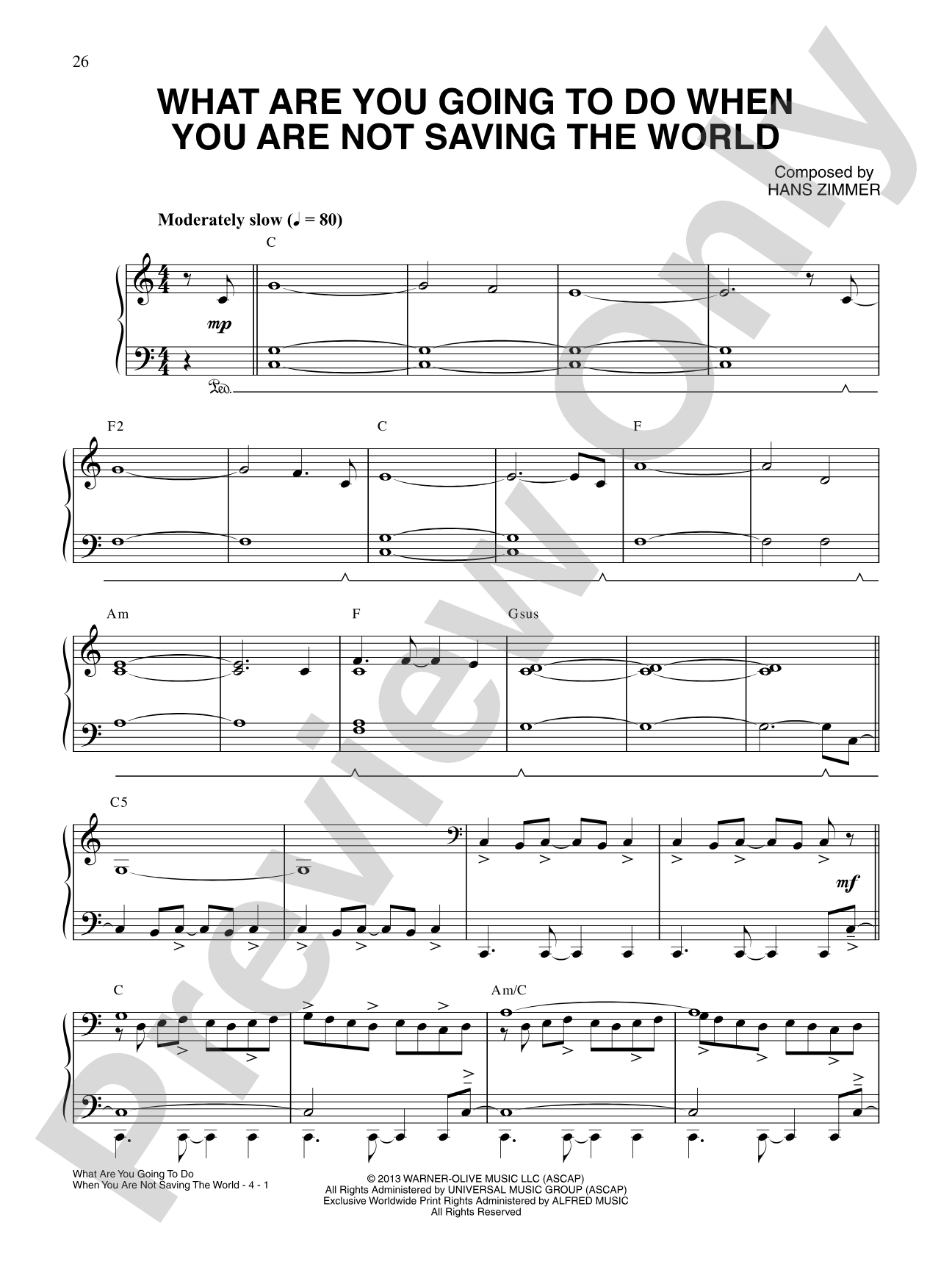

What Are You Going to Do When You Are Not Saving the World? (from Man of Steel): Piano
Sheet Music Selections from the Original Motion Picture Soundtrack
Music by Hans Zimmer
Item: 00-PS-0014421
$4.99
Pickup currently not available
Related Items
Look to the Stars (from Man of Steel): Piano |
$4.99
|
View | |
Goodbye My Son (from Man of Steel): Piano |
$4.99
|
View | |
If You Love These People (from Man of Steel): Piano |
$4.99
|
View | |
Krypton's Last (from Man of Steel): Piano |
$4.99
|
View | |
This Is Clark Kent (from Man of Steel): Piano |
$4.99
|
View | |
Flight (from Man of Steel): Piano |
$4.99
|
View | |
Man of Steel: Piano Book |
$14.99
|
View |
Description
For pianists who love epic film scores, this collection contains arrangements of seven standout themes from Hans Zimmer's soundtrack to the smash-hit motion picture. Titles: Look to the Stars * If You Love These People * Krypton's Last * Goodbye My Son * This Is Clark Kent * Flight * What Are You Going to Do When You Are Not Saving the World?


What Are You Going to Do When You Are Not Saving the World? (from Man of Steel): Piano isn't in MakeMusic Cloud just yet...but it could be. Let us know you'd like to see it, and you'll help shape what comes next. In the meantime, start a free trial and dive into thousands of interactive titles your students can play along with today.
Request This Title
Tell us you want it.
Start Your Free Trial
Explore everything that's ready to play right now.
Sample Audio
No sample audio found.
Sample Video
No sample videos found.
Additional Details
Publisher:
Alfred Music
Page Count:
32
SKU:
00-PS-0014421
More about this title
About the Composer: Hans Zimmer
Hans Zimmer stands among the most prolific and influential film composers of our time, with a career spanning over four decades and more than 150 film scores. His work across genres—from intimate character dramas to massive blockbusters—demonstrates a gift for translating visual storytelling into memorable, emotionally resonant music. Zimmer's approach to composition blends orchestral tradition with electronic texture, creating soundscapes that feel both contemporary and timeless.
For music educators, Zimmer's scores offer rich material for students to study orchestration, thematic development, and the relationship between music and narrative. His themes are singable and recognizable, yet harmonically sophisticated enough to reward deeper analysis. Many of his works have become teaching tools in schools worldwide, introducing young musicians to film scoring as a legitimate and demanding compositional discipline.
Why we love this
These arrangements capture the architectural grandeur of Zimmer's orchestral writing while making it accessible to intermediate and advanced pianists. The collection balances technical challenge with melodic payoff; you'll find sweeping thematic passages that reward careful voicing alongside rhythmic and textural variety that keeps both player and listener engaged. Programming film music alongside classical repertoire signals to audiences that great composition transcends medium.
What to expect
These arrangements transport you into the emotional world of a superhero origin story: moments of quiet introspection and loss sit alongside soaring heroic themes and propulsive action sequences. The music sweeps between intimate character moments and grand, almost unbearable beauty, giving pianists the chance to inhabit radically different emotional territories within a single session.
Who it's for
Intermediate to advanced pianists drawn to contemporary film music and looking to expand their performance repertoire beyond classical standards. This collection appeals equally to students preparing recital programs that showcase range and personality, and to teachers seeking engaging material that motivates practice through familiarity and sheer musical excitement.
How to get the most out of it
- Honor the orchestral roots of these themes by thinking in terms of orchestral color. Where you see thicker chords or octaves, imagine strings or brass; where the texture thins, think of a solo instrument stepping into the light.
- Manage the dynamic range with intention. Zimmer's themes often build from intimate moments to overwhelming crescendos. Use pedal sparingly in quieter passages to maintain clarity, then allow fuller resonance as the stakes rise.
- Pay close attention to tempo markings and any rubato indicated in the score. Film music often moves with the pacing of a scene; rushing through transitions or holding back on climactic moments will flatten the arc.
- Approach the rhythmic drive in pieces like "Flight" and "What Are You Going to Do When You Are Not Saving the World?" with steady pulse and confidence. These themes gain their power from forward momentum, not hesitation.
How to use it
Feature one or two of these themes in a recital alongside classical or contemporary concert music to create programming contrast and draw broader audiences into your concert hall. Alternatively, use the collection as a full standalone recital focused on film music, pairing Zimmer with other major composers who write for screen.
Skills your students will build
- Voice leading across wide hand spans and registral shifts
- Pedal control and timing in sustained harmonic textures
- Thematic development and motivic recognition across multiple arrangements
- Tempo flexibility and rubato within a driving pulse
- Dynamic control across a wide range, from intimate to climactic
- Reading and interpreting composer intent from film music notation