
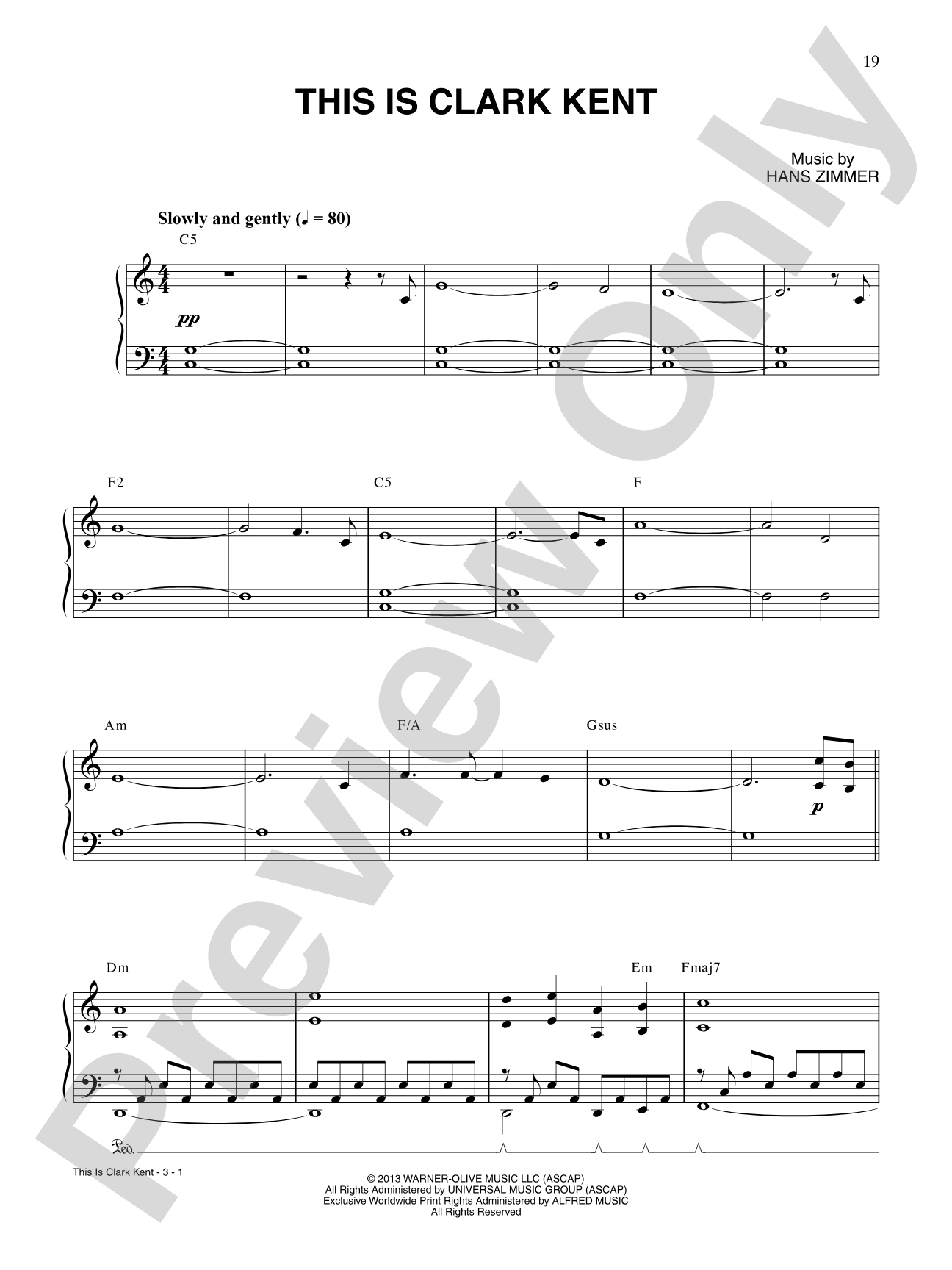

This Is Clark Kent (from Man of Steel): Piano
Sheet Music Selections from the Original Motion Picture Soundtrack
Music by Hans Zimmer
Item: 00-PS-0014419
$4.99
Pickup currently not available
Related Items
Look to the Stars (from Man of Steel): Piano |
$4.99
|
View | |
Goodbye My Son (from Man of Steel): Piano |
$4.99
|
View | |
If You Love These People (from Man of Steel): Piano |
$4.99
|
View | |
Krypton's Last (from Man of Steel): Piano |
$4.99
|
View | |
Flight (from Man of Steel): Piano |
$4.99
|
View | |
What Are You Going to Do When You Are Not Saving the World? (from Man of Steel): Piano |
$4.99
|
View | |
Man of Steel: Piano Book |
$14.99
|
View |
Description
For pianists who love epic film scores, this collection contains arrangements of seven standout themes from Hans Zimmer's soundtrack to the smash-hit motion picture. Titles: Look to the Stars * If You Love These People * Krypton's Last * Goodbye My Son * This Is Clark Kent * Flight * What Are You Going to Do When You Are Not Saving the World?


This Is Clark Kent (from Man of Steel): Piano isn't in MakeMusic Cloud just yet...but it could be. Let us know you'd like to see it, and you'll help shape what comes next. In the meantime, start a free trial and dive into thousands of interactive titles your students can play along with today.
Request This Title
Tell us you want it.
Start Your Free Trial
Explore everything that's ready to play right now.
Sample Audio
No sample audio found.
Sample Video
No sample videos found.
Additional Details
Publisher:
Alfred Music
Page Count:
32
SKU:
00-PS-0014419
More about this title
About the Composer: Hans Zimmer
Hans Zimmer stands among contemporary film music's most influential voices, with a career spanning over four decades and a compositional approach that redefined how orchestral writing functions in cinema. His work across genres—from intimate character studies to massive superhero franchises—demonstrates mastery of thematic development, harmonic sophistication, and the orchestration of emotional depth at blockbuster scale.
For music educators, Zimmer's film scores offer rich pedagogical material. His themes reward detailed analysis of how melody, harmony, and texture work together to convey narrative. Piano arrangements of his work give students access to sophisticated compositional techniques, film music literacy, and the satisfying experience of playing music they recognize and care about.
Why we love this
These seven arrangements capture some of Zimmer's most memorable superhero themes in a format that lets pianists experience how film composers build emotional arcs through orchestral writing. The collection moves from reflective pieces like "This Is Clark Kent" to soaring, kinetic ones like "Flight," giving students variety in tone and technical demand across 32 pages.
What to expect
These arrangements pulse with the same sense of grandeur, introspection, and forward momentum that made the original film score resonate with audiences. Whether moving through the devastated beauty of "Krypton's Last" or the exhilarating rush of "Flight," the piano captures Zimmer's gift for making emotion feel both epic and intimate.
Who it's for
Pianists who want to build sight-reading skills on music they love will find these arrangements engaging and musically substantial. Intermediate to advanced students gain experience with film score idioms, harmonic language beyond classical forms, and the particular demands of arranging orchestral music for solo keyboard.
How to get the most out of it
- Pay attention to the harmonic shifts that underscore emotional turning points; Zimmer's themes often rest on subtle modulations that feel inevitable once you've heard them, so let those shifts breathe naturally rather than rushing through them.
- Layer the dynamic changes deliberately. Film scores rely on crescendos and diminuendos to mirror onscreen action and character development; treat dynamic markings as narrative directions, not just volume adjustments.
- Balance melodic clarity with accompaniment texture. These arrangements often assign the main theme to one hand while the other creates harmonic momentum; resist the urge to let the accompaniment overtake the tune, even when it sounds impressive.
- Use the digital format's freedom to loop and practice sections repeatedly. Film music often rewards obsessive attention to small details; isolate passages that feel awkward and work them until they feel inevitable.
How to use it
Solo recitals benefit enormously from including a film score arrangement or two; audiences connect immediately to familiar melodies, and pianists get to shine on music that showcases both technical skill and emotional maturity. These pieces also work well in a unit on contemporary film music, where students can compare how different arrangers approach the same themes or analyze what makes a theme memorable across formats.
Skills your students will build
- Reading and executing dynamic range across multiple octaves
- Maintaining harmonic momentum in accompanimental patterns while keeping melody distinct
- Interpreting modern compositional idioms (quartal harmony, layered ostinatos, modal thinking) in performance
- Balancing emotional expression with technical clarity in film music contexts