
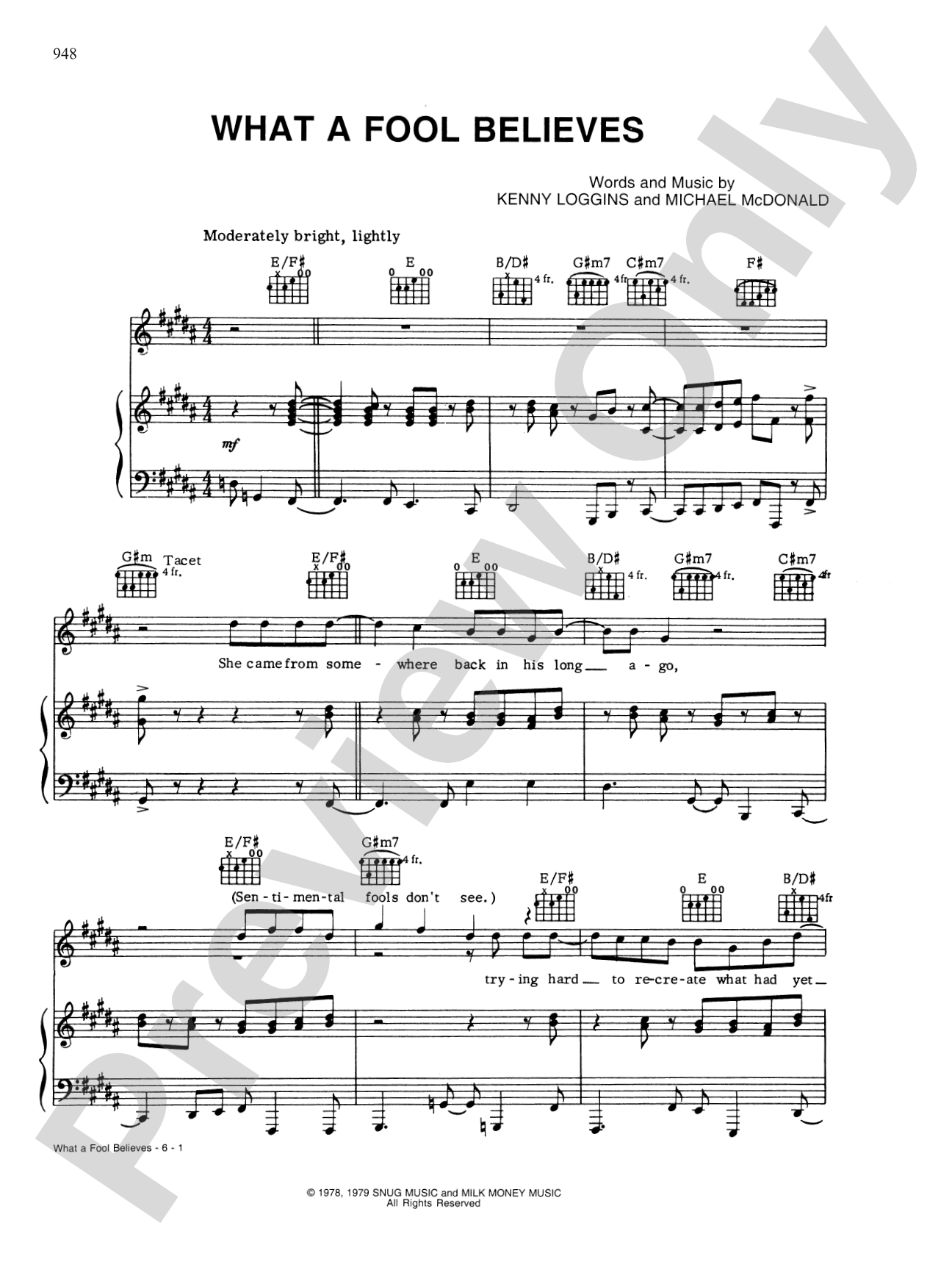
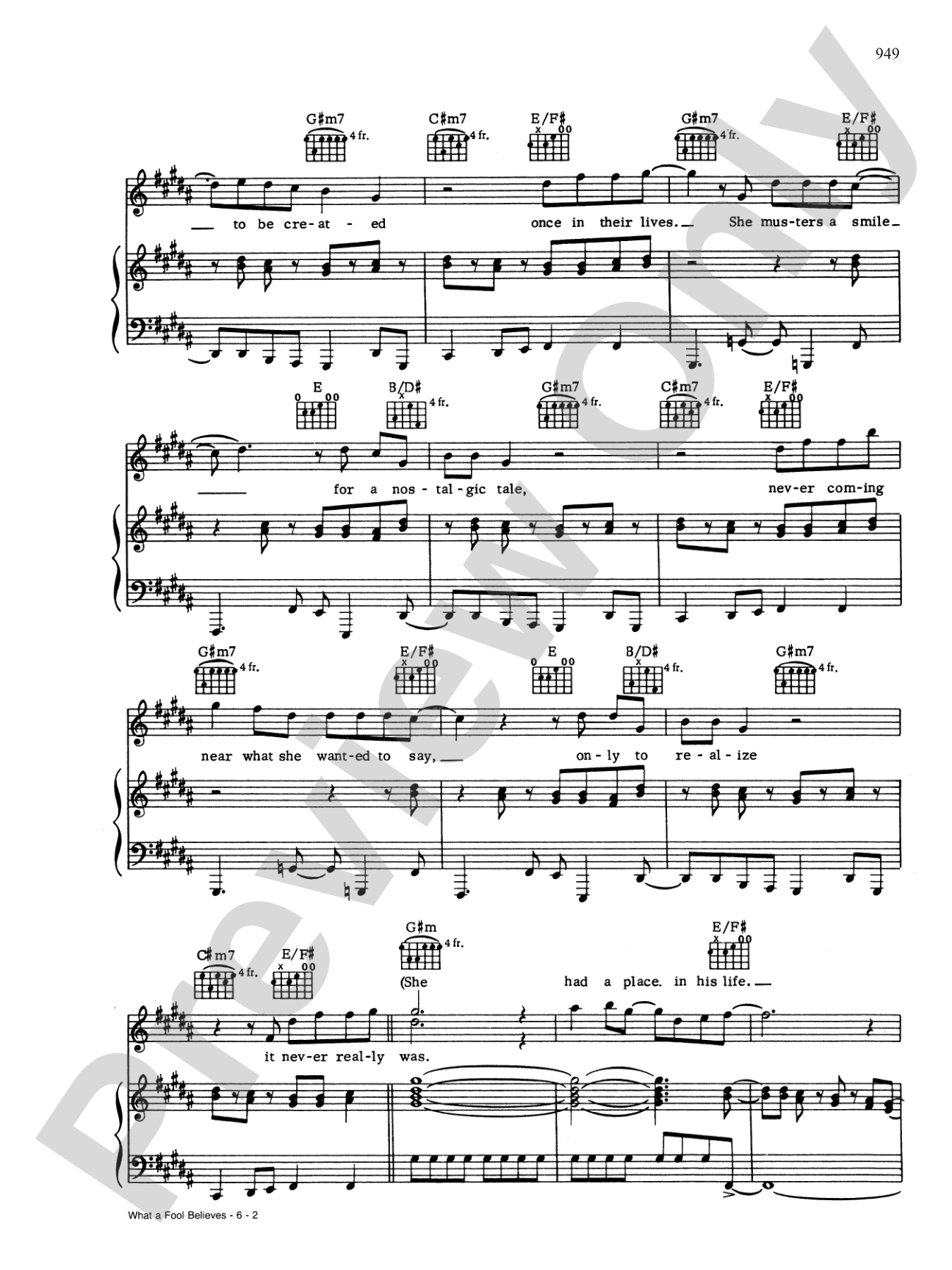

What a Fool Believes: Piano/Vocal/Chords
Item: 00-PSP-000626
$5.99
One moment…
Related Items
She Bangs: Piano/Vocal/Chords |
$5.99
|
View | |
And We Danced: Piano/Vocal/Chords |
$5.99
|
View | |
And You and I: Piano/Vocal/Chords |
$4.99
|
View | |
Another Brick in the Wall, Part II: Piano/Vocal/Chords |
$4.99
|
View | |
Believe: Piano/Vocal/Chords |
$4.99
|
View | |
Best Friend: Piano/Vocal/Chords |
$5.99
|
View | |
Conga: Piano/Vocal/Chords |
$4.99
|
View | |
Could It Be I'm Falling in Love?: Piano/Vocal/Chords |
$4.99
|
View | |
Da Ya Think I'm Sexy?: Piano/Vocal/Chords |
$4.99
|
View | |
Dirty Laundry: Piano/Vocal/Chords |
$5.99
|
View | |
Don't Let Me Be Misunderstood: Piano/Vocal/Chords |
$4.99
|
View | |
Express Yourself: Piano/Vocal/Chords |
$5.99
|
View | |
Hallelujah I Love Her So: Piano/Vocal/Chords |
$4.99
|
View | |
Heat of the Moment: Piano/Vocal/Chords |
$5.99
|
View | |
I Can't Drive 55: Piano/Vocal/Chords |
$4.99
|
View | |
I Dig Rock and Roll Music: Piano/Vocal/Chords |
$4.99
|
View | |
I Got a Woman: Piano/Vocal/Chords |
$4.99
|
View | |
If You Could Read My Mind: Piano/Vocal/Chords |
$4.99
|
View | |
Rhinestone Cowboy: Piano/Vocal/Chords |
$4.99
|
View | |
Take Me Home Country Roads: Piano/Vocal/Chords |
$4.99
|
View | |
Your Smiling Face: Piano/Vocal/Chords |
$4.99
|
View | |
Sealed with a Kiss: Piano/Vocal/Chords |
$4.99
|
View | |
Rhythm Is Gonna Get You: Piano/Vocal/Chords |
$4.99
|
View | |
One: Piano/Vocal/Chords |
$5.99
|
View | |
San Franciscan Nights: Piano/Vocal/Chords |
$4.99
|
View | |
I'll Be Around (Whenever You Want Me): Piano/Vocal/Chords |
$4.99
|
View | |
Love Train: Piano/Vocal/Chords |
$4.99
|
View | |
Upside Down ('Round-N-'Round): Piano/Vocal/Chords |
$4.99
|
View | |
You Should Be Dancing: Piano/Vocal/Chords |
$4.99
|
View | |
I Got You Babe: Piano/Vocal/Chords |
$4.99
|
View | |
Killing Me Softly with His Song: Piano/Vocal/Chords |
$4.99
|
View | |
Somebody's Baby: Piano/Vocal/Chords |
$5.99
|
View | |
Looks That Kill: Piano/Vocal/Chords |
$4.99
|
View | |
Into the Groove: Piano/Vocal/Chords |
$5.99
|
View | |
You Belong to the City: Piano/Vocal/Chords |
$4.99
|
View | |
Nothing's Gonna Stop Us Now: Piano/Vocal/Chords |
$4.99
|
View | |
What's Love Got to Do with It: Piano/Vocal/Chords |
$5.99
|
View | |
Like a Prayer: Piano/Vocal/Chords |
$5.99
|
View | |
Jungle Boogie: Piano/Vocal/Chords |
$4.99
|
View | |
When I See You Smile: Piano/Vocal/Chords |
$5.99
|
View | |
Vogue: Piano/Vocal/Chords |
$5.99
|
View | |
If You Asked Me To: Piano/Vocal/Chords |
$4.99
|
View | |
Take a Bow: Piano/Vocal/Chords |
$4.99
|
View | |
If It Makes You Happy: Piano/Vocal/Chords |
$4.99
|
View | |
Sunshine of Your Love: Piano/Vocal/Chords |
$4.99
|
View | |
Irresistible: Piano/Vocal/Chords |
$5.99
|
View | |
Lady: Piano/Vocal/Chords |
$4.99
|
View | |
White Flag: Piano/Vocal/Chords |
$4.99
|
View | |
The Reason: Piano/Vocal/Chords |
$4.99
|
View | |
Untitled (How Could This Happen to Me?): Piano/Vocal/Chords |
$5.99
|
View |
Description
Over 200 of your favorite pop/rock songs, all in one book! The Ultimate Song Pages: Piano Volume 1 provides the lyrics along with piano and chord arrangements for some of the greatest pop and rock hits ever written.
Artists featured: 50 Cent * ABBA * Aerosmith * Avril Lavigne * the Beatles * the Bee Gees * Bruce Hornsby * Bruce Springsteen * Celine Dion * Cher * Chicago * Coldplay * Cream * Diana Ross * Dixie Chicks * Elvis Presley * Eric Clapton * Grateful Dead * Green Day * Hall & Oates * Jerry Lee Lewis * Jim Brickman * Jimmy Buffett * Joni Mitchell * Kelly Clarkson * Kenny Loggins * Madonna * Mariah Carey * Michael Jackson * Motley Crue * Neil Young * Nickelback * Pink Floyd * R.E.M. * Ray Charles * Rod Stewart * Santana * Sheryl Crow * Steppenwolf * The Cars * The Doobie Brothers * The Who * The Eagles * The Rolling Stones * Tina Turner * Van Halen * Van Morrison * Wham! * Whitney Houston, and many more!


Artists featured: 50 Cent * ABBA * Aerosmith * Avril Lavigne * the Beatles * the Bee Gees * Bruce Hornsby * Bruce Springsteen * Celine Dion * Cher * Chicago * Coldplay * Cream * Diana Ross * Dixie Chicks * Elvis Presley * Eric Clapton * Grateful Dead * Green Day * Hall & Oates * Jerry Lee Lewis * Jim Brickman * Jimmy Buffett * Joni Mitchell * Kelly Clarkson * Kenny Loggins * Madonna * Mariah Carey * Michael Jackson * Motley Crue * Neil Young * Nickelback * Pink Floyd * R.E.M. * Ray Charles * Rod Stewart * Santana * Sheryl Crow * Steppenwolf * The Cars * The Doobie Brothers * The Who * The Eagles * The Rolling Stones * Tina Turner * Van Halen * Van Morrison * Wham! * Whitney Houston, and many more!
What a Fool Believes: Piano/Vocal/Chords isn't in MakeMusic Cloud just yet...but it could be. Let us know you'd like to see it, and you'll help shape what comes next. In the meantime, start a free trial and dive into thousands of interactive titles your students can play along with today.
Request This Title
Tell us you want it.
Start Your Free Trial
Explore everything that's ready to play right now.
Sample Audio
No sample audio found.
Sample Video
No sample videos found.
Additional Details
Series:
The Ultimate Song Pages
Publisher:
Alfred Music
Page Count:
999
SKU:
00-PSP-000626
More about this title
About the Composer: Kenny Loggins
Kenny Loggins built his career on crafting songs that became the soundtrack to American life. As a member of the Loggins and Messina partnership and later as a solo artist, he established himself as a bridge between rock authenticity and mainstream pop sensibility, with particular skill in writing songs that worked equally well on radio and in intimate settings. His compositions have earned Grammy recognition and remain staples of American popular music, covering everything from introspective ballads to energetic rock numbers.
Loggins' approach to songwriting emphasizes clarity and emotional directness. Whether writing for his own recordings or collaborating with other artists, he prioritizes melodies that stick in listeners' minds and lyrics that connect to shared human experiences. This combination of accessibility and craft has made his work enduring material for musicians across skill levels.
Why we love this
This collection captures the actual sheet music students and teachers need for real rehearsals and performances. "What a Fool Believes" sits alongside over 200 other iconic arrangements in a single resource, making it practical for pianists preparing accompaniments, vocalists building recital programs, or ensemble directors who need instantly accessible pop/rock charts. The combination of melody line, lyrics, and chord symbols means pianists can support singers without needing separate materials.
What to expect
"What a Fool Believes" carries the polished sophistication of 1970s soul-pop, with lush harmonic movement and a vocal melody that sits naturally in the middle register. The song balances an understated, almost conversational opening with moments of genuine emotional weight, creating the feeling of a intimate conversation that occasionally swells with warmth.
Who it's for
This book serves pianists accompanying singers in recitals, rehearsals, or performances; vocalists preparing audition or recital material with chord guidance; and musicians looking for authentic arrangements of songs they actually want to play. It's equally useful for private studio teachers building lesson repertoire and for ensemble directors needing quick-reference charts.
How to get the most out of it
- Balance vocal clarity with harmonic support; the piano fills space without overwhelming the singer, so voicings should open up around the vocal phrases.
- Lock into the groove early. The 1970s soul-rock feel of this track depends on steady, committed comping in the left hand rather than ornamental fills.
- Reference a recorded version before your first read-through. Knowing the original arrangement helps you anticipate dynamic shapes and rhythmic pocket.
How to use it
Pair this with other Doobie Brothers or Loggins-era material in a 70s pop/rock recital program. It works as a transition piece between more classical material and contemporary songs, or as a closer in a mixed-repertoire vocal recital where authenticity and memorability matter as much as technical display.
Skills your students will build
- Reading chord symbols and building coherent harmonic accompaniments
- Balancing vocal support with rhythmic comping
- Understanding groove-based playing in popular music contexts
- Coordinating melody, lyric placement, and harmonic movement on the page