
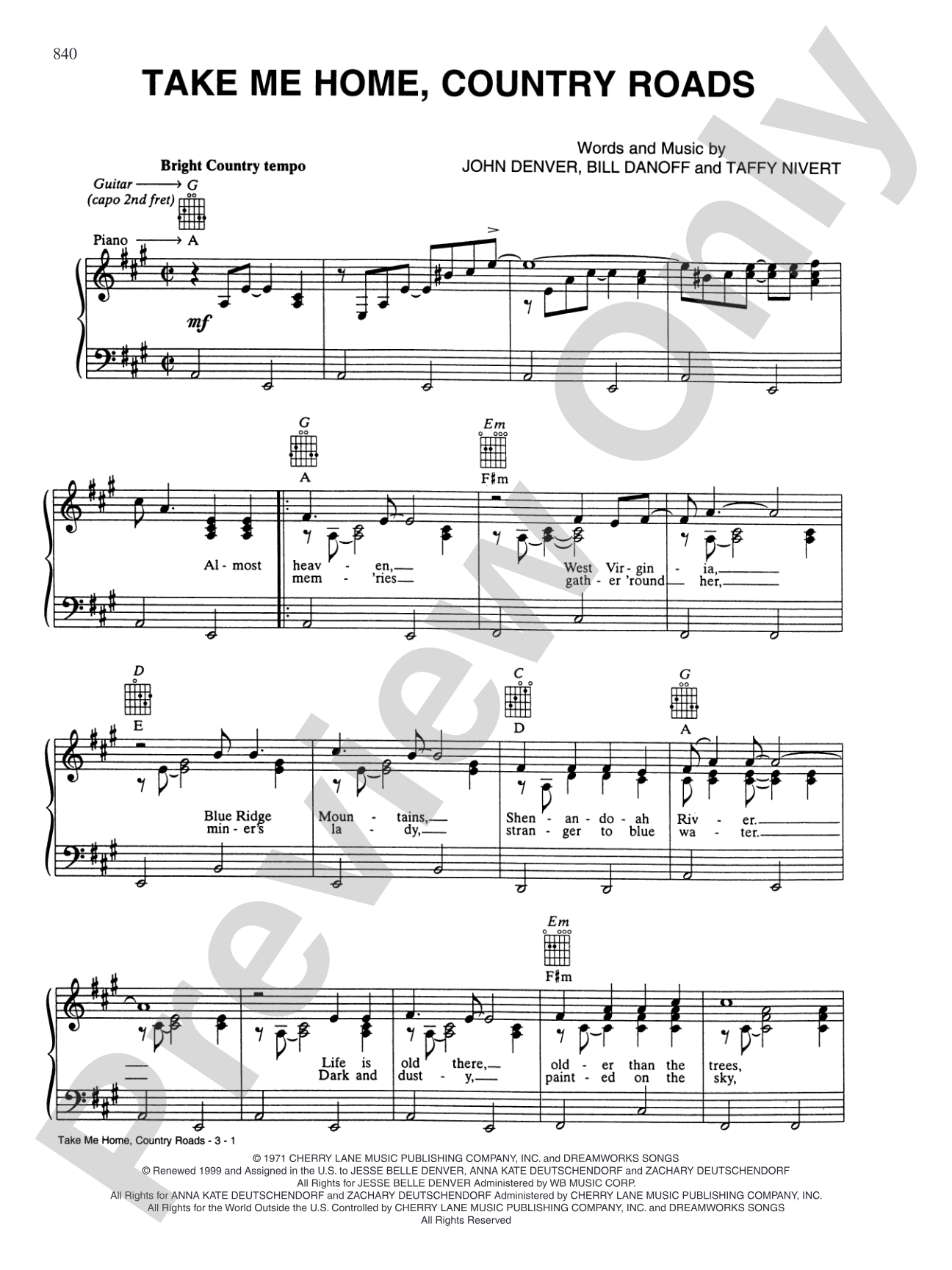

Take Me Home Country Roads: Piano/Vocal/Chords
Item: 00-PSP-000546
$4.99
Pickup currently not available
Related Items
She Bangs: Piano/Vocal/Chords |
$5.99
|
View | |
And We Danced: Piano/Vocal/Chords |
$5.99
|
View | |
And You and I: Piano/Vocal/Chords |
$4.99
|
View | |
Another Brick in the Wall, Part II: Piano/Vocal/Chords |
$4.99
|
View | |
Believe: Piano/Vocal/Chords |
$4.99
|
View | |
Best Friend: Piano/Vocal/Chords |
$5.99
|
View | |
Conga: Piano/Vocal/Chords |
$4.99
|
View | |
Could It Be I'm Falling in Love?: Piano/Vocal/Chords |
$4.99
|
View | |
Da Ya Think I'm Sexy?: Piano/Vocal/Chords |
$4.99
|
View | |
Dirty Laundry: Piano/Vocal/Chords |
$5.99
|
View | |
Don't Let Me Be Misunderstood: Piano/Vocal/Chords |
$4.99
|
View | |
Express Yourself: Piano/Vocal/Chords |
$5.99
|
View | |
Hallelujah I Love Her So: Piano/Vocal/Chords |
$4.99
|
View | |
Heat of the Moment: Piano/Vocal/Chords |
$5.99
|
View | |
I Can't Drive 55: Piano/Vocal/Chords |
$4.99
|
View | |
I Dig Rock and Roll Music: Piano/Vocal/Chords |
$4.99
|
View | |
I Got a Woman: Piano/Vocal/Chords |
$4.99
|
View | |
If You Could Read My Mind: Piano/Vocal/Chords |
$4.99
|
View | |
Rhinestone Cowboy: Piano/Vocal/Chords |
$4.99
|
View | |
Your Smiling Face: Piano/Vocal/Chords |
$4.99
|
View | |
Sealed with a Kiss: Piano/Vocal/Chords |
$4.99
|
View | |
Rhythm Is Gonna Get You: Piano/Vocal/Chords |
$4.99
|
View | |
One: Piano/Vocal/Chords |
$5.99
|
View | |
San Franciscan Nights: Piano/Vocal/Chords |
$4.99
|
View | |
I'll Be Around (Whenever You Want Me): Piano/Vocal/Chords |
$4.99
|
View | |
Love Train: Piano/Vocal/Chords |
$4.99
|
View | |
Upside Down ('Round-N-'Round): Piano/Vocal/Chords |
$4.99
|
View | |
You Should Be Dancing: Piano/Vocal/Chords |
$4.99
|
View | |
What a Fool Believes: Piano/Vocal/Chords |
$5.99
|
View | |
I Got You Babe: Piano/Vocal/Chords |
$4.99
|
View | |
Killing Me Softly with His Song: Piano/Vocal/Chords |
$4.99
|
View | |
Somebody's Baby: Piano/Vocal/Chords |
$5.99
|
View | |
Looks That Kill: Piano/Vocal/Chords |
$4.99
|
View | |
Into the Groove: Piano/Vocal/Chords |
$5.99
|
View | |
You Belong to the City: Piano/Vocal/Chords |
$4.99
|
View | |
Nothing's Gonna Stop Us Now: Piano/Vocal/Chords |
$4.99
|
View | |
What's Love Got to Do with It: Piano/Vocal/Chords |
$5.99
|
View | |
Like a Prayer: Piano/Vocal/Chords |
$5.99
|
View | |
Jungle Boogie: Piano/Vocal/Chords |
$4.99
|
View | |
When I See You Smile: Piano/Vocal/Chords |
$5.99
|
View | |
Vogue: Piano/Vocal/Chords |
$5.99
|
View | |
If You Asked Me To: Piano/Vocal/Chords |
$4.99
|
View | |
Take a Bow: Piano/Vocal/Chords |
$4.99
|
View | |
If It Makes You Happy: Piano/Vocal/Chords |
$4.99
|
View | |
Sunshine of Your Love: Piano/Vocal/Chords |
$4.99
|
View | |
Irresistible: Piano/Vocal/Chords |
$5.99
|
View | |
Lady: Piano/Vocal/Chords |
$4.99
|
View | |
White Flag: Piano/Vocal/Chords |
$4.99
|
View | |
The Reason: Piano/Vocal/Chords |
$4.99
|
View | |
Untitled (How Could This Happen to Me?): Piano/Vocal/Chords |
$5.99
|
View |
Description
Over 200 of your favorite pop/rock songs, all in one book! The Ultimate Song Pages: Piano Volume 1 provides the lyrics along with piano and chord arrangements for some of the greatest pop and rock hits ever written.
Artists featured: 50 Cent * ABBA * Aerosmith * Avril Lavigne * the Beatles * the Bee Gees * Bruce Hornsby * Bruce Springsteen * Celine Dion * Cher * Chicago * Coldplay * Cream * Diana Ross * Dixie Chicks * Elvis Presley * Eric Clapton * Grateful Dead * Green Day * Hall & Oates * Jerry Lee Lewis * Jim Brickman * Jimmy Buffett * Joni Mitchell * Kelly Clarkson * Kenny Loggins * Madonna * Mariah Carey * Michael Jackson * Motley Crue * Neil Young * Nickelback * Pink Floyd * R.E.M. * Ray Charles * Rod Stewart * Santana * Sheryl Crow * Steppenwolf * The Cars * The Doobie Brothers * The Who * The Eagles * The Rolling Stones * Tina Turner * Van Halen * Van Morrison * Wham! * Whitney Houston, and many more!


Artists featured: 50 Cent * ABBA * Aerosmith * Avril Lavigne * the Beatles * the Bee Gees * Bruce Hornsby * Bruce Springsteen * Celine Dion * Cher * Chicago * Coldplay * Cream * Diana Ross * Dixie Chicks * Elvis Presley * Eric Clapton * Grateful Dead * Green Day * Hall & Oates * Jerry Lee Lewis * Jim Brickman * Jimmy Buffett * Joni Mitchell * Kelly Clarkson * Kenny Loggins * Madonna * Mariah Carey * Michael Jackson * Motley Crue * Neil Young * Nickelback * Pink Floyd * R.E.M. * Ray Charles * Rod Stewart * Santana * Sheryl Crow * Steppenwolf * The Cars * The Doobie Brothers * The Who * The Eagles * The Rolling Stones * Tina Turner * Van Halen * Van Morrison * Wham! * Whitney Houston, and many more!
Take Me Home Country Roads: Piano/Vocal/Chords isn't in MakeMusic Cloud just yet...but it could be. Let us know you'd like to see it, and you'll help shape what comes next. In the meantime, start a free trial and dive into thousands of interactive titles your students can play along with today.
Request This Title
Tell us you want it.
Start Your Free Trial
Explore everything that's ready to play right now.
Sample Audio
No sample audio found.
Sample Video
No sample videos found.
Additional Details
Series:
The Ultimate Song Pages
Publisher:
Alfred Music
Page Count:
999
SKU:
00-PSP-000546
More about this title
About the Artist: John Denver
John Denver (1943–1997) built a career on authentic storytelling and acoustic accessibility, becoming one of the most commercially successful singer-songwriters of the 1970s. His gift for melody and his ability to make complex emotions feel immediate and personal made his songs instantly singable and endlessly coverable—which is precisely why so many of his recordings appear throughout this collection alongside the work of countless artists who learned from his approach to songwriting.
Why we love this
This collection transforms the intimidating task of teaching song accompaniment into something genuinely playable. With over 200 arrangements spanning decades of pop and rock, you'll find material that meets singers where they are—whether that's a student who wants to accompany a school performance or an adult returning to piano after years away. The chord symbols paired with accessible piano voicings mean your students can learn the mechanics of song accompaniment without getting stuck on overly complicated arrangements.
What to expect
Opening this collection feels like having a backstage pass to the last 50 years of popular music. You move between eras and aesthetics fluidly, discovering the shared DNA between a Beatles arrangement and a contemporary pop hit, noticing how certain progressions resurface again and again. There's a democratic quality to seeing these songs side by side—Aretha Franklin next to ABBA next to Green Day—that reminds you how songwriting craft transcends genre.
Who it's for
This book serves pianists who want a practical library of contemporary and classic songs ready to perform or teach. It's equally valuable for private studio teachers building a repertoire of accompaniments, singers seeking piano-based resources for recitals or casual performances, and intermediate pianists who want to develop fluency with common chord progressions and song forms without getting bogged down in classical technique books.
How to get the most out of it
- Start by learning the chord progression first, then layer in the melody line once your left hand feels secure. Separating these tasks makes the whole piece absorb faster.
- Use the chord symbols as permission to reshape the accompaniment to match your hands. The written voicings are suggestions, not commands; simpler left-hand patterns often feel more musical than what's printed.
- When accompanying a vocalist, keep your tempo steady even if the vocal line pulls around it. Your consistent pulse in the left hand becomes the musical foundation.
- Experiment with the dynamics of the accompaniment independent of the vocal line. Sometimes pulling back the piano texture on a vulnerable verse deepens the impact of the lyric.
How to use it
Use this resource to build a rotation of pieces for student recitals, giving performers agency in choosing songs that genuinely excite them. It also works beautifully as a sight-reading source during ensemble warm-ups or as the foundation for student-led coffee house performances where singers bring their own accompanists. For community programs or adult learning classes, this becomes an immediate confidence builder since recognizing songs removes half the cognitive load of learning a new piece.
Skills your students will build
- Reading and interpreting chord symbols in real time
- Playing from lead sheets and incomplete notation
- Coordinating melody and accompaniment independently
- Recognizing common chord progressions across genres
- Adapting written arrangements to suit their own hands and musical choices