
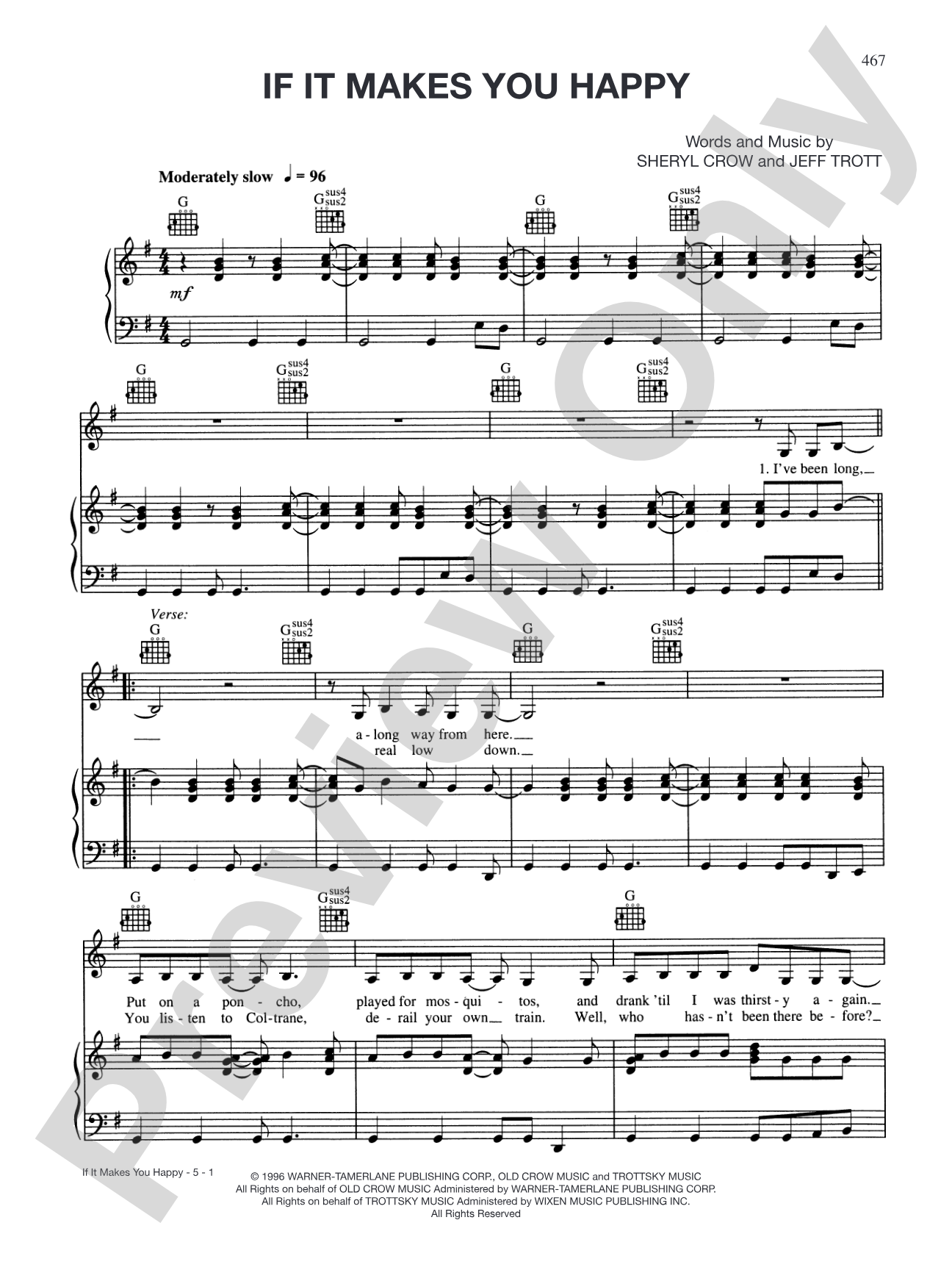

If It Makes You Happy: Piano/Vocal/Chords
Item: 00-PSP-000680
$4.99
Pickup currently not available
Related Items
She Bangs: Piano/Vocal/Chords |
$5.99
|
View | |
And We Danced: Piano/Vocal/Chords |
$5.99
|
View | |
And You and I: Piano/Vocal/Chords |
$4.99
|
View | |
Another Brick in the Wall, Part II: Piano/Vocal/Chords |
$4.99
|
View | |
Believe: Piano/Vocal/Chords |
$4.99
|
View | |
Best Friend: Piano/Vocal/Chords |
$5.99
|
View | |
Conga: Piano/Vocal/Chords |
$4.99
|
View | |
Could It Be I'm Falling in Love?: Piano/Vocal/Chords |
$4.99
|
View | |
Da Ya Think I'm Sexy?: Piano/Vocal/Chords |
$4.99
|
View | |
Dirty Laundry: Piano/Vocal/Chords |
$5.99
|
View | |
Don't Let Me Be Misunderstood: Piano/Vocal/Chords |
$4.99
|
View | |
Express Yourself: Piano/Vocal/Chords |
$5.99
|
View | |
Hallelujah I Love Her So: Piano/Vocal/Chords |
$4.99
|
View | |
Heat of the Moment: Piano/Vocal/Chords |
$5.99
|
View | |
I Can't Drive 55: Piano/Vocal/Chords |
$4.99
|
View | |
I Dig Rock and Roll Music: Piano/Vocal/Chords |
$4.99
|
View | |
I Got a Woman: Piano/Vocal/Chords |
$4.99
|
View | |
If You Could Read My Mind: Piano/Vocal/Chords |
$4.99
|
View | |
Rhinestone Cowboy: Piano/Vocal/Chords |
$4.99
|
View | |
Take Me Home Country Roads: Piano/Vocal/Chords |
$4.99
|
View | |
Your Smiling Face: Piano/Vocal/Chords |
$4.99
|
View | |
Sealed with a Kiss: Piano/Vocal/Chords |
$4.99
|
View | |
Rhythm Is Gonna Get You: Piano/Vocal/Chords |
$4.99
|
View | |
One: Piano/Vocal/Chords |
$5.99
|
View | |
San Franciscan Nights: Piano/Vocal/Chords |
$4.99
|
View | |
I'll Be Around (Whenever You Want Me): Piano/Vocal/Chords |
$4.99
|
View | |
Love Train: Piano/Vocal/Chords |
$4.99
|
View | |
Upside Down ('Round-N-'Round): Piano/Vocal/Chords |
$4.99
|
View | |
You Should Be Dancing: Piano/Vocal/Chords |
$4.99
|
View | |
What a Fool Believes: Piano/Vocal/Chords |
$5.99
|
View | |
I Got You Babe: Piano/Vocal/Chords |
$4.99
|
View | |
Killing Me Softly with His Song: Piano/Vocal/Chords |
$4.99
|
View | |
Somebody's Baby: Piano/Vocal/Chords |
$5.99
|
View | |
Looks That Kill: Piano/Vocal/Chords |
$4.99
|
View | |
Into the Groove: Piano/Vocal/Chords |
$5.99
|
View | |
You Belong to the City: Piano/Vocal/Chords |
$4.99
|
View | |
Nothing's Gonna Stop Us Now: Piano/Vocal/Chords |
$4.99
|
View | |
What's Love Got to Do with It: Piano/Vocal/Chords |
$5.99
|
View | |
Like a Prayer: Piano/Vocal/Chords |
$5.99
|
View | |
Jungle Boogie: Piano/Vocal/Chords |
$4.99
|
View | |
When I See You Smile: Piano/Vocal/Chords |
$5.99
|
View | |
Vogue: Piano/Vocal/Chords |
$5.99
|
View | |
If You Asked Me To: Piano/Vocal/Chords |
$4.99
|
View | |
Take a Bow: Piano/Vocal/Chords |
$4.99
|
View | |
Sunshine of Your Love: Piano/Vocal/Chords |
$4.99
|
View | |
Irresistible: Piano/Vocal/Chords |
$5.99
|
View | |
Lady: Piano/Vocal/Chords |
$4.99
|
View | |
White Flag: Piano/Vocal/Chords |
$4.99
|
View | |
The Reason: Piano/Vocal/Chords |
$4.99
|
View | |
Untitled (How Could This Happen to Me?): Piano/Vocal/Chords |
$5.99
|
View |
Description
Over 200 of your favorite pop/rock songs, all in one book! The Ultimate Song Pages: Piano Volume 1 provides the lyrics along with piano and chord arrangements for some of the greatest pop and rock hits ever written.
Artists featured: 50 Cent * ABBA * Aerosmith * Avril Lavigne * the Beatles * the Bee Gees * Bruce Hornsby * Bruce Springsteen * Celine Dion * Cher * Chicago * Coldplay * Cream * Diana Ross * Dixie Chicks * Elvis Presley * Eric Clapton * Grateful Dead * Green Day * Hall & Oates * Jerry Lee Lewis * Jim Brickman * Jimmy Buffett * Joni Mitchell * Kelly Clarkson * Kenny Loggins * Madonna * Mariah Carey * Michael Jackson * Motley Crue * Neil Young * Nickelback * Pink Floyd * R.E.M. * Ray Charles * Rod Stewart * Santana * Sheryl Crow * Steppenwolf * The Cars * The Doobie Brothers * The Who * The Eagles * The Rolling Stones * Tina Turner * Van Halen * Van Morrison * Wham! * Whitney Houston, and many more!


Artists featured: 50 Cent * ABBA * Aerosmith * Avril Lavigne * the Beatles * the Bee Gees * Bruce Hornsby * Bruce Springsteen * Celine Dion * Cher * Chicago * Coldplay * Cream * Diana Ross * Dixie Chicks * Elvis Presley * Eric Clapton * Grateful Dead * Green Day * Hall & Oates * Jerry Lee Lewis * Jim Brickman * Jimmy Buffett * Joni Mitchell * Kelly Clarkson * Kenny Loggins * Madonna * Mariah Carey * Michael Jackson * Motley Crue * Neil Young * Nickelback * Pink Floyd * R.E.M. * Ray Charles * Rod Stewart * Santana * Sheryl Crow * Steppenwolf * The Cars * The Doobie Brothers * The Who * The Eagles * The Rolling Stones * Tina Turner * Van Halen * Van Morrison * Wham! * Whitney Houston, and many more!
If It Makes You Happy: Piano/Vocal/Chords isn't in MakeMusic Cloud just yet...but it could be. Let us know you'd like to see it, and you'll help shape what comes next. In the meantime, start a free trial and dive into thousands of interactive titles your students can play along with today.
Request This Title
Tell us you want it.
Start Your Free Trial
Explore everything that's ready to play right now.
Sample Audio
No sample audio found.
Sample Video
No sample videos found.
Additional Details
Series:
The Ultimate Song Pages
Publisher:
Alfred Music
Page Count:
999
SKU:
00-PSP-000680
More about this title
About the Composer: Sheryl Crow
Sheryl Crow is a Grammy Award-winning singer-songwriter who emerged from the pop-rock landscape of the 1990s with a distinctive voice and songwriting sensibility that blended rock confidence with accessible melodies. Her career spans multiple decades of chart success, live performance, and cultural influence across radio, television, and film.
Why we love this
This collection spans genuine hits across five decades of popular music, giving pianists and singers real songs they already know and want to play. The inclusion of 200-plus arrangements in a single volume means you have material for any mood, any skill level within your studio or ensemble, and any programming need without hunting across multiple books.
What to expect
Flipping through this book is like having a jukebox at your fingertips; you move seamlessly from the driving energy of classic rock to the lush production values of 1980s pop ballads to the stripped-down authenticity of folk-influenced songwriting. Each song carries its original melodic identity while the piano arrangements provide enough harmonic sophistication to hold your interest as a player.
Who it's for
Pianists preparing for recitals, studio teachers seeking contemporary repertoire that engages students, vocalists building a performance repertoire from songs already in popular culture, and anyone performing in casual or cocktail settings who needs reliable arrangements of recognizable material.
How to get the most out of it
- Work through the chord progressions first without the vocal line to lock the harmonic movement in your hands, then layer the melody on top.
- Pay attention to the specific voicings shown in the chord notation; many of these arrangements suggest contemporary jazz and pop voicing choices that won't sound right if simplified.
- Balance your volume between the vocal line and the accompaniment so the lyrics remain clear; these are songs people know the words to, and they want to hear them.
- Use the breadth of the collection to group songs by key or style within a set, which creates natural practice sequences and more satisfying performance flow.
How to use it
Use individual selections as recital closers or encores when you want audience recognition and connection; the familiarity of these songs creates immediate engagement. Build a mixed program by pairing arrangements from different eras and styles, letting the variety showcase your range as a performer or your studio's stylistic breadth.
Skills your students will build
- Reading chord symbols and translating them into jazz and pop voicings
- Balancing melody and accompaniment in vocal-piano contexts
- Interpreting stylistic markers and era-specific rhythmic feels from written notation
- Sight-reading across a wide range of keys and song structures
- Coordinating hand independence when managing both harmonic support and melodic doubling