
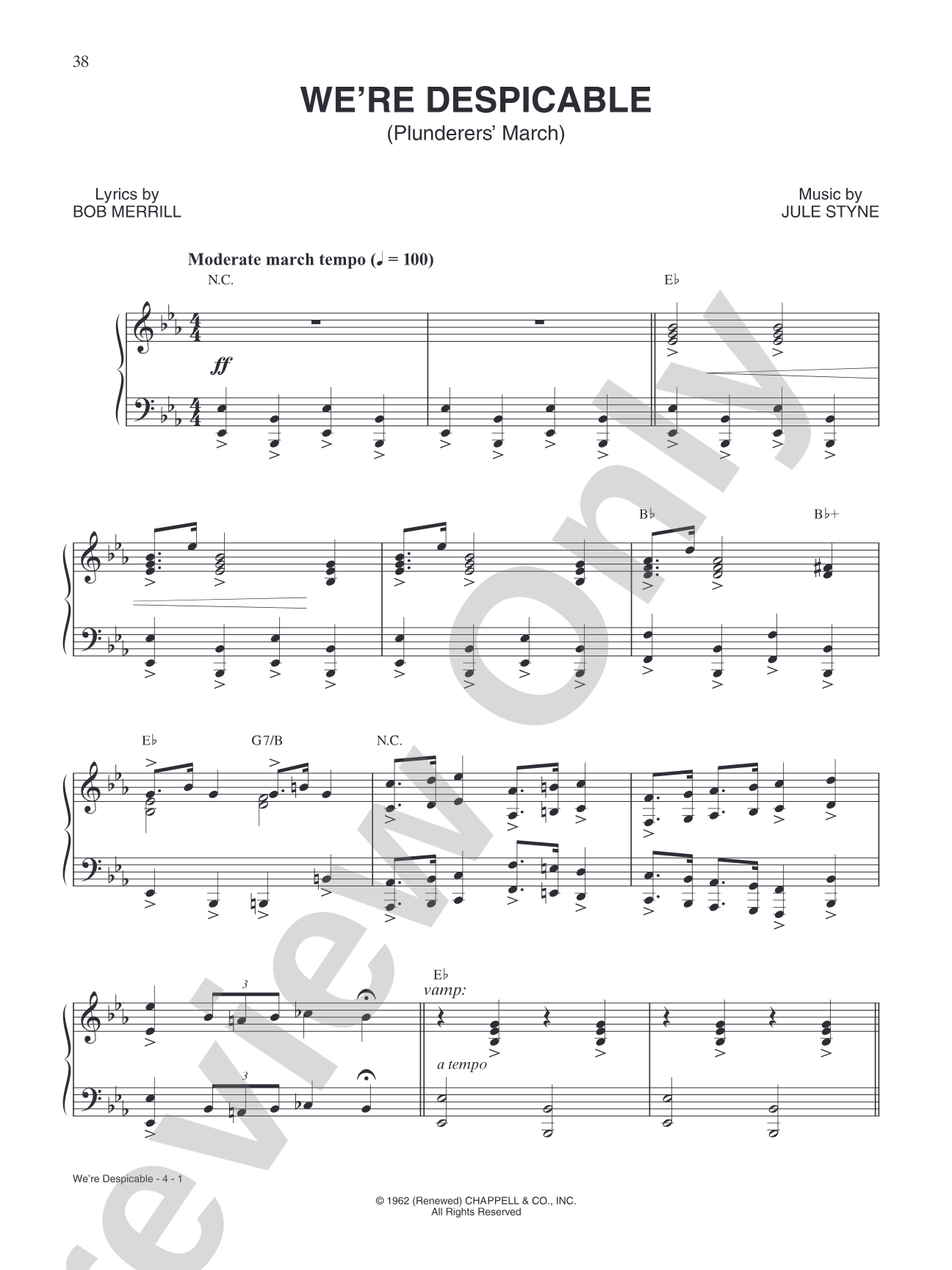

We're Despicable: Piano/Vocal/Chords
Sheet Music from the First Animated Christmas Special
Lyrics by Bob Merrill, music by Jule Styne
Item: 00-PS-0013431
$4.99
One moment…
Related Items
Ringle, Ringle: Piano/Vocal/Chords |
$4.99
|
View | |
Winter Was Warm: Piano/Vocal/Chords |
$4.99
|
View | |
The Lord's Bright Blessing (reprise): Piano/Vocal/Chords |
$4.99
|
View | |
The Lord's Bright Blessing: Piano/Vocal/Chords |
$5.99
|
View | |
Alone In The World: Piano/Vocal/Chords |
$4.99
|
View | |
It's Great To Be Back On Broadway: Piano/Vocal/Chords |
$9.99
|
View |
Description
Mr. Magoo's Christmas Carol debuted on the NBC television network on December 18, 1962, capturing the hearts of milllions with Broadway-caliber songs written by Bob Merrill and Jule Styne (Funny Girl) at the peak of their careers. Although this landmark production gradually became obscured by countless other televised Christmas specials that followed, its score remains noteworthy today for its timeless songs. Now, for the first time, this collectible songbook allows pianists and singers to explore the music and bring it to life anew. A fascinating historical foreword by animation expert Darrell Van Citters is included. Titles: * It's Great to Be Back on Broadway * Ringle, Ringle * The Lord's Bright Blessing * Alone in the World * Winter Was Warm * We're Despicable * The Lord's Bright Blessing (Reprise).


We're Despicable: Piano/Vocal/Chords isn't in MakeMusic Cloud just yet...but it could be. Let us know you'd like to see it, and you'll help shape what comes next. In the meantime, start a free trial and dive into thousands of interactive titles your students can play along with today.
Request This Title
Tell us you want it.
Start Your Free Trial
Explore everything that's ready to play right now.
Sample Audio
No sample audio found.
Sample Video
No sample videos found.
Additional Details
Publisher:
Alfred Music
Page Count:
44
SKU:
00-PS-0013431
More about this title
About the Composer: Jule Styne
Jule Styne (1905-1975) composed some of Broadway's most enduring melodies, with a gift for writing songs that lodge themselves in memory through sheer melodic invention. His collaborations with lyricist Bob Merrill produced classics including Funny Girl and Gentlemen Prefer Blondes, and his work across stage, film, and television demonstrated equal facility in each medium.
Styne's career peaked in the 1950s and 1960s when he brought his theatrical sensibility to television specials, creating scores that matched the ambitions of prime-time productions. Mr. Magoo's Christmas Carol represents Styne at his most generous, crafting songs that blend humor, pathos, and genuine melodic warmth without sacrificing sophistication.
Why we love this
The orchestrations and vocal writing reflect genuine theatrical craft rather than simplification for television; these are songs written for singers and pianists who can handle real musicality. The collection captures a specific moment in American entertainment when a Christmas special could anchor itself in substantive songwriting, making this repertoire both historically valuable and genuinely rewarding to perform.
What to expect
The score evokes the warmth and theatrical grandeur of 1960s television at its most ambitious, with melodies that feel both familiar and freshly composed. Whether tender or comedic, the songs carry genuine emotion without sentimentality, capturing moments of human connection amid a holiday narrative.
Who it's for
Pianists and singers preparing recital or concert repertoire, voice students exploring mid-20th-century musical theater song, and performing arts educators seeking substantive holiday material beyond the typical secular Christmas catalog. This collection appeals to musicians who value melodic sophistication and theatrical intelligence.
How to get the most out of it
- Balance the narrative arc across the collection. "Alone in the World" and "We're Despicable" demand emotional specificity, while "Ringle, Ringle" and "It's Great to Be Back on Broadway" require rhythmic brightness. Shift your vocal character between numbers rather than applying the same energy throughout.
- Honor the piano writing as essential to the arrangement. These are not bare-bones lead sheets; the piano part carries harmonic color and rhythmic definition that shape how the melody should breathe.
- Pay attention to lyric clarity in the comic numbers. The humor in "We're Despicable" lands when the text is articulate and the rhythm is precise. Sloppy diction undermines Merrill's wit.
- Use the historical foreword to anchor your interpretation. Understanding the television context and Styne's theatrical intentions will inform phrasing choices that feel true to the material.
How to use it
Feature individual selections in holiday concerts or recitals; "It's Great to Be Back on Broadway" and "Ringle, Ringle" work particularly well alongside classic American songbook standards. The collection also serves as a bridge between theatrical repertoire and traditional holiday music, offering singers variety within a cohesive dramatic arc.
Skills your students will build
- Interpreting mid-century theatrical song style and phrasing conventions
- Balancing melody and accompaniment in piano-vocal writing
- Sustaining contrasting vocal characters (comic, tender, grand) within a single performance
- Reading and executing rhythmically precise comic diction
- Understanding the relationship between lyrics and melody in American songwriting