
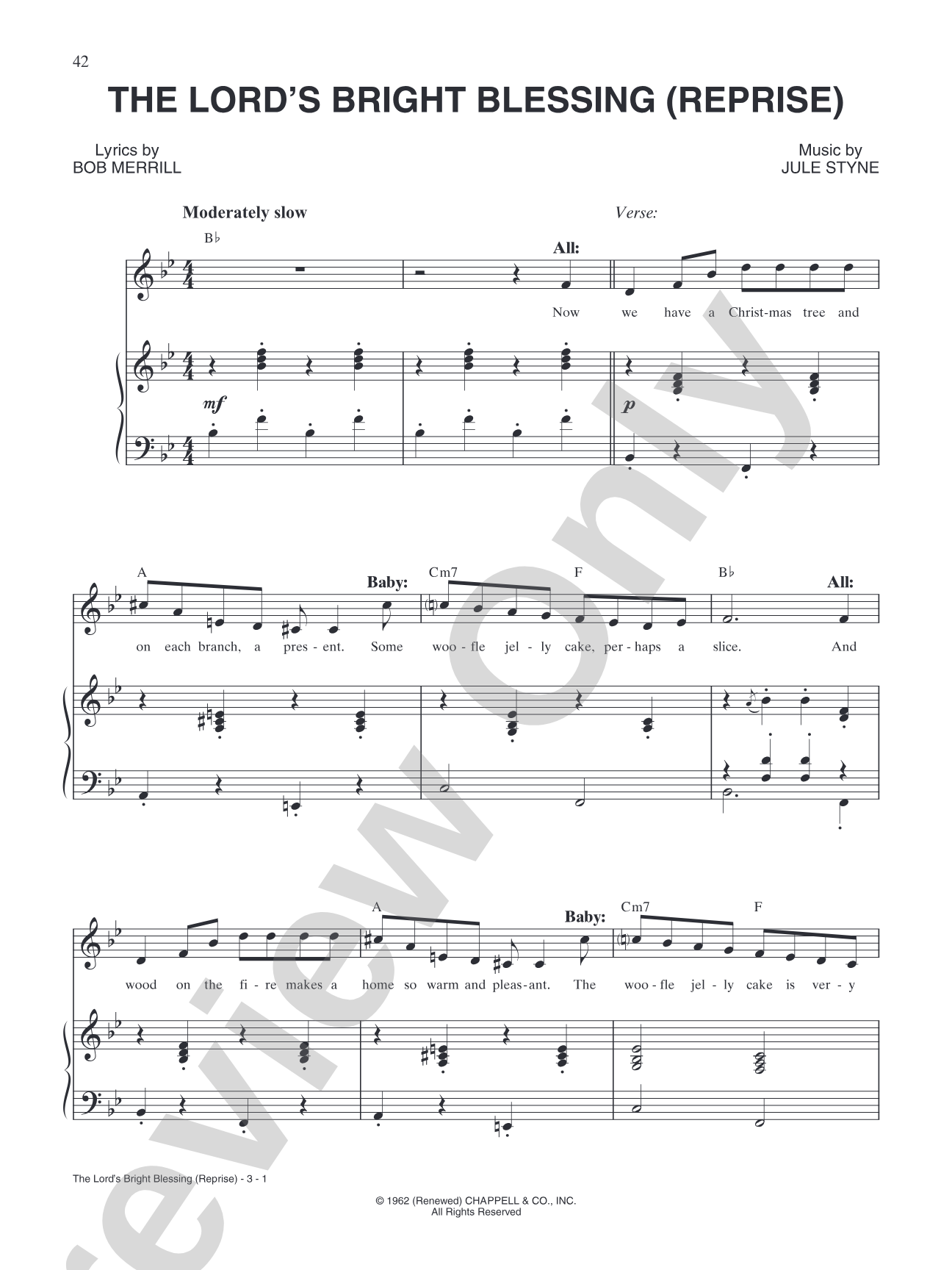

The Lord's Bright Blessing (reprise): Piano/Vocal/Chords
Sheet Music from the First Animated Christmas Special
Lyrics by Bob Merrill, music by Jule Styne
Item: 00-PS-0013429
$4.99
One moment…
Related Items
Ringle, Ringle: Piano/Vocal/Chords |
$4.99
|
View | |
Winter Was Warm: Piano/Vocal/Chords |
$4.99
|
View | |
The Lord's Bright Blessing: Piano/Vocal/Chords |
$5.99
|
View | |
We're Despicable: Piano/Vocal/Chords |
$4.99
|
View | |
Alone In The World: Piano/Vocal/Chords |
$4.99
|
View | |
It's Great To Be Back On Broadway: Piano/Vocal/Chords |
$9.99
|
View |
Description
Mr. Magoo's Christmas Carol debuted on the NBC television network on December 18, 1962, capturing the hearts of milllions with Broadway-caliber songs written by Bob Merrill and Jule Styne (Funny Girl) at the peak of their careers. Although this landmark production gradually became obscured by countless other televised Christmas specials that followed, its score remains noteworthy today for its timeless songs. Now, for the first time, this collectible songbook allows pianists and singers to explore the music and bring it to life anew. A fascinating historical foreword by animation expert Darrell Van Citters is included. Titles: * It's Great to Be Back on Broadway * Ringle, Ringle * The Lord's Bright Blessing * Alone in the World * Winter Was Warm * We're Despicable * The Lord's Bright Blessing (Reprise).


The Lord's Bright Blessing (reprise): Piano/Vocal/Chords isn't in MakeMusic Cloud just yet...but it could be. Let us know you'd like to see it, and you'll help shape what comes next. In the meantime, start a free trial and dive into thousands of interactive titles your students can play along with today.
Request This Title
Tell us you want it.
Start Your Free Trial
Explore everything that's ready to play right now.
Sample Audio
No sample audio found.
Sample Video
No sample videos found.
Additional Details
Publisher:
Alfred Music
Page Count:
44
SKU:
00-PS-0013429
More about this title
About the Composer: Jule Styne
Jule Styne (1905-1975) was one of Broadway's most prolific and commercially successful composers, with a gift for crafting melodies that lodged themselves in the public ear. Working with lyricist Bob Merrill on Mr. Magoo's Christmas Carol, Styne brought his theatrical sophistication to television animation at a moment when such ambition was rare in the medium. His scores for Funny Girl, Gypsy, and Bells Are Ringing established him as a master of character-driven songwriting, and his work here demonstrates why those songs endured long after their original productions closed.
Why we love this
These songs sit at a sweet spot between genuine theatrical craft and accessibility for young singers and pianists. Styne and Merrill's melodies are genuinely memorable (they were written for television, after all, and needed to stick), yet the harmonic language and phrasing offer enough sophistication to reward careful interpretation. Programming a song from this score signals both cultural literacy and a willingness to reclaim overlooked but real musical gems.
What to expect
Warm, mid-century theatrical nostalgia permeates these songs. The melodic lines carry a gentle optimism characteristic of 1960s television songwriting, while the harmonic progressions suggest both Tin Pan Alley tradition and Broadway sophistication. There's an earnestness to the material that feels genuine rather than saccharine.
Who it's for
Pianists and singers preparing seasonal repertoire will find accessible yet substantive material here. High school or college choral and piano students working on jazz chords and swing-influenced rhythms benefit from Styne's particular melodic and harmonic style. Community theater programs and recital contexts offer natural homes for this music.
How to get the most out of it
- Honor the lyrical intent of each phrase; Styne's melodies are shaped by the words they carry, so singing the text as communication rather than decoration will guide your interpretation naturally.
- Balance accompaniment density carefully on piano. The chord symbols offer rich harmonic possibilities, but sparse, well-voiced support often serves the melody more effectively than full block chords.
- Lean into the theatrical storytelling. These songs were written for a narrative context; understanding what each character experiences in that moment informs phrasing choices and emotional weight.
How to use it
A song from this collection works particularly well in holiday or winter-themed recitals where you want to include something beyond the standard carol repertoire. It pairs naturally with other mid-century popular songs or theater music, and the historical context (provided in the foreword) offers a conversation starter for program notes.
Skills your students will build
- Jazz chord voicing and recognition
- Interpreting swing rhythms and theatrical phrasing
- Singing through legit (theatrical) vocal lines with clear diction
- Understanding song form in theatrical context
- Balancing melody and accompaniment texture