
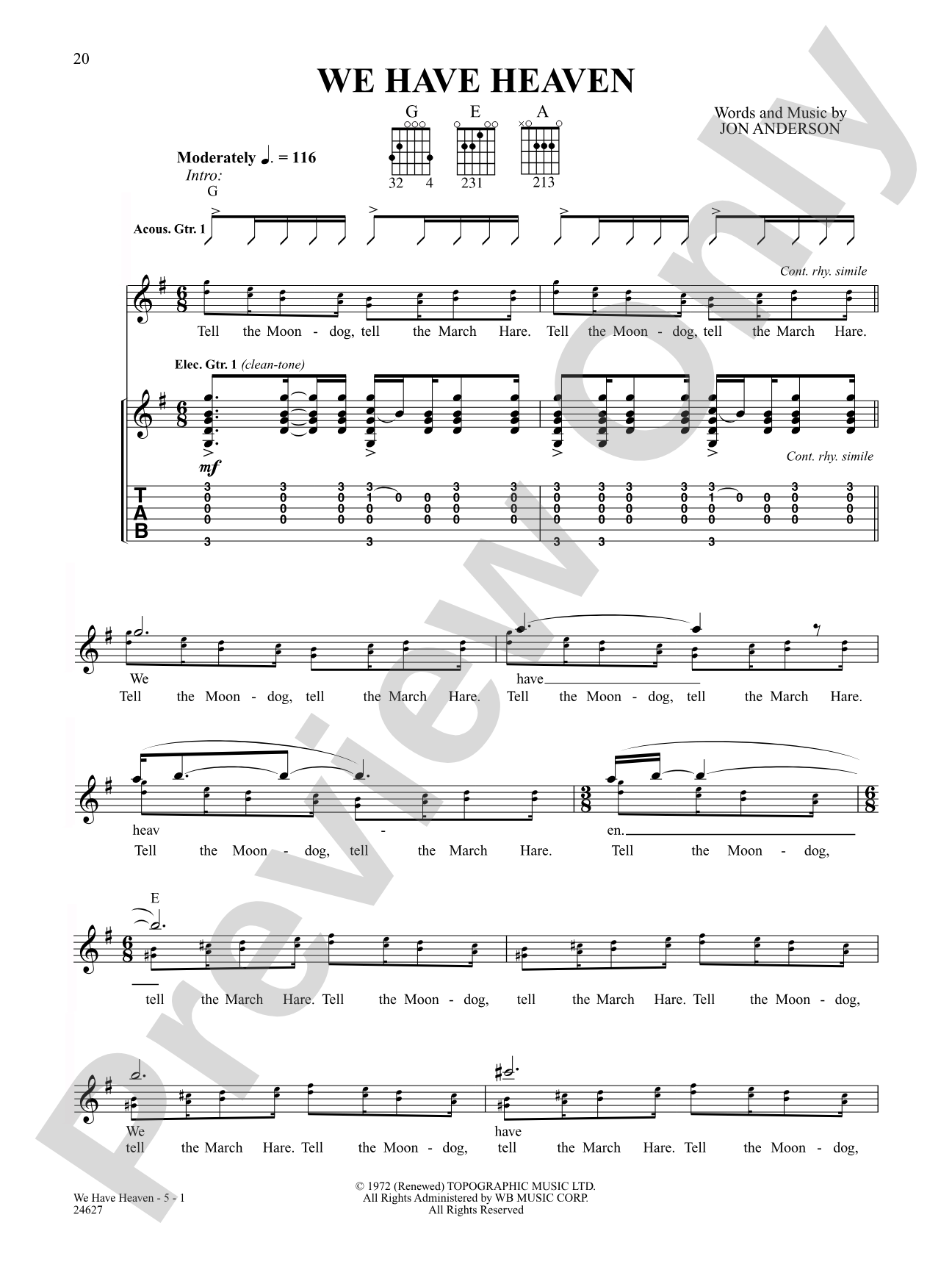

We Have Heaven: Authentic Guitar TAB
Yes
Item: 00-PSG-000014
$4.99
One moment…
Description
If you touched a guitar in the early 70s, you tried to play "Roundabout." From its opening harmonics, and Spanish-guitar influenced introduction, Steve Howe's classically influenced approach to rock resounded with a whole generation of guitarists weaned on the blues scale. Alfred Music is proud to add the classic Yes album, Fragile, to the Classic Album Edition Series. Titles are: Roundabout * Cans and Brahms * We Have Heaven * South Side of the Sky * Five Per Cent of Nothing * Long Distance Runaround * Fish (Schindleria Praematurus) * Mood for a Day * Heart of the Sunrise.


We Have Heaven: Authentic Guitar TAB isn't in MakeMusic Cloud just yet...but it could be. Let us know you'd like to see it, and you'll help shape what comes next. In the meantime, start a free trial and dive into thousands of interactive titles your students can play along with today.
Request This Title
Tell us you want it.
Start Your Free Trial
Explore everything that's ready to play right now.
Sample Audio
No sample audio found.
Sample Video
No sample videos found.
Additional Details
Series:
Alfred's Classic Album Editions
Publisher:
Alfred Music
Page Count:
80
SKU:
00-PSG-000014
More about this title
About the Artist: Yes
Yes emerged from London in 1968 as progressive rock pioneers who redefined what a rock band could accomplish. Built on Jon Anderson's visionary vocals, Chris Squire's thunderous bass lines, and Steve Howe's virtuosic guitar work, the band crafted intricate arrangements that drew from classical music, jazz, and Eastern influences while maintaining undeniable rock power. Their 1971 album Fragile stands as a landmark in progressive rock, showcasing each member's technical prowess and compositional voice.
The band's impact on guitar education has been profound. Steve Howe's work on these pieces demonstrated that rock guitarists could master fingerstyle technique, modal harmony, and classical forms while staying rooted in contemporary music. Generations of players have studied Yes arrangements to expand beyond pentatonic blues into more sophisticated harmonic and rhythmic territory.
Why we love this
This collection captures nine complete arrangements from one of rock's most technically demanding albums, giving guitarists direct access to Steve Howe's fingerboard vocabulary and compositional approach. The authentic transcriptions preserve the harmonic sophistication and fingerstyle technique that made these pieces essential listening for anyone seeking to move beyond standard rock patterns. Programming these pieces signals serious musicianship to your ensemble and students alike.
What to expect
These pieces pulse with intellectual ambition and virtuosic energy. You'll encounter Spanish-influenced fingerpicking alongside complex rhythmic structures, moments of delicate restraint followed by expansive harmonic movement. The writing feels both composed and discovered, as if Howe is inviting you into his technical thought process.
Who it's for
Guitar students and teachers working at intermediate to advanced levels who want to expand beyond standard rock repertoire into progressive rock's technical and harmonic demands. This collection is ideal for ensemble guitarists preparing for recitals, concert solos, or program material that demonstrates fingerstyle mastery and harmonic awareness. Players interested in Steve Howe's approach to classical technique applied within a rock context will find direct pedagogical value here.
How to get the most out of it
- Pay close attention to the fingering suggestions in the TAB; they're designed to help you navigate Howe's use of open strings and modal positions that create the classical resonance these pieces demand.
- The opening harmonics on 'Roundabout' require precise touch and muting. Work slowly at first to establish consistency before bringing up the tempo.
- Study how the arrangements shift between fingerstyle sections and fuller chord voicings. This clarity separates a transcribed part from a truly musical interpretation.
- Use a tuner with you throughout learning these pieces. Several tracks employ alternate tunings or drop-tuned strings that are critical to the original sound.
How to use it
Feature individual pieces as recital material for advanced students seeking to demonstrate fingerstyle capability and harmonic sophistication. 'Mood for a Day' and 'Cans and Brahms' work particularly well as solo recital selections. Alternately, assign multiple pieces to an ensemble studying progressive rock as a genre, using these transcriptions to examine how classical compositional approaches integrate with rock instrumentation and rhythm.
Skills your students will build
- Fingerstyle technique across open strings and modal positions
- Reading and executing complex rhythmic notation (mixed meters and syncopation)
- Harmonic analysis of modal and jazz-influenced chord progressions
- Interpreting detailed TAB notation that preserves fingering and technical approach
- Dynamic control and tone color variation across sustained and percussive passages
- Understanding classical compositional structure within rock contexts