
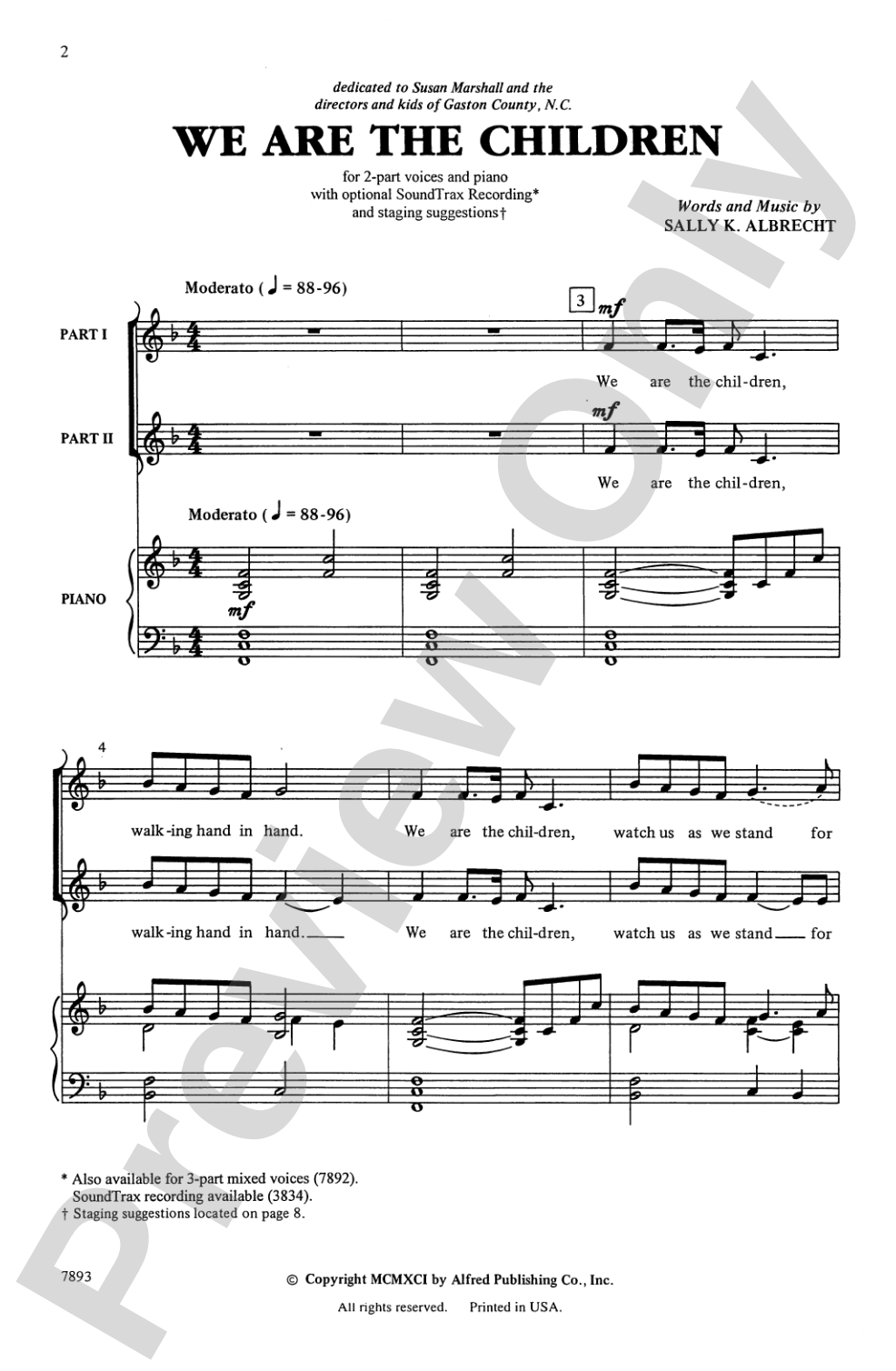
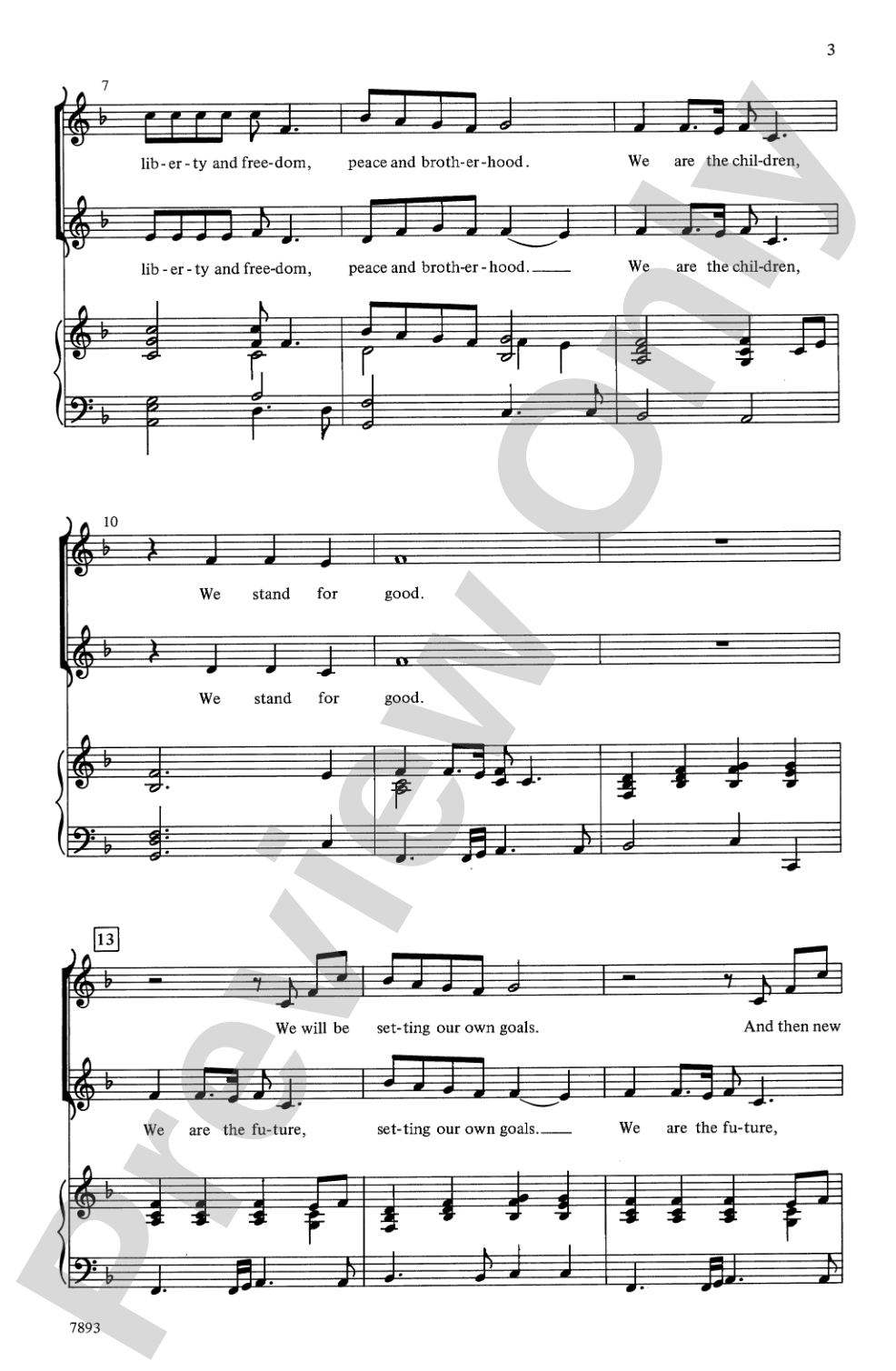

We Are the Children: 2-Part (with Opt. Staging) Choral Octavo
Music by Sally K. Albrecht
Item: 00-PO-0004621
$2.25
Minimum order quantity: 20 copies
Pickup currently not available
Description
A stirring work by Sally K. Albrecht. Easily performable, but so effective. The inspiring text ('We are the children, we stand for peace and brotherhood.') is both timely and moving. INCLUDED IN THE PUBLICATION ARE SALLY'S OWN SIMPLE STAGING SUGGESTIONS.


We Are the Children: 2-Part (with Opt. Staging) Choral Octavo isn't in MakeMusic Cloud just yet...but it could be. Let us know you'd like to see it, and you'll help shape what comes next. In the meantime, start a free trial and dive into thousands of interactive titles your students can play along with today.
Request This Title
Tell us you want it.
Start Your Free Trial
Explore everything that's ready to play right now.
Sample Audio
1
Audio File
--:--
0:00
0:00
Sample Video
No sample videos found.
Additional Details
Series:
Alfred Archive Edition: Alfred Choral Designs
Publisher:
Alfred Music
Page Count:
8
SKU:
00-PO-0004621
More about this title
About the Composer: Sally K. Albrecht
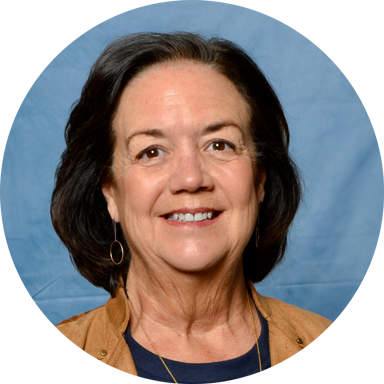
Sally K. Albrecht has shaped American choral education for over four decades as a composer, conductor, and clinician whose work with choral movement has influenced how directors approach staging and physicality in performance. Since 1987, she has received annual ASCAP Special Music Awards and maintains more than 600 published choral works alongside 75 larger musicals and songbooks. She has conducted honor choirs at Lincoln Center, Carnegie Hall, and The Kennedy Center, and served as Director of School Choral, Vocal, and Elementary Publications for Alfred Music and other major publishers.
Albrecht earned her B.A. in Music and Theater from Rollins College (Florida) in 1976, followed by an M.A. in Drama and an M.M. in Accompanying from the University of Miami. She has taught at Oakland University, Jersey City State College, and Meredith College, and was recently honored with the Distinguished Alumna Award from both the University of Miami Frost School of Music and Rollins College. She lives in Wake Forest, North Carolina, with her husband, composer and arranger Jay Althouse.
Why we love this
Albrecht writes music that resonates with young singers while respecting their developing voices and musical abilities. Her integrated staging suggestions remove the guesswork from adding movement, letting you focus on teaching the text and music rather than choreographing from scratch. The message of peace and brotherhood lands hard with young people precisely because the musical setting is honest and unadorned, not saccharine.
What to expect
Straightforward and earnest, with harmonies that feel accessible without being simplistic. The piece carries quiet conviction rather than bombast, creating space for young voices to sing with genuine expression and allowing staging to enhance rather than distract from the emotional core.
Who it's for
Directors working with developing two-part choirs, middle school through early high school, who want meaningful repertoire with social relevance. This piece is equally valuable for community choirs, youth ensembles, and peace-themed concert programming where authentic messaging matters to your singers.
How to get the most out of it
- Encourage singers to internalize the message before rehearsing staging. When the text feels genuine to them, their physical choices will follow naturally.
- Layer the staging gradually. Start with voice and text alone, then add simple movement once the two-part harmonies are secure.
- Use the recorded accompaniment during the learning phase to reinforce pitch accuracy in both parts, then remove it for a cappella performance if desired.
- Balance projection with intimacy. This piece works best when singers sing from conviction, not volume.
How to use it
Pair this with other peace-themed repertoire to create a thematic concert section, or open a program with it to establish a thoughtful tone. Its modest eight-page length makes it ideal for festivals, assembly performances, or community service events where the message becomes part of the occasion itself.
Skills your students will build
- Singing supported two-part harmony in a secular context
- Interpreting text-driven vocal expression and emotional authenticity
- Coordinating singing with simple movement and staging
- Understanding how physicality enhances rather than competes with vocal production