
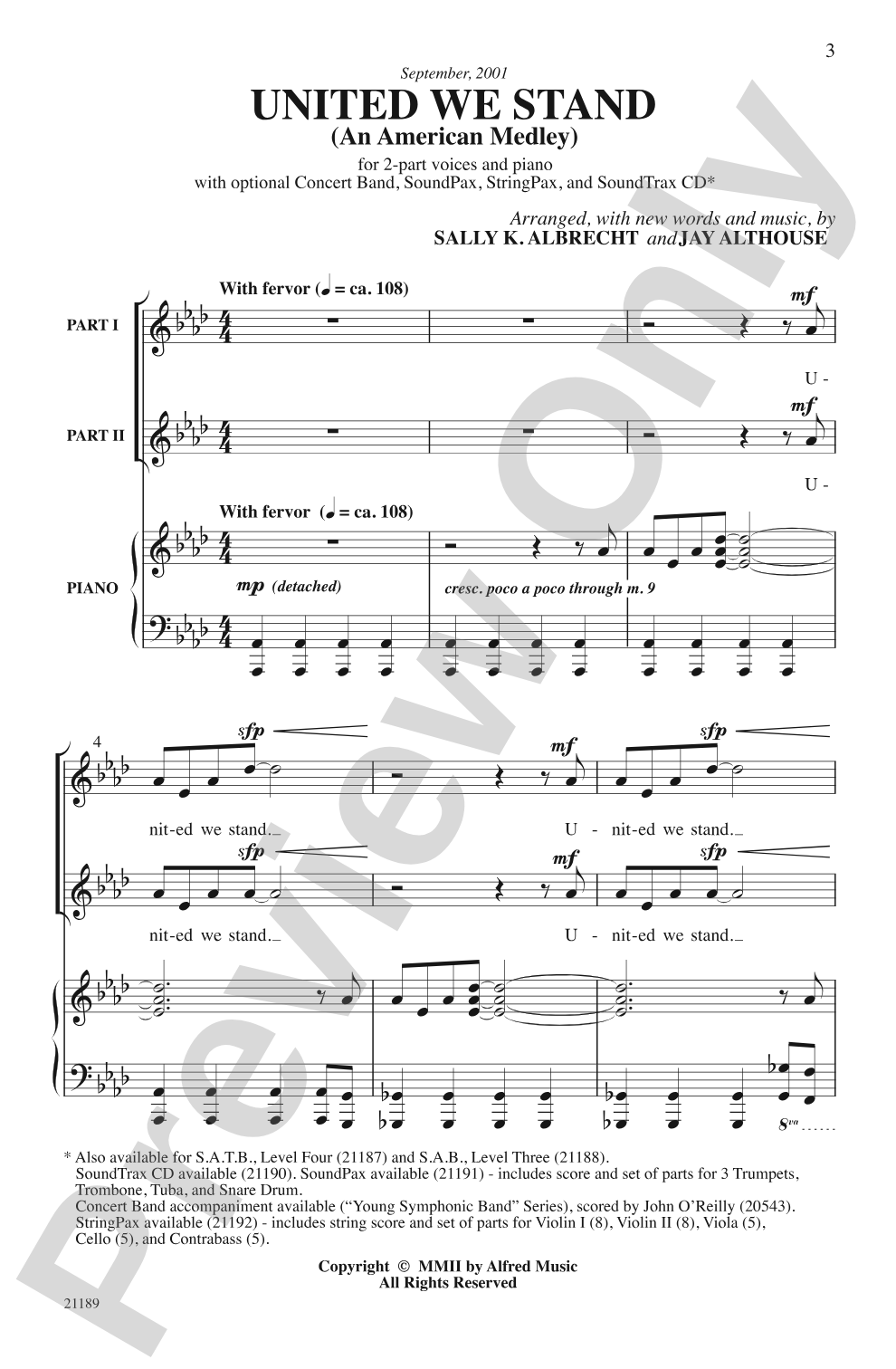
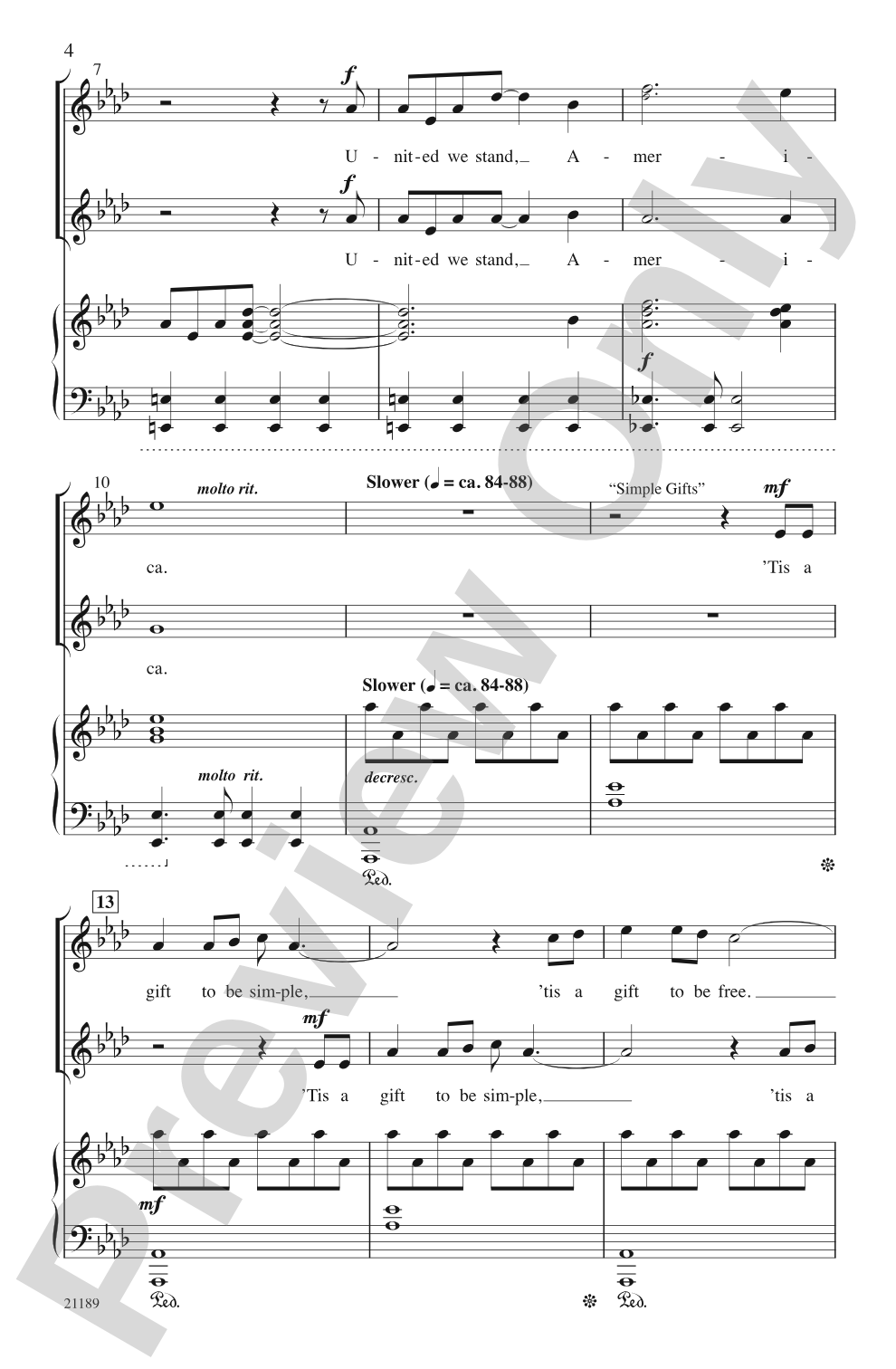

United We Stand (An American Medley): 2-Part Choral Octavo
Arr. Sally K. Albrecht and Jay Althouse
Item: 00-PO-0002893
$2.25
Minimum order quantity: 20 copies
Pickup currently not available
Related Items
United We Stand (An American Medley): SATB Choral Octavo |
$2.25
|
View | |
United We Stand (An American Medley): SAB Choral Octavo |
$2.25
|
View | |
United We Stand (An American Medley): Choral SoundPax |
$20.00
|
View | |
United We Stand (An American Medley): Choral Instrumental Parts |
$35.00
|
View | |
United We Stand (An American Medley): SATB Choral Octavo |
$2.25
|
View | |
United We Stand (An American Medley): SAB Choral Octavo |
$2.25
|
View | |
United We Stand (An American Medley): 2-Part Choral Octavo |
$2.25
|
View | |
United We Stand (An American Medley): Choral Octavo SoundTrax CD |
$27.99
|
View | |
United We Stand (An American Medley): Choral SoundPax |
$20.00
|
View | |
United We Stand (An American Medley): Choral Instrumental Parts |
$35.00
|
View |
Description
This stirring tribute to America is the perfect finale for your upcoming concert. After a stunning opening fanfare, excerpts of "Simple Gifts," "America, the Beautiful," "America," and the chorus of "Battle Hymn" are presented, leading up to a big final statement of the fanfare. The audience may also sing along on two sections of the choral. All three voicings are compatible, making this the perfect choice for a festival or joint finale. Add the full Concert Band arrangement and/or the StringPax and get your entire school involved. A SoundPax for brass and percussion is also available.


United We Stand (An American Medley): 2-Part Choral Octavo isn't in MakeMusic Cloud just yet...but it could be. Let us know you'd like to see it, and you'll help shape what comes next. In the meantime, start a free trial and dive into thousands of interactive titles your students can play along with today.
Request This Title
Tell us you want it.
Start Your Free Trial
Explore everything that's ready to play right now.
Sample Audio
1
Audio File
--:--
0:00
0:00
Sample Video
No sample videos found.
Additional Details
Series:
Alfred Archive Edition: Alfred Choral Designs
Publisher:
Alfred Music
Page Count:
12
SKU:
00-PO-0002893
More about this title
About the Arranger: Sally K. Albrecht
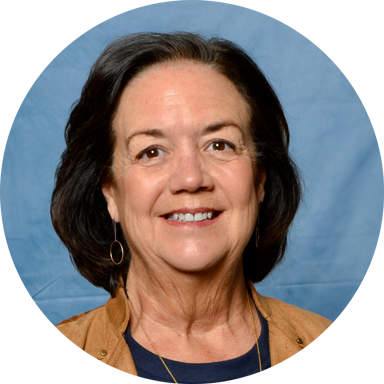
Sally K. Albrecht has spent over three decades shaping choral music education as a composer, conductor, and clinician with a distinctive focus on integrating movement into choral performance. Her prolific output includes more than 600 choral publications and 75 larger works for stage, alongside annual ASCAP Special Music Awards dating back to 1987. She has led honor choirs at prestigious venues including Lincoln Center, Carnegie Hall, and The Kennedy Center, and served as Director of School Choral, Vocal, and Elementary Publications for major educational publishers, including Alfred Music.
Albrecht holds degrees from Rollins College (B.A. in Music and Theater, 1976), the University of Miami (M.A. in Drama, 1977, and M.M. in Accompanying, 1979), and has taught at Oakland University, Jersey City State College, and Meredith College. She is a Distinguished Alumna of both the University of Miami Frost School of Music and Rollins College, where she serves on the Board of Trustees. She resides in Wake Forest, North Carolina with her husband, composer and arranger Jay Althouse.
Why we love this
This medley balances accessibility with musical substance, drawing from five beloved American songs without feeling scattered. The built-in audience participation moments and flexible voicing compatibility make it genuinely practical for mixed-skill ensembles and festival settings, while the fanfare framing gives it concert gravitas that justifies a strong finale spot.
What to expect
A confident procession through American musical heritage, anchored by the brightness of a brass fanfare. The piece moves from introspection ("Simple Gifts") through affirmation ("America, the Beautiful") to triumphant unity ("Battle Hymn"), inviting both your singers and the audience into something larger than themselves.
Who it's for
Choirs in grades 6-12 and beyond seeking a patriotic finale that works for concert contexts, 4th of July celebrations, and festivals. The 2-part voicing accommodates developing singers and mixed-ability ensembles while remaining musically satisfying for more advanced groups.
How to get the most out of it
- Shape the opening fanfare with clarity and energy; it sets the tone for the entire piece and returns as your closing statement, so consistency matters.
- Give each folk melody its own character as they arrive: let the simplicity of 'Simple Gifts' breathe, make 'America, the Beautiful' soar, and drive the 'Battle Hymn' chorus with purpose.
- Use the audience participation sections as moments to build momentum and connection. Cue the audience clearly and sustain their engagement into the final fanfare.
- Balance the independent 2-part writing so upper and lower voices remain distinct without either dominating; this clarity is especially important in ensemble settings.
How to use it
Reserve this for your final selection on a concert or festival program where it can command full attention and give singers a chance to share the stage with the band or orchestra through the compatible arrangements. It works equally well as a standalone choral finale or as the anchor of a patriotic program block.
Skills your students will build
- Singing in 2-part harmony with independence between parts
- Sustaining ensemble unity across multiple melody transitions
- Responding to and executing audience participation cues
- Balancing vocal tone and blend across contrasting musical styles