

Two Renaissance Chorals (Adoramus Te / Ave Maria): 3-Part Mixed, a cappella Choral Octavo
Arr. Russell Robinson
Level: Moderate
Item: 00-PO-0002711
$2.25
Minimum order quantity: 20 copies
Pickup currently not available
Related Items
Two Renaissance Chorals (Adoramus Te / Ave Maria): SSA, a cappella Choral Octavo |
$2.25
|
View | |
Two Renaissance Chorals (Adoramus Te / Ave Maria): TBB, a cappella Choral Octavo |
$2.25
|
View | |
Two Renaissance Chorals (Adoramus Te / Ave Maria): SATB, a cappella Choral Octavo |
$1.65
|
View | |
Two Renaissance Chorals (Adoramus Te / Ave Maria): SSA, a cappella Choral Octavo |
$2.25
|
View | |
Two Renaissance Chorals (Adoramus Te / Ave Maria): TBB, a cappella Choral Octavo |
$2.25
|
View | |
Two Renaissance Chorals (Adoramus Te / Ave Maria): 3-Part Mixed, a cappella Choral Octavo |
$2.25
|
View |
Description
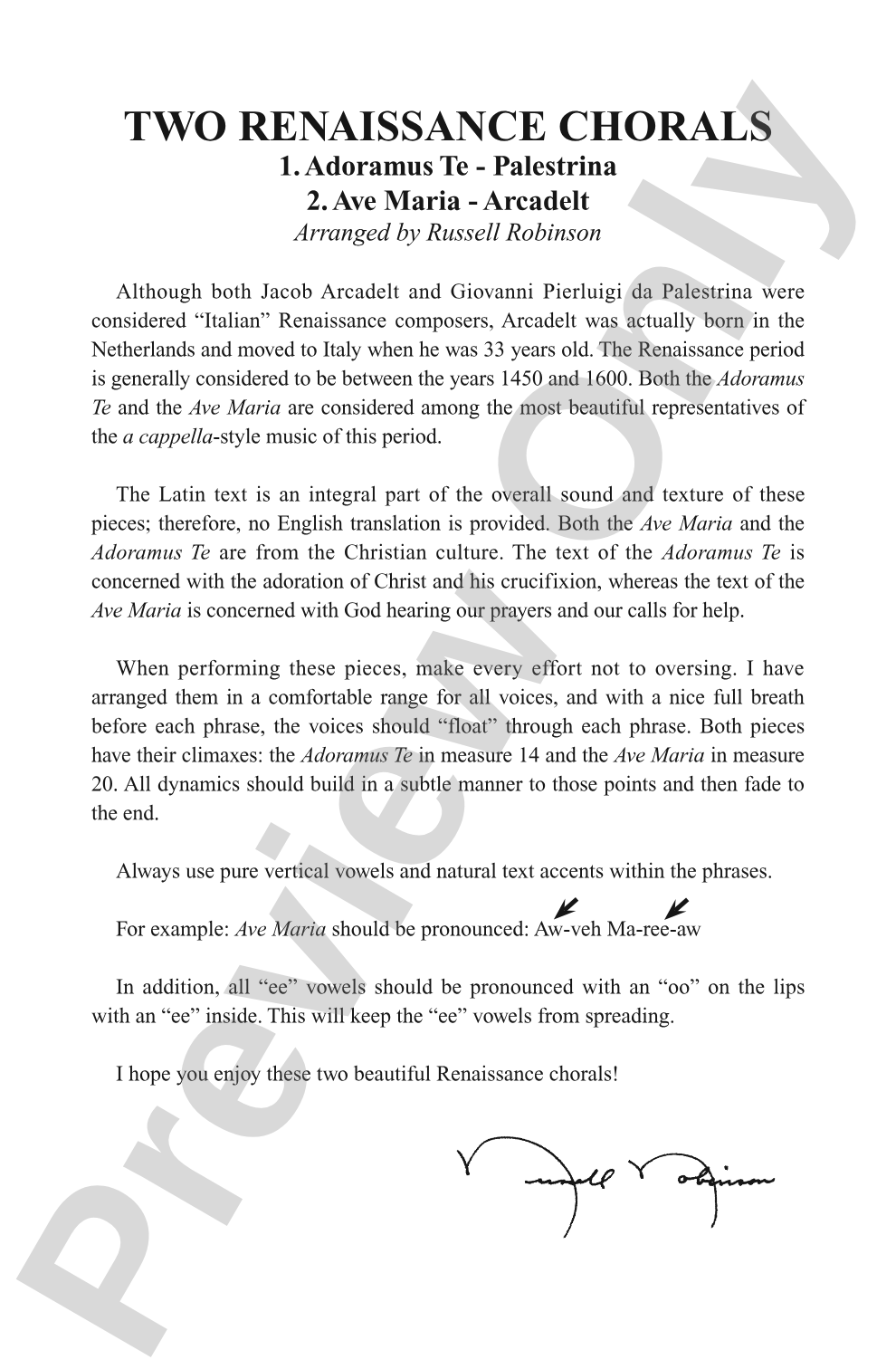
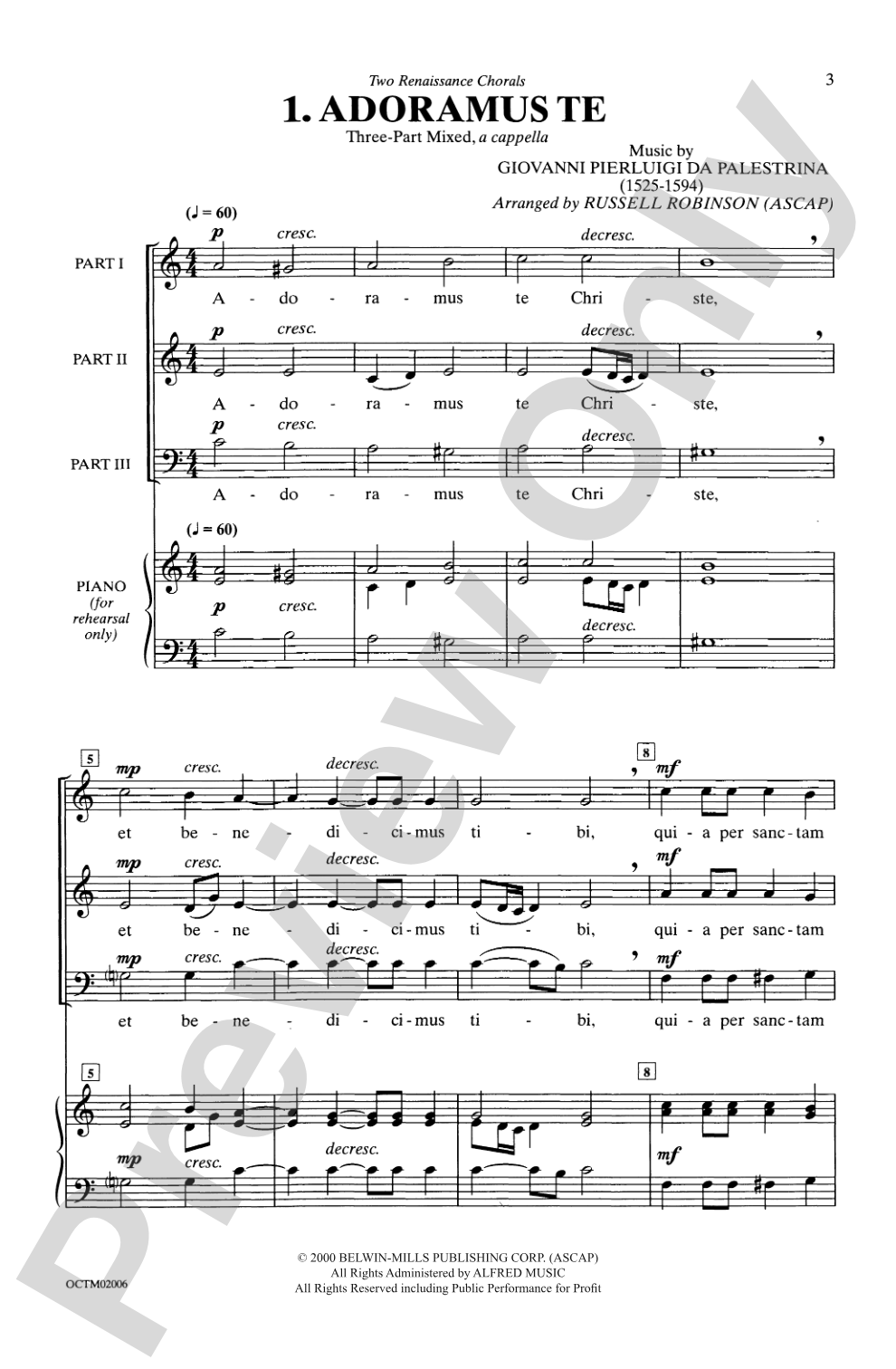
Two choral classics from the Renaissance period - "Adoramus Te" (Palestrina) and "Ave Maria" (Arcadelt) - are now available in this easy SATB edition. They were previously released in men's, women's, and three-part mixed voicings. An exceptional addition to any concert


Two Renaissance Chorals (Adoramus Te / Ave Maria): 3-Part Mixed, a cappella Choral Octavo isn't in MakeMusic Cloud just yet...but it could be. Let us know you'd like to see it, and you'll help shape what comes next. In the meantime, start a free trial and dive into thousands of interactive titles your students can play along with today.
Request This Title
Tell us you want it.
Start Your Free Trial
Explore everything that's ready to play right now.
Sample Audio
No sample audio found.
Sample Video
No sample videos found.
Additional Details
Series:
Alfred Archive Edition: Belwin Festival Series
Publisher:
Alfred Music
Page Count:
8
SKU:
00-PO-0002711
More about this title
Why we love this
Robinson's SAB voicing strikes an honest balance between accessibility and musical integrity. These Renaissance masterworks maintain their essential character without oversimplification, letting singers across a three-part mixed choir experience repertoire that anchors any sacred choral program.
What to expect
Serene and contemplative. Both pieces inhabit that quiet spiritual space characteristic of Renaissance sacred music, where restraint and clarity allow the text to breathe. The a cappella scoring creates an intimate sound that feels timeless.
Who it's for
Choirs with mixed voices at the intermediate level who want authentic Renaissance repertoire without the vocal demands of traditional SATB scoring. Works equally well in school choirs, community ensembles, or church settings where three-part mixed voicing is standard.
How to get the most out of it
- Shape the long lines through breath management rather than dynamic swells; let the text and melodic contour guide phrasing in absence of instrumental support.
- Tune vertically by locking onto the soprano line as your pitch reference, then adjust alto and bass around it.
- Balance the alto line carefully in both pieces; it often carries harmonic weight that can disappear without deliberate attention in rehearsal.
How to use it
Pair these as a focused liturgical or devotional set within a larger concert, or open a program with them to establish a reverent tone. They're equally effective in shorter church services where two contrasting yet complementary pieces anchor the musical moment.
Skills your students will build
- Singing in thirds and fourths without instrumental reinforcement
- Sustaining pitch accuracy across longer melodic phrases
- Balancing three independent vocal lines with equal clarity
- Interpreting Renaissance text underlay and phrasing conventions