
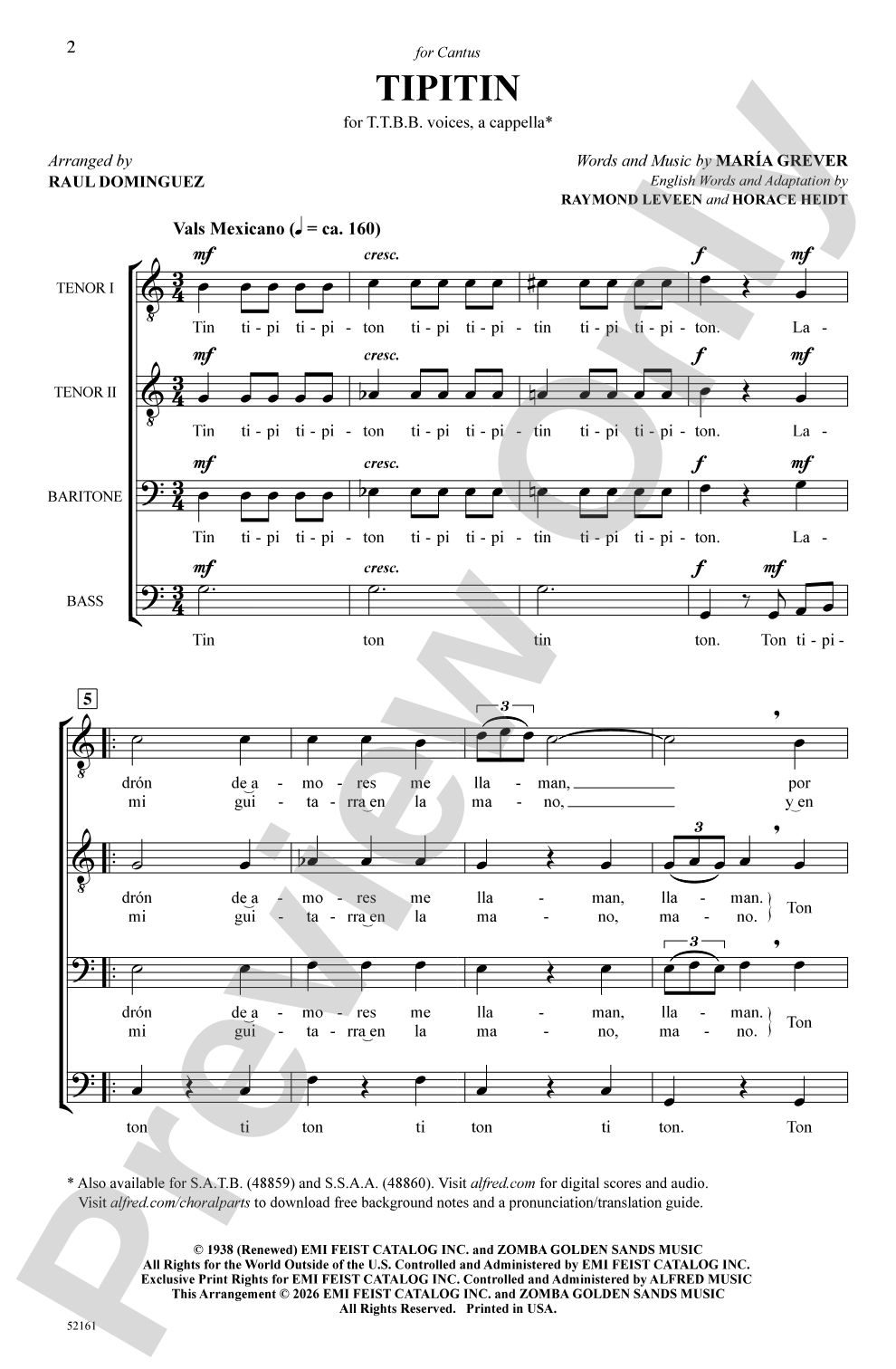

Tipitin: TTBB a cappella Choral Octavo
Words and music by María Grever / English words and adaptation by Raymond Leveen and Horace Heidt / arr. Raul Dominguez
Item: 00-PO-0007805
$2.40
Minimum order quantity: 20 copies
One moment…
Description
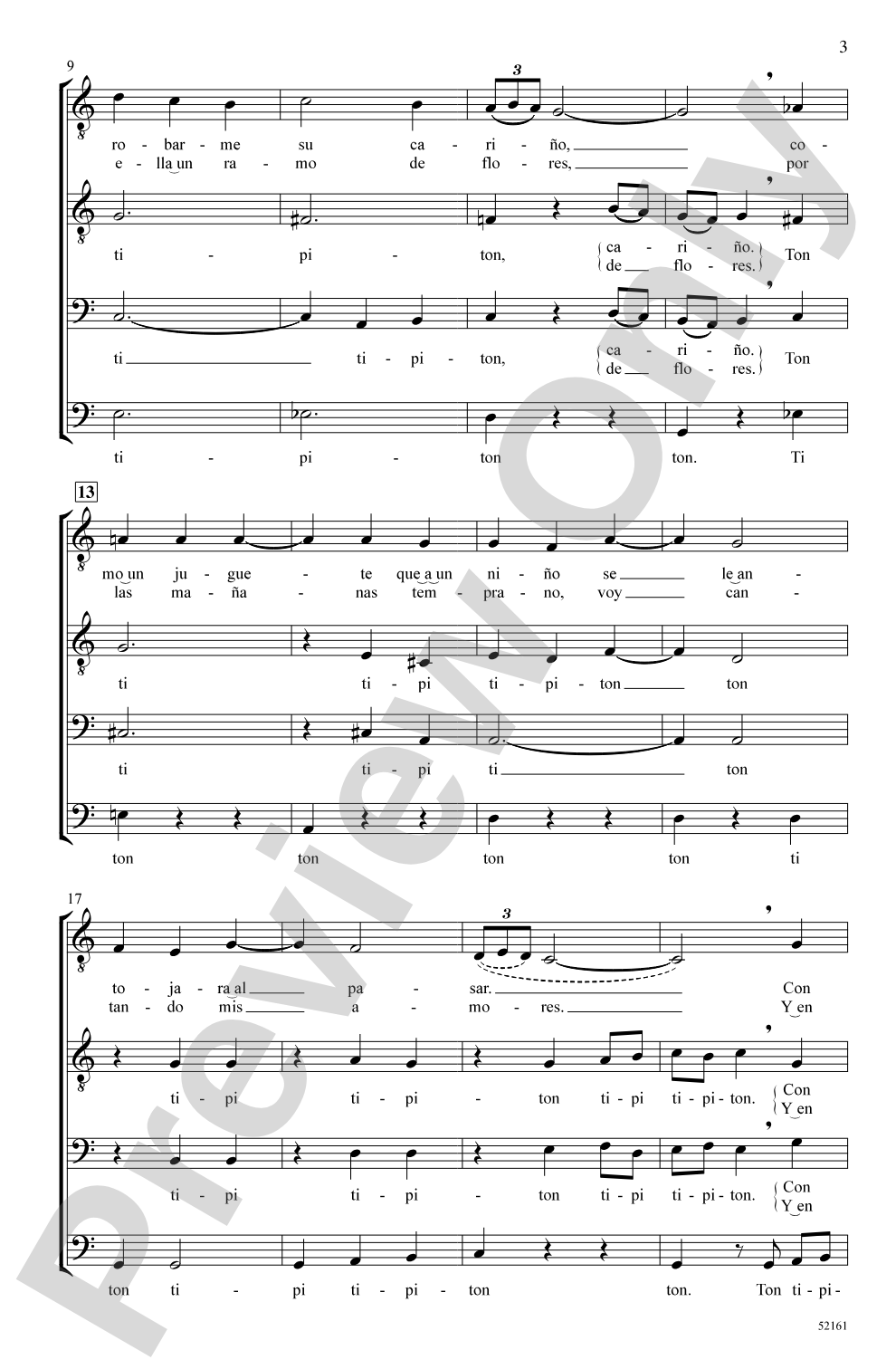
New TTBB voicing recorded by Cantus! Written by Mexico's first well-known female composer, María Grever, this vals Mexicano (Mexican waltz) makes a charming a cappella work for outstanding choirs. The textured setting offers well-conceived choral parts throughout, sometimes using lower voices to provide a dance-like underscore for the lilting melody. A full translation and pronunciation notes aid in the understanding and mastery of an entirely Spanish text, which recounts a story of new love. Feature an agile tenor on the jaunty descant near the end.


Discover MakeMusic Cloud: thousands of interactive titles your students can play along with today.
Sample Audio
1
Audio File
--:--
0:00
0:00
Sample Video
Additional Details
Series:
Lawson-Gould
Publisher:
Alfred Music
Page Count:
8
SKU:
00-PO-0007805
More about this title
About the Composer: Maria Grever
María Grever (1894, 1951) stands as Mexico's pioneering female composer, breaking into a musical landscape dominated by men and establishing herself as a prolific songwriter across multiple genres. Her output spanned art songs, piano works, and popular compositions that gained international recognition; she even won awards in the United States during an era when Mexican classical music received limited attention abroad. Grever's ability to blend folk idioms with sophisticated compositional technique made her work accessible without sacrificing musical substance, a quality that still resonates in her choral settings today.
Why we love this
Tipitin offers choirs a chance to perform authentic Mexican repertoire by its creator rather than an arrangement, bringing fresh cultural context to concert programs. The voicing is genuinely elegant; Dominguez uses the lower voices to anchor a lilting melody with rhythmic sophistication that feels idiomatic to the waltz genre without resorting to novelty effects. A Spanish-language text with full translation and pronunciation notes removes barriers, letting singers engage meaningfully with the story while audiences experience music beyond the usual European canon.
What to expect
Tipitin dances with unhurried elegance, its Spanish text unfolding a story of emerging affection over lilting waltz rhythms. The lower voices create a textured foundation that feels both supportive and playful, while the melody floats above with a lightness that never tips into frivolity; the result is sophisticated charm, the kind of piece that audiences find themselves humming as they leave the hall.
Who it's for
TTBB choirs seeking concert repertoire that showcases solid ensemble blend and tuning while introducing audiences to a non-European composer. Directors programming festival or contest entries will appreciate a piece that is both musically substantial and culturally meaningful, performed here in a recording by Cantus that models excellent intonation and style.
How to get the most out of it
- Shape the melody as a true dance line, letting the waltz rhythm breathe naturally rather than conducting it rigidly; the underscore from lower voices should feel like an accompaniment, not a pulse-keeper.
- Use the pronunciation guide to ensure clean diction that honors the text's narrative arc; mispronounced syllables will obscure the story of new love the piece conveys.
- Balance the tenor descant near the end so it soars above the ensemble without forcing; this moment works best when it feels like an unexpected flourish rather than a desperate high point.
- Build the harmonic texture gradually through rehearsals; the textured setting rewards sections that listen horizontally to their own lines and vertically to surrounding voices.
How to use it
Program this alongside or between more familiar European art song repertoire to broaden your concert's musical geography; the a cappella format makes it a natural neighbor to Renaissance motets or contemporary choral works. Its accessible melodic beauty and moderate difficulty make it ideal for showcasing ensemble maturity without demanding the resources of larger works, leaving room on a program for multiple smaller gems.
Skills your students will build
- Reading and performing in Spanish with accurate pronunciation and natural phrasing
- Balancing textured TTBB voicing where lower voices provide harmonic and rhythmic foundation
- Maintaining waltz rhythm and dance-like character in an a cappella context
- Blending and tuning chromatic movement in a sophisticated harmonic language
- Performing with stylistic awareness of Latin American musical idioms