
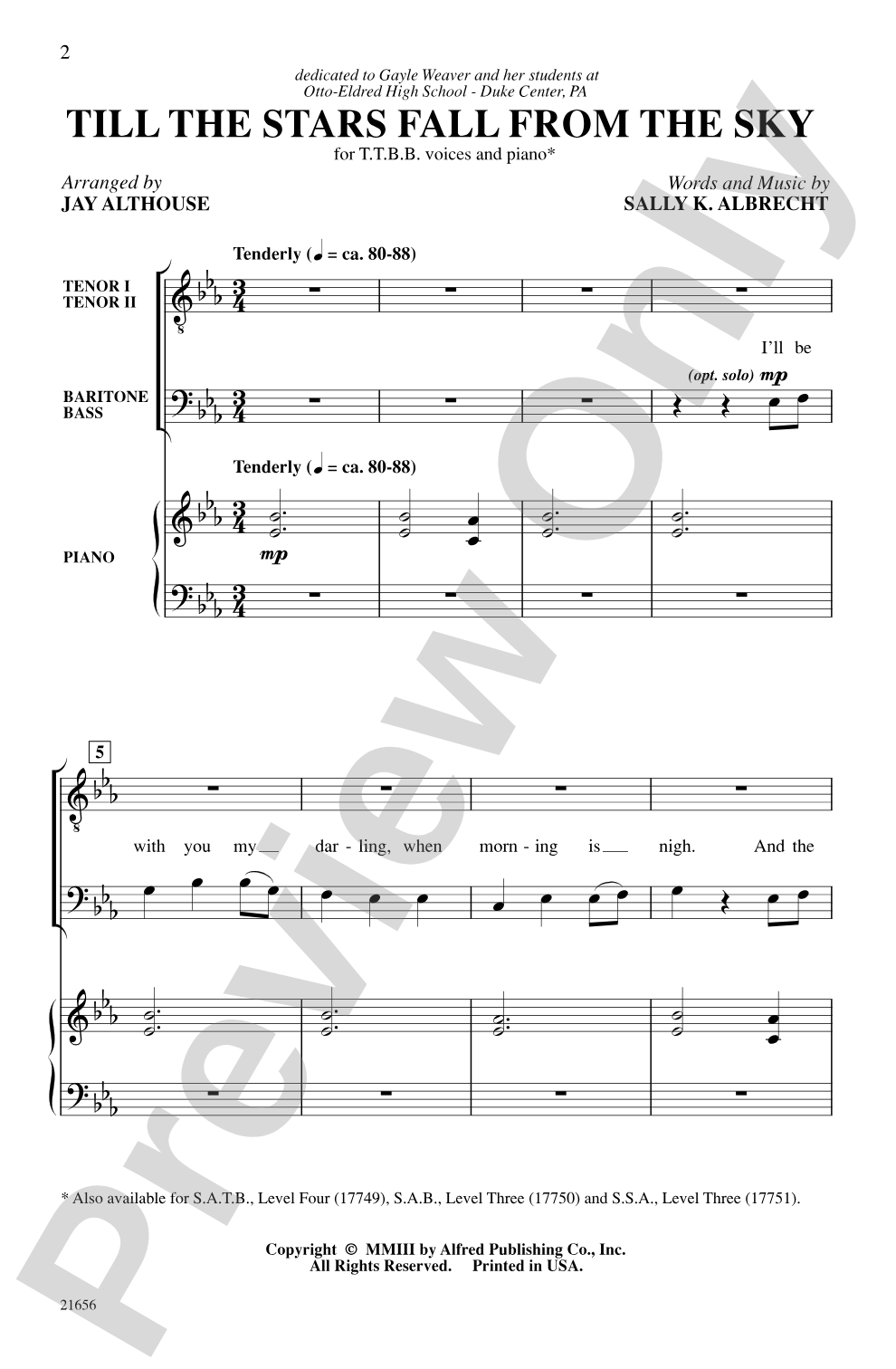
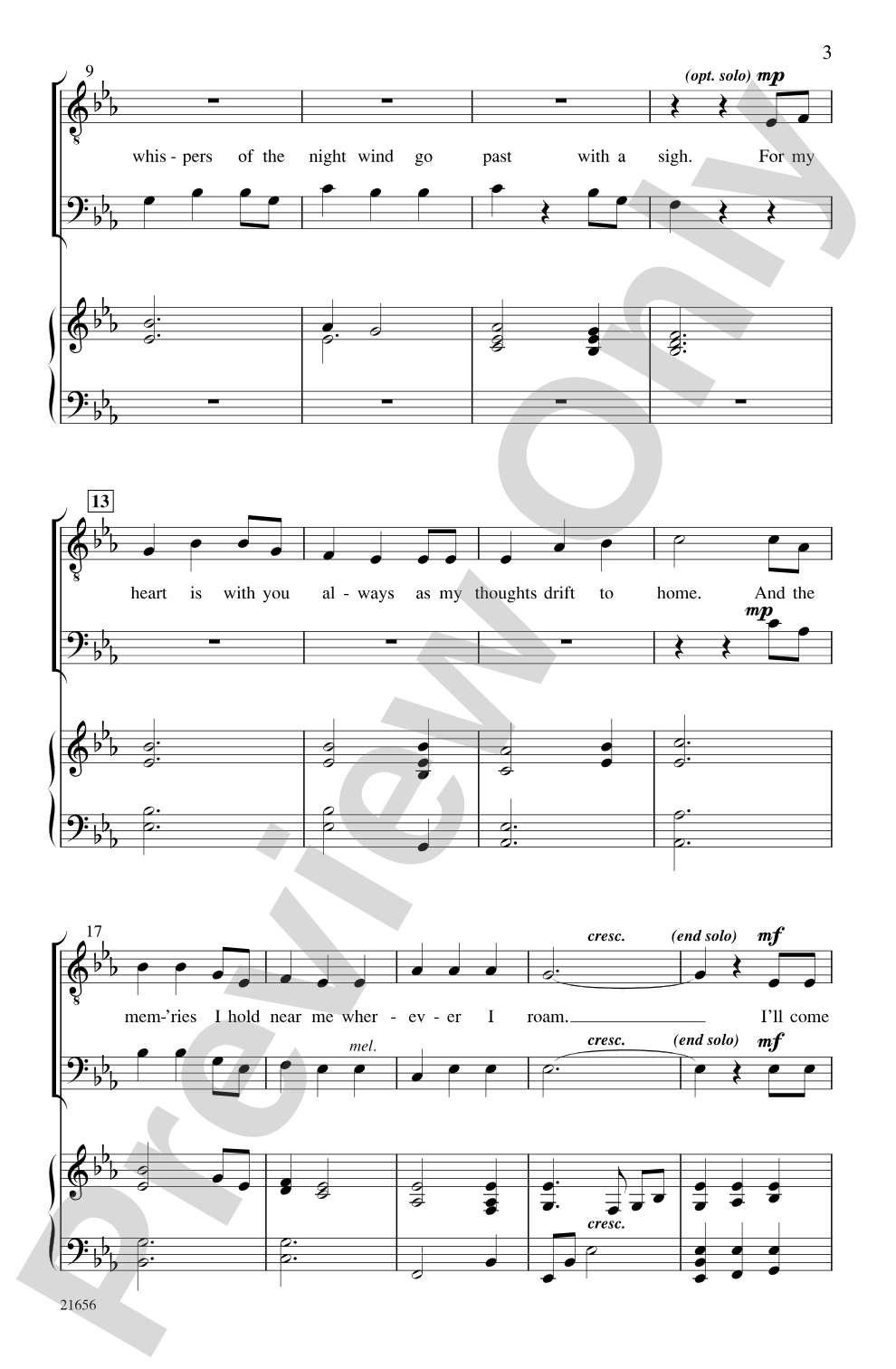

Till the Stars Fall from the Sky: TTBB Choral Octavo
Music by Sally K. Albrecht and Jay Althouse
Item: 00-PO-0002201

$2.25
Minimum order quantity: 20 copies
Pickup currently not available
Related Items
Till the Stars Fall from the Sky: SATB Choral Octavo |
$2.25
|
View | |
Till the Stars Fall from the Sky: SAB Choral Octavo |
$2.25
|
View | |
Till the Stars Fall from the Sky: SSA Choral Octavo |
$2.25
|
View | |
Till the Stars Fall from the Sky: SATB Choral Octavo |
$2.25
|
View | |
Till the Stars Fall from the Sky: SAB Choral Octavo |
$2.25
|
View | |
Till the Stars Fall from the Sky: SSA Choral Octavo |
$2.25
|
View | |
Till the Stars Fall from the Sky: TTBB Choral Octavo |
$2.25
|
View |
Description
Introducing a new voicing of this classic song by Sally Albrecht and Jay Althouse. Reminiscent of an Irish folk song, this solid choral piece sounds as great in men's voices as it does in the formerly released mixed voice and treble arrangements. An touching, nature-inspired text is supported by a lovely melody and excellent choral writing. Powerful in its simplicity. "I am yours now and forever, till the stars fall from the sky."


Don't just read it, hear it, play along with it, and watch your students grow with it. In MakeMusic Cloud, Till the Stars Fall from the Sky: TTBB Choral Octavo comes alive with professional accompaniment, adjustable tempo, and built-in practice tools that turn solo practice into real progress.
Open in the Player
Jump straight in and assign it today.
Start Your Free Trial
Open this title and explore the full library in minutes.
Sample Audio
1
Audio File
--:--
0:00
0:00
Sample Video
No sample videos found.
Additional Details
Series:
Alfred Archive Edition: Alfred Choral Designs
Publisher:
Alfred Music
Page Count:
8
SKU:
00-PO-0002201
More about this title
About the Composer: Sally K. Albrecht
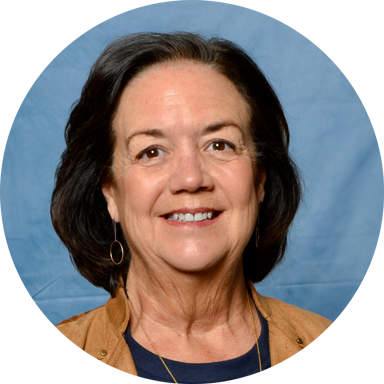
Sally K. Albrecht has shaped American choral music for over four decades as a composer, conductor, and advocate for expressive choral performance. A recipient of the ASCAP Special Music Award annually since 1987, she has published more than 600 choral works alongside 75 larger theatrical and songbook projects. Her conducting has led honor choirs at prestigious venues including Lincoln Center, Carnegie Hall, and The Kennedy Center. She spent three decades directing school choral and vocal publications for major educational publishers, most recently Alfred Music, while also teaching at Oakland University, Jersey City State College, and Meredith College.
Albrecht holds degrees from Rollins College (B.A. in Music and Theater, 1976), the University of Miami (M.A. in Drama, 1977; M.M. in Accompanying, 1979), and has received the Distinguished Alumna Award from both institutions. She served as Chair of the Board of Trustees for Omicron Delta Kappa National Leadership Honor Society and received their "Pillar of Leadership" award. She resides in Wake Forest, North Carolina, with her husband, composer and arranger Jay Althouse.
Why we love this
Men's choirs often lack contemporary material with genuine lyrical warmth and singability, making this fresh TTBB voicing a genuine asset to your repertoire rotation. Albrecht and Althouse have crafted writing that respects the lower register without sacrificing the piece's emotional core; the folk idiom sits naturally in these voices and the eight-page length makes it manageable for festival season without feeling slight. The text's quiet devotion and the melody's understated beauty create the kind of piece that audiences remember long after the concert ends.
What to expect
Tender and grounded, with the quiet certainty of folk melody. The piece unfolds like an old promise kept, its simple harmonic language carrying surprising emotional depth. There's both strength and gentleness in the writing; the lower voices anchor the sound while the tenors float a melody that feels timeless and intimate all at once.
Who it's for
TTBB choirs seeking repertoire that balances accessibility with genuine artistic substance. This arrangement works equally well for high school men's groups building their festival repertoire, college and university male choruses, and community and church choirs wanting to feature male voices in programming. Singers will appreciate writing that honors their range and resonance without condescension.
How to get the most out of it
- Balance the melody between first and second tenors in measures where both parts carry the tune; resist the urge to weight it entirely to Tenor 1, which can sound thin across a full choir.
- Shape the harmonic progression by bringing out inner voice movement, especially in the bass and baritone lines, where Albrecht and Althouse embed countermelodic fragments.
- Let the dynamic arc breathe at phrase endings rather than cutting off abruptly; the folk character thrives on gentle, sustained releases that feel conversational rather than formal.
- Attend closely to vowel consistency across all four parts during sustained chords, particularly the open vowels in the text's central image of stars falling.
How to use it
Pair this with other nature-inspired secular pieces to create a thematic concert section, or program it as a ballast moment between more energetic festival selections. Its emotional transparency makes it particularly effective as a closing piece on a concert, leaving audiences with a sense of quiet resolution. The eight-page scope also positions it well as part of a longer set without overshadowing surrounding repertoire.
Skills your students will build
- Balancing melody and inner-voice harmony in four-part voicing
- Sustaining legit through folk-style phrasing rather than classical operatic technique
- Blending vowels across chord changes in extended harmonic progressions
- Interpreting text-driven dynamics in contemporary secular choral literature