
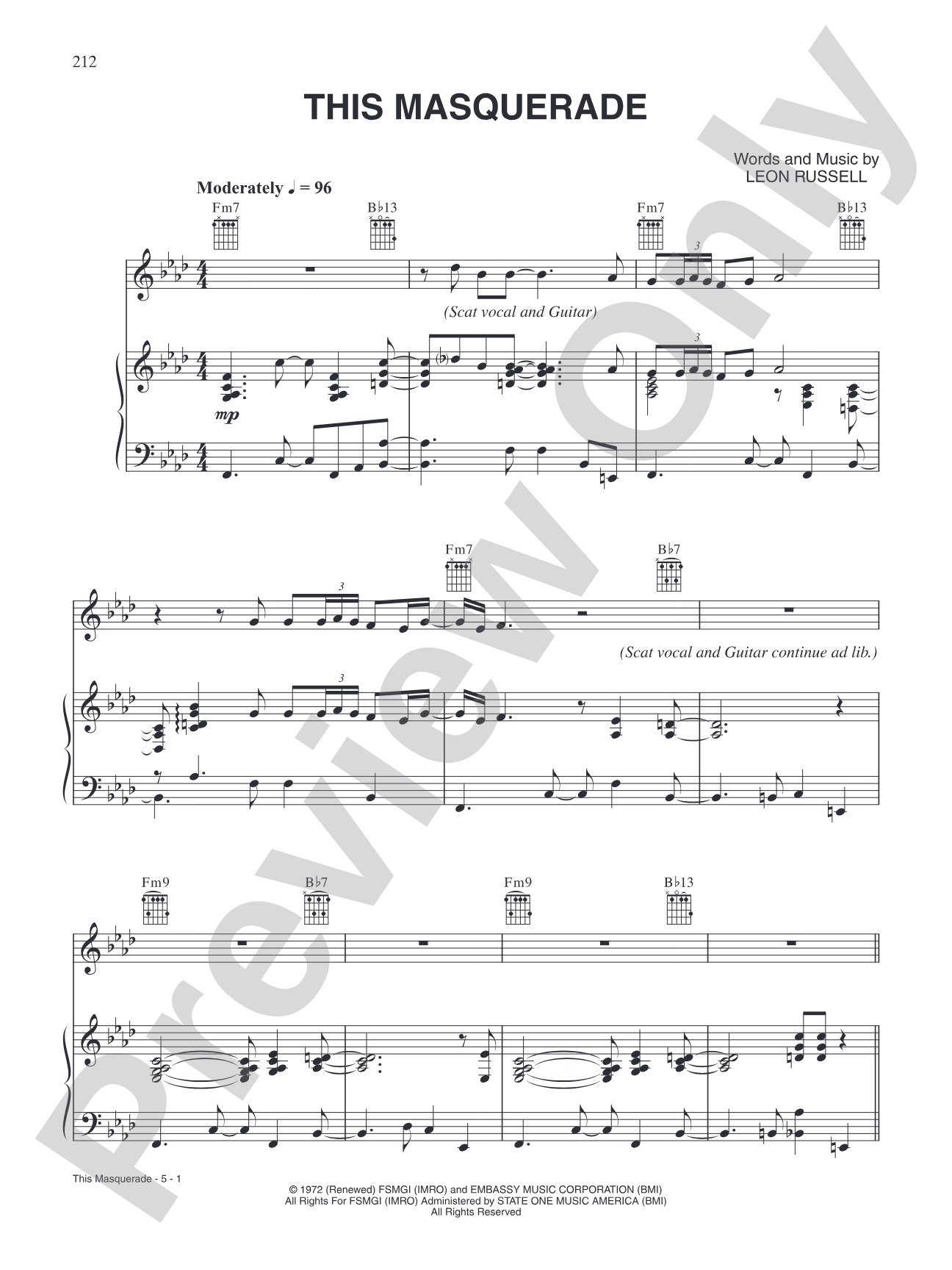

This Masquerade: Piano/Vocal/Chords
Ten Years of Popular Sheet Music Bestsellers
Item: 00-PS-0010781
$4.99
Pickup currently not available
Related Items
Sundown: Piano/Vocal/Chords |
$4.99
|
View | |
O-O-H Child: Piano/Vocal/Chords |
$4.99
|
View | |
Stayin' Alive (from "Saturday Night Fever"): Piano/Vocal/Chords |
$5.99
|
View | |
Whipping Post: Piano/Vocal/Chords |
$5.99
|
View | |
Taxi: Piano/Vocal/Chords |
$9.99
|
View | |
Shower the People: Piano/Vocal/Chords |
$4.99
|
View | |
Another Saturday Night: Piano/Vocal/Chords |
$4.99
|
View | |
Looking for a Love: Piano/Vocal/Chords |
$4.99
|
View |
Description
This songbook contains more than 40 of the biggest hits of the '70s. Each song is sure to spark a memory or create a new one for pianists or vocalists of all ages. For practice, performance, or pleasure, play and sing your way through your favorite decade in pop music history! Titles: All My Love (Led Zeppelin) * Another Saturday Night (Cat Stevens) * Big Yellow Taxi (Joni Mitchell) * Born to Run (Bruce Springsteen) * Casey Jones (Grateful Dead) * Cat's in the Cradle (Harry Chapin) * Closer to the Heart (Rush) * Comfortably Numb (Pink Floyd) * Dancing Queen (ABBA) * Desperado (Eagles) * Evergreen (Barbra Streisand) * Flash Light (Parliament) * Hotel California (Eagles) * How Deep Is Your Love (Bee Gees) * Killing Me Softly with His Song (Roberta Flack) * Layla (Derek and the Dominos) * Lights (Journey) * Lola (The Kinks) * Looking for a Love (Bobby Womack) * Maggie May (Rod Stewart) * Margaritaville (Jimmy Buffett) * Moondance (Van Morrison) * Nobody Does It Better (Carly Simon) * Old Time Rock & Roll (Bob Seger) * O-o-h Child (The Five Stairsteps) * The Rose (Bette Midler) * Roundabout (Yes) * Shower the People (James Taylor) * Song from M*A*S*H* (Suicide is Painless) (Johnny Mandel) * Stairway to Heaven (Led Zeppelin) * Star Wars Main Title (John Williams) * Stayin' Alive (Bee Gees) * Sundown (Gordon Lightfoot) * Take Me Home, Country Roads (John Denver) * Taxi (Harry Chapin) * Theme from Ice Castles (Melissa Manchester) * Theme from New York, New York (Frank Sinatra) * This Masquerade (George Benson) * Thunder Road (Bruce Springsteen) * Weekend in New England (Barry Manilow) * Wheel in the Sky (Journey) * Whipping Post (The Allman Brothers Band) * Wild Horses (The Rolling Stones) * Wish You Were Here (Pink Floyd) * You Light Up My Life (Debby Boone) * You Needed Me (Anne Murray).


This Masquerade: Piano/Vocal/Chords isn't in MakeMusic Cloud just yet...but it could be. Let us know you'd like to see it, and you'll help shape what comes next. In the meantime, start a free trial and dive into thousands of interactive titles your students can play along with today.
Request This Title
Tell us you want it.
Start Your Free Trial
Explore everything that's ready to play right now.
Sample Audio
No sample audio found.
Sample Video
No sample videos found.
Additional Details
Series:
Decade by Decade
Publisher:
Alfred Music
Page Count:
256
SKU:
00-PS-0010781
More about this title
About the Composer: Leon Russell
Leon Russell was a pianist, singer, and composer who became a defining figure in Southern rock and country-soul fusion during the 1970s. His work as both a performer and songwriter bridged rock, blues, gospel, and country idioms, earning him the nickname "The Master of Space and Time" for his ability to blend genres with sophisticated arrangement sensibilities.
Russell's influence on '70s music extended far beyond his own recordings. His songwriting and production work shaped the sound of the decade, and his ability to craft songs that felt both intimate and expansive made him a model for artists working across genre lines. His catalog remains a cornerstone of the singer-songwriter and rock repertoire.
Why we love this
This collection captures the sonic and emotional range of the '70s through songs that genuinely matter to listeners across generations. The variety is remarkable: introspective ballads sit alongside anthemic rockers, and the selection respects both canonical classics and deeper catalog cuts. For pianists and vocalists, the repertoire offers genuine interpretive challenges alongside immediately rewarding material.
What to expect
Stepping into a warm, familiar living room where the records never stopped playing. These songs carry memory and emotion without apology, mixing the introspective and the celebratory, the intimate and the anthemic. There's a comfort in the material and a recognition that great pop songwriting from this era holds up precisely because it was built on genuine melodic and harmonic craft.
Who it's for
Pianists and singers who want repertoire that connects with audiences immediately. This collection works equally well for music students building performance confidence, adult learners returning to music, and singers preparing for casual performance contexts where the material feels personal and accessible.
How to get the most out of it
- Recognize that many of these songs were originally arranged for full bands or orchestras. Decide early whether you'll stay close to the original piano voicings in the book or adapt them to suit your touch and the room's acoustics.
- Pay attention to dynamics and phrasing cues in the chord charts. Songs like "Comfortably Numb" and "Stairway to Heaven" depend on restraint in the early sections to earn their climaxes.
- For uptempo material ("Dancing Queen," "Stayin' Alive"), keep the groove steady and let the vocal line carry the melody. The piano needn't compete.
- Consider the key of each song in relation to your voice type or playing comfort. These arrangements may sit in the original keys, and transposing a few pieces can transform the set from exhausting to sustainable.
How to use it
This collection is ideal for recital encores, singer-songwriter showcase programs, or a themed concert exploring a single decade. Piano students can use individual songs as performance pieces or sight-reading practice across a semester. Vocalists preparing for auditions or performance portfolios will find songs that showcase different stylistic ranges and emotional registers.
Skills your students will build
- Reading piano/vocal/chord notation and translating it into personal interpretation
- Managing key signatures and transposition decisions to match vocal range or instrumental comfort
- Balancing accompaniment and melody roles across different song textures
- Phrasing and dynamics choices that honor both the original recording and ensemble performance contexts
- Sight-reading stamina across 40+ songs in varied styles and tempos