
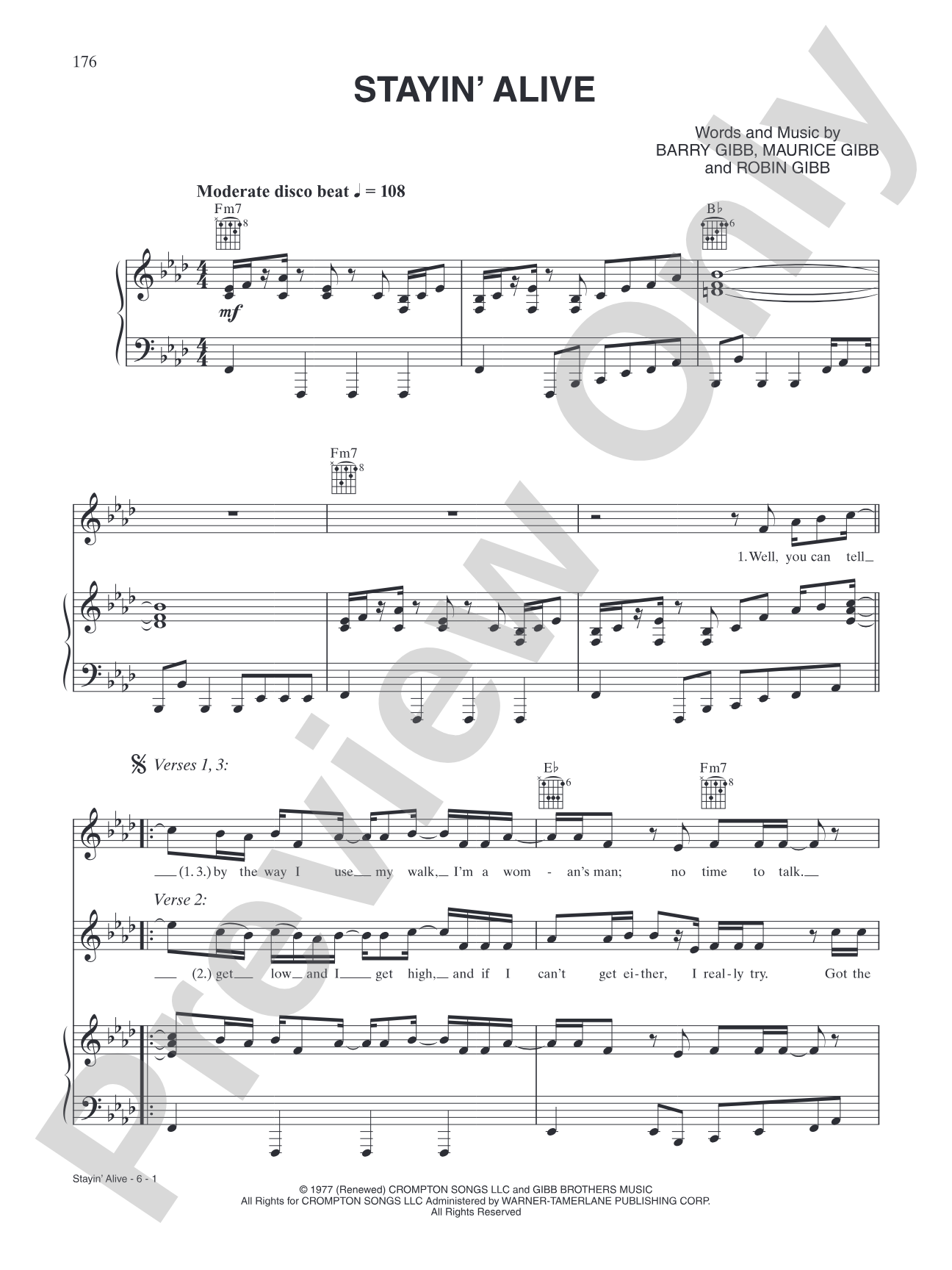
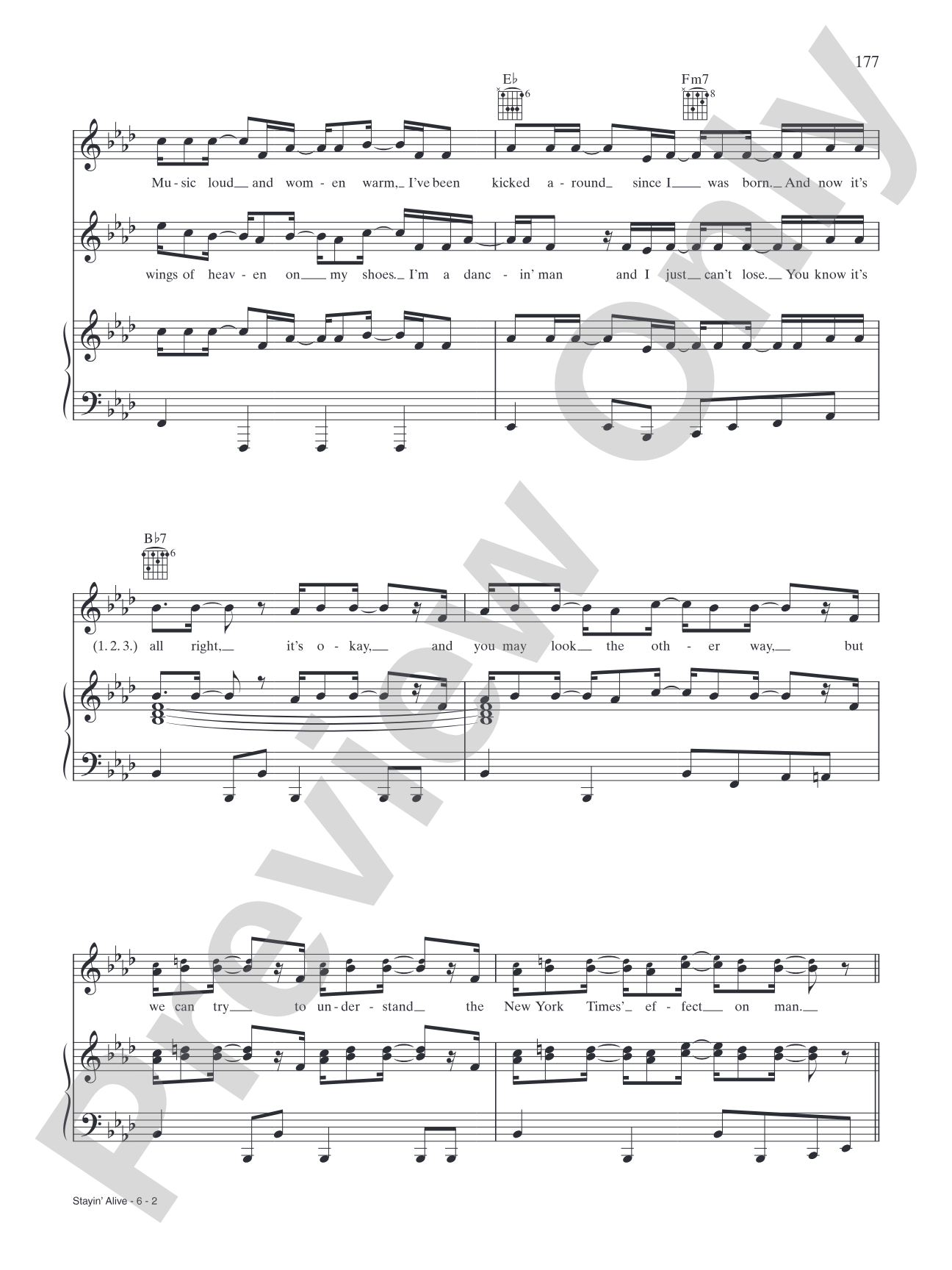

Stayin' Alive (from "Saturday Night Fever"): Piano/Vocal/Chords
Ten Years of Popular Sheet Music Bestsellers
Item: 00-PS-0010820
$5.99
One moment…
Related Items
Sundown: Piano/Vocal/Chords |
$4.99
|
View | |
This Masquerade: Piano/Vocal/Chords |
$4.99
|
View | |
O-O-H Child: Piano/Vocal/Chords |
$4.99
|
View | |
Whipping Post: Piano/Vocal/Chords |
$5.99
|
View | |
Taxi: Piano/Vocal/Chords |
$9.99
|
View | |
Shower the People: Piano/Vocal/Chords |
$4.99
|
View | |
Another Saturday Night: Piano/Vocal/Chords |
$4.99
|
View | |
Looking for a Love: Piano/Vocal/Chords |
$4.99
|
View |
Description
This songbook contains more than 40 of the biggest hits of the '70s. Each song is sure to spark a memory or create a new one for pianists or vocalists of all ages. For practice, performance, or pleasure, play and sing your way through your favorite decade in pop music history! Titles: All My Love (Led Zeppelin) * Another Saturday Night (Cat Stevens) * Big Yellow Taxi (Joni Mitchell) * Born to Run (Bruce Springsteen) * Casey Jones (Grateful Dead) * Cat's in the Cradle (Harry Chapin) * Closer to the Heart (Rush) * Comfortably Numb (Pink Floyd) * Dancing Queen (ABBA) * Desperado (Eagles) * Evergreen (Barbra Streisand) * Flash Light (Parliament) * Hotel California (Eagles) * How Deep Is Your Love (Bee Gees) * Killing Me Softly with His Song (Roberta Flack) * Layla (Derek and the Dominos) * Lights (Journey) * Lola (The Kinks) * Looking for a Love (Bobby Womack) * Maggie May (Rod Stewart) * Margaritaville (Jimmy Buffett) * Moondance (Van Morrison) * Nobody Does It Better (Carly Simon) * Old Time Rock & Roll (Bob Seger) * O-o-h Child (The Five Stairsteps) * The Rose (Bette Midler) * Roundabout (Yes) * Shower the People (James Taylor) * Song from M*A*S*H* (Suicide is Painless) (Johnny Mandel) * Stairway to Heaven (Led Zeppelin) * Star Wars Main Title (John Williams) * Stayin' Alive (Bee Gees) * Sundown (Gordon Lightfoot) * Take Me Home, Country Roads (John Denver) * Taxi (Harry Chapin) * Theme from Ice Castles (Melissa Manchester) * Theme from New York, New York (Frank Sinatra) * This Masquerade (George Benson) * Thunder Road (Bruce Springsteen) * Weekend in New England (Barry Manilow) * Wheel in the Sky (Journey) * Whipping Post (The Allman Brothers Band) * Wild Horses (The Rolling Stones) * Wish You Were Here (Pink Floyd) * You Light Up My Life (Debby Boone) * You Needed Me (Anne Murray).


Stayin' Alive (from "Saturday Night Fever"): Piano/Vocal/Chords isn't in MakeMusic Cloud just yet...but it could be. Let us know you'd like to see it, and you'll help shape what comes next. In the meantime, start a free trial and dive into thousands of interactive titles your students can play along with today.
Request This Title
Tell us you want it.
Start Your Free Trial
Explore everything that's ready to play right now.
Sample Audio
No sample audio found.
Sample Video
No sample videos found.
Additional Details
Series:
Decade by Decade
Publisher:
Alfred Music
Page Count:
256
SKU:
00-PS-0010820
More about this title
About the Composer: Barry Gibb
Barry Gibb, Maurice Gibb, and Robin Gibb formed the Bee Gees in the 1960s and became one of the most influential pop acts of their generation. The trio's mastery of vocal harmony, production innovation, and songwriting made them central figures in the disco explosion of the 1970s, with "Saturday Night Fever" standing as their cultural peak. Their catalog spans multiple decades and demonstrates how compositional versatility and meticulous arrangement can sustain artistic relevance across changing musical landscapes.
For music educators, the Bee Gees' work offers accessible yet sophisticated examples of harmony, countermelody, and rhythmic precision. Their songs reward close listening and reveal production techniques that remain contemporary teaching tools.
Why we love this
This collection places "Stayin' Alive" alongside 40 other essential '70s tracks, giving your singers and pianists access to an entire era's vocabulary in one volume. The decade-spanning repertoire means you can pair this song with contextual programming choices, and the arrangement format (piano/vocal/chords) works equally well for accompaniment rehearsals, solo recitals, or mixed-ensemble performance.
What to expect
"Stayin' Alive" pulses with infectious rhythm and silky vocal lines that make you move even while reading notation on a stand. The falsetto melodies and lush keyboard textures evoke the precise, polished production of Saturday Night Fever, transporting players straight into the disco era's confidence and groove.
Who it's for
Pianists and singers of all ages who want accessible arrangements of authentic '70s hits can use this book for solo performance, duo rehearsal, or informal entertainment. Music teachers serving students in grades 5 and up will find the chord notation and singable melodies work well for mixed-ability groups; the professional transcriptions capture the original spirit without requiring extensive rewriting.
How to get the most out of it
- Lock the signature 4-on-the-floor kick pattern in your left hand before adding the right-hand figures; this foundation holds everything together.
- Sing the iconic falsetto sections with breath support that keeps the tone consistent across the register shift—light but never breathy.
- Pay attention to the chord voicings notated in this arrangement; they define the disco feel, so don't simplify or substitute.
- Layer the performance: establish the bass line, add the chordal rhythm, then bring in the vocal melody last for clean ensemble balance.
How to use it
Pair this with other songs from the collection to build a themed concert celebrating a specific decade or musical movement. A singer performing "Stayin' Alive" as part of a longer recital connecting '70s pop traditions to contemporary pop gives audiences a clear historical throughline, and the piano/vocal format lets you accompany yourself or work with a pianist in your ensemble.
Skills your students will build
- Reading and executing steady disco groove patterns in the left hand
- Singing falsetto and modal mixture across multiple octaves
- Interpreting jazz-influenced chord voicings from lead-sheet notation
- Balancing melody and accompaniment in piano/vocal performance
- Understanding how arrangement and orchestration shape popular song identity