
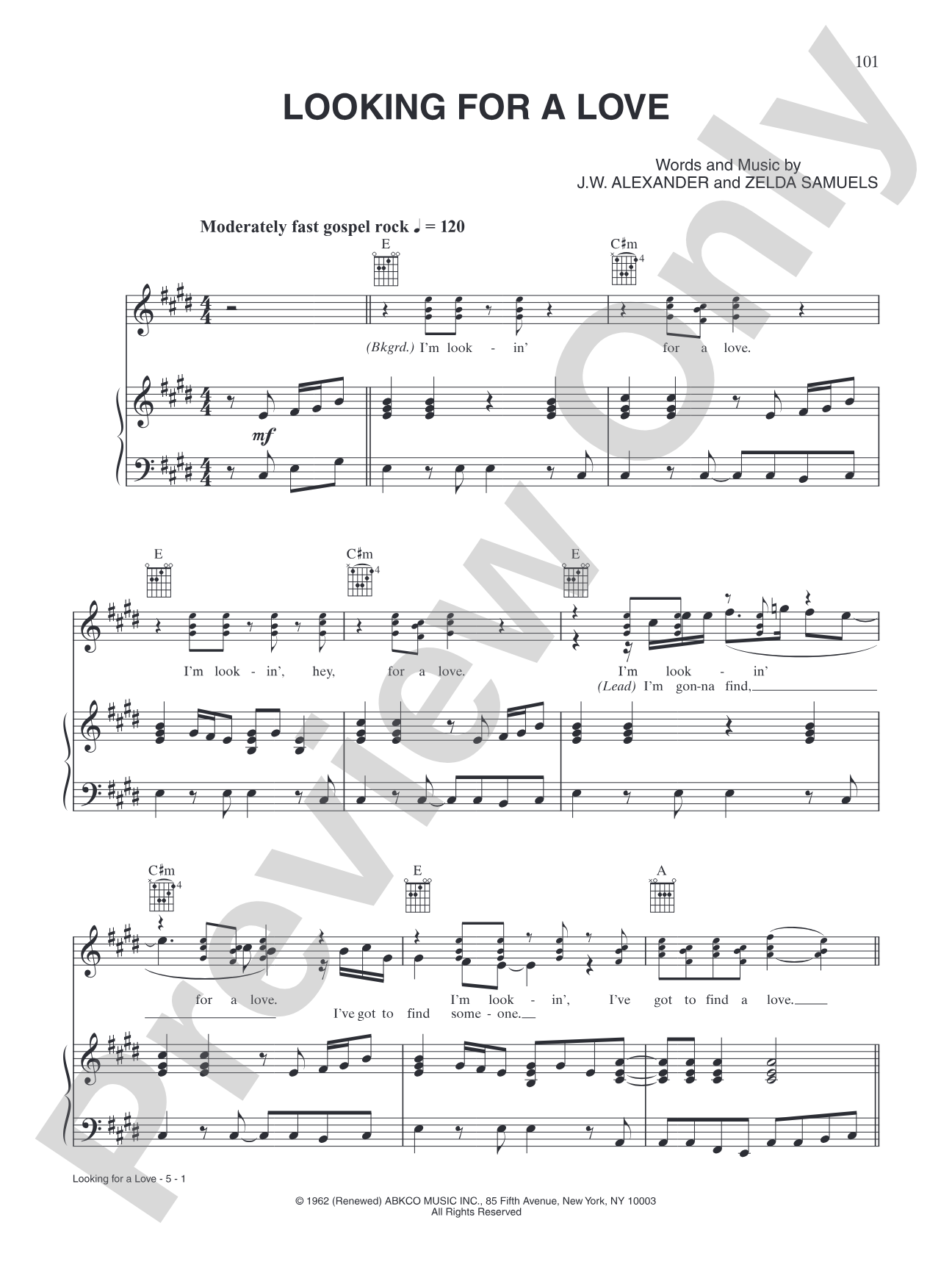

Looking for a Love: Piano/Vocal/Chords
Ten Years of Popular Sheet Music Bestsellers
Item: 00-PS-0010989
$4.99
Pickup currently not available
Related Items
Sundown: Piano/Vocal/Chords |
$4.99
|
View | |
This Masquerade: Piano/Vocal/Chords |
$4.99
|
View | |
O-O-H Child: Piano/Vocal/Chords |
$4.99
|
View | |
Stayin' Alive (from "Saturday Night Fever"): Piano/Vocal/Chords |
$5.99
|
View | |
Whipping Post: Piano/Vocal/Chords |
$5.99
|
View | |
Taxi: Piano/Vocal/Chords |
$9.99
|
View | |
Shower the People: Piano/Vocal/Chords |
$4.99
|
View | |
Another Saturday Night: Piano/Vocal/Chords |
$4.99
|
View |
Description
This songbook contains more than 40 of the biggest hits of the '70s. Each song is sure to spark a memory or create a new one for pianists or vocalists of all ages. For practice, performance, or pleasure, play and sing your way through your favorite decade in pop music history! Titles: All My Love (Led Zeppelin) * Another Saturday Night (Cat Stevens) * Big Yellow Taxi (Joni Mitchell) * Born to Run (Bruce Springsteen) * Casey Jones (Grateful Dead) * Cat's in the Cradle (Harry Chapin) * Closer to the Heart (Rush) * Comfortably Numb (Pink Floyd) * Dancing Queen (ABBA) * Desperado (Eagles) * Evergreen (Barbra Streisand) * Flash Light (Parliament) * Hotel California (Eagles) * How Deep Is Your Love (Bee Gees) * Killing Me Softly with His Song (Roberta Flack) * Layla (Derek and the Dominos) * Lights (Journey) * Lola (The Kinks) * Looking for a Love (Bobby Womack) * Maggie May (Rod Stewart) * Margaritaville (Jimmy Buffett) * Moondance (Van Morrison) * Nobody Does It Better (Carly Simon) * Old Time Rock & Roll (Bob Seger) * O-o-h Child (The Five Stairsteps) * The Rose (Bette Midler) * Roundabout (Yes) * Shower the People (James Taylor) * Song from M*A*S*H* (Suicide is Painless) (Johnny Mandel) * Stairway to Heaven (Led Zeppelin) * Star Wars Main Title (John Williams) * Stayin' Alive (Bee Gees) * Sundown (Gordon Lightfoot) * Take Me Home, Country Roads (John Denver) * Taxi (Harry Chapin) * Theme from Ice Castles (Melissa Manchester) * Theme from New York, New York (Frank Sinatra) * This Masquerade (George Benson) * Thunder Road (Bruce Springsteen) * Weekend in New England (Barry Manilow) * Wheel in the Sky (Journey) * Whipping Post (The Allman Brothers Band) * Wild Horses (The Rolling Stones) * Wish You Were Here (Pink Floyd) * You Light Up My Life (Debby Boone) * You Needed Me (Anne Murray).


Looking for a Love: Piano/Vocal/Chords isn't in MakeMusic Cloud just yet...but it could be. Let us know you'd like to see it, and you'll help shape what comes next. In the meantime, start a free trial and dive into thousands of interactive titles your students can play along with today.
Request This Title
Tell us you want it.
Start Your Free Trial
Explore everything that's ready to play right now.
Sample Audio
No sample audio found.
Sample Video
No sample videos found.
Additional Details
Series:
Decade by Decade
Publisher:
Alfred Music
Page Count:
256
SKU:
00-PS-0010989
More about this title
About the Composer: J.W. Alexander
J.W. Alexander co-wrote "Looking for a Love," one of the defining soul and R&B songs of the early 1970s. Originally recorded by Bobby Womack in 1974, the song became a staple of the decade's popular music landscape and has since been covered by countless artists across genres.
Alexander's work as a songwriter helped shape the soul and pop sound of the 1970s, contributing to the era's rich catalog of emotionally resonant material. His songwriting partnership produced music that continues to resonate with performers and audiences today.
Why we love this
This collection spans the full emotional and stylistic range of '70s pop and rock, from introspective singer-songwriter material (James Taylor, Joni Mitchell) to arena anthems (Led Zeppelin, Rush) to pure disco joy (ABBA, Bee Gees). Whether you're teaching beginners or working with experienced musicians, the variety here means students encounter different vocal ranges, piano textures, and harmonic language without monotony. Pianists and singers alike will find genuinely singable arrangements that honor the original recordings while remaining playable at multiple skill levels.
What to expect
Opening this songbook is like stepping into a time capsule filled with songs that defined a generation. From the acoustic intimacy of "The Rose" to the synth-driven propulsion of "Flash Light," from the storytelling specificity of "Cat's in the Cradle" to the anthemic sweep of "Stairway to Heaven," these arrangements capture the emotional authenticity that made '70s music endure. Every page invites you to reconnect with melodies and harmonies that shaped how people listen to pop music.
Who it's for
Pianists and vocalists across all skill levels will find material here worth returning to. Whether you're a student building jazz voicing skills, a community musician performing at open mics, or an adult learner reclaiming songs from your past, this collection offers substance alongside nostalgia. Music directors can dip into this resource for recital programming, church services, or educational settings where context and familiarity boost engagement.
How to get the most out of it
- Honor the original key and vocal range of each song; transpose selectively only when it serves your performer, not as a default. The arrangements are written to match the original recordings most singers and pianists will reference.
- Pay attention to the chord symbols as a guide to voicing and comping. These songs often rely on specific harmonic colors (like the suspended chords in "Hotel California" or the jazz voicings in "How Deep Is Your Love") that anchor the song's identity.
- Use the rhythm section feel as your foundation. Whether swung ("Stayin' Alive"), straight-eighth ("Born to Run"), or laid-back shuffle ("Moondance"), locking into the groove makes the whole arrangement breathe.
- Balance vocal storytelling with piano sensitivity. These songs were written for intimate connection; resist the urge to oversell the accompaniment.
How to use it
Program selections from this collection for recitals, open houses, or community performances where audience familiarity enhances engagement and reduces performance anxiety. Use individual songs as supplementary repertoire in voice or piano lessons to build musicianship while working with material students already know and love. Extract excerpts for sight-reading practice or as models of specific harmonic or melodic techniques across different styles and eras.
Skills your students will build
- Reading piano/vocal/chord notation and translating chord symbols into voice-leading choices
- Accompanying singers while maintaining independent keyboard voicing and comping patterns
- Navigating varied harmonic vocabulary (suspended chords, sevenths, extended harmonies) across multiple song styles
- Responding dynamically to vocal phrasing and emotional intent in accompaniment
- Building fluency with pop and rock song forms and grooves
- Sight-reading across a wide range of keys, tempos, and stylistic contexts