
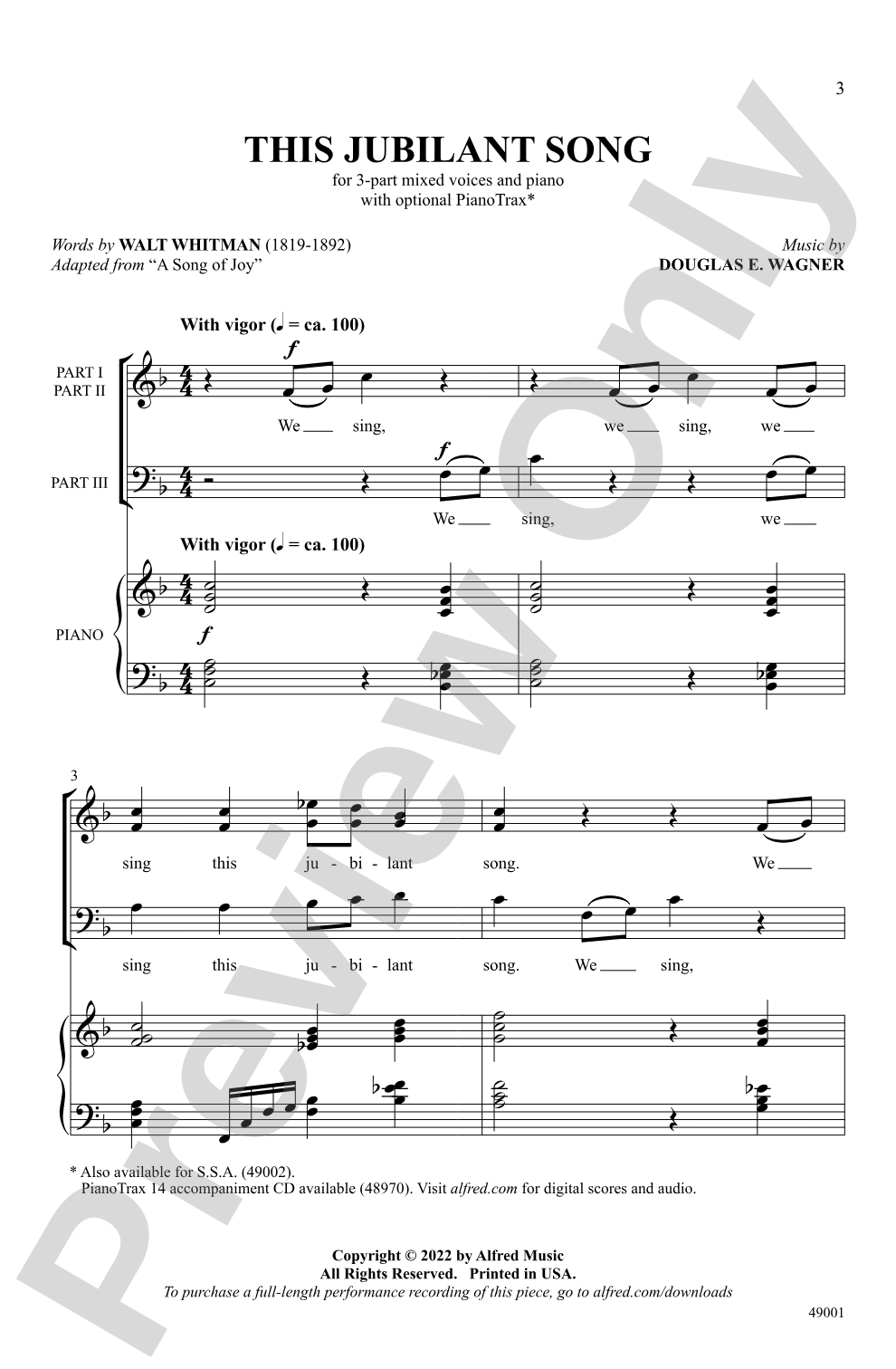
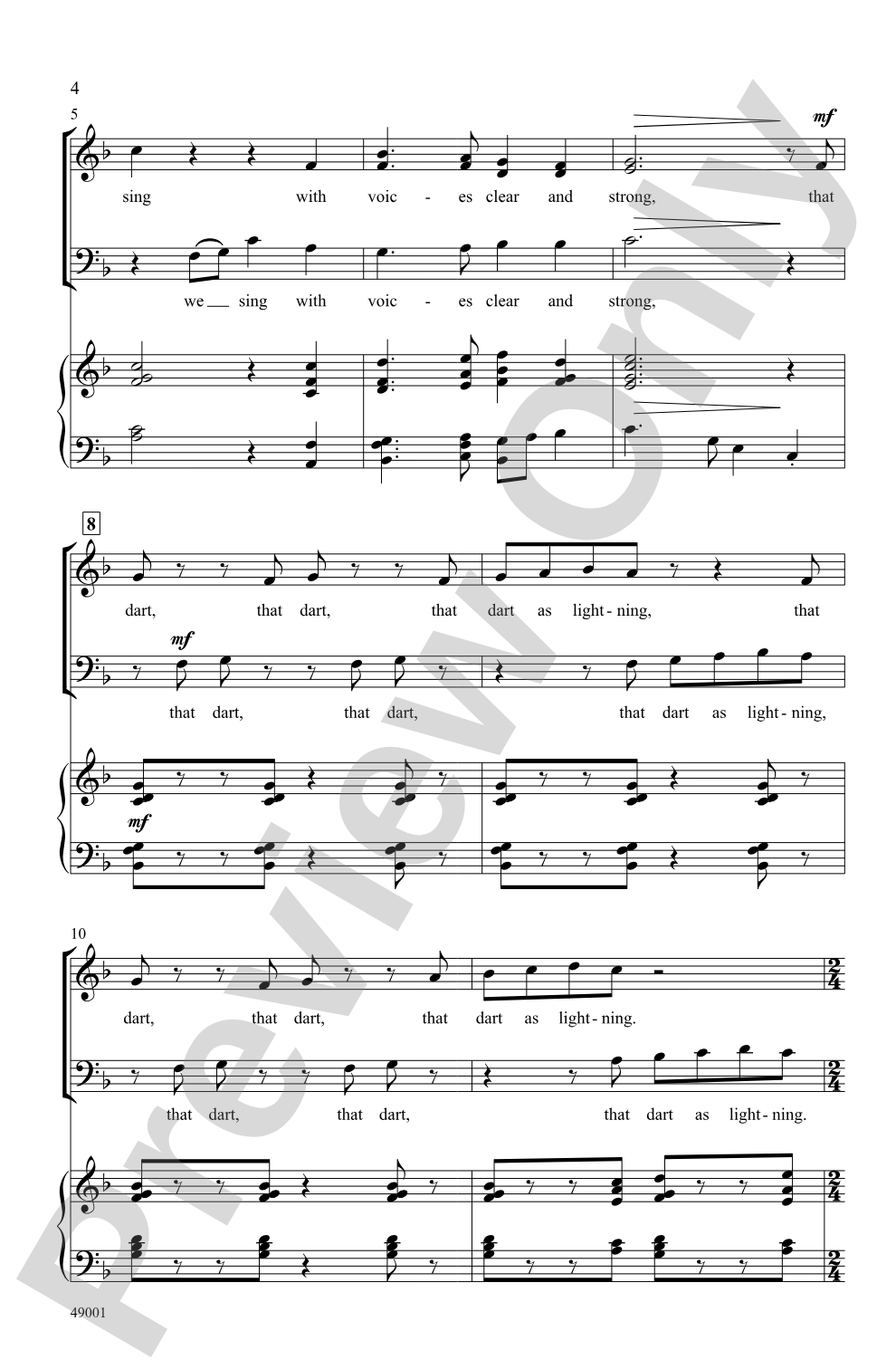

This Jubilant Song: 3-Part Mixed Choral Octavo
Words by Walt Whitman, music by Douglas E. Wagner
Item: 00-PO-0006850
$2.05
Minimum order quantity: 20 copies
Pickup currently not available
Description
Captivate your audience and adjudicators with this masterful work for three-part mixed and treble groups. Grand, awe-inspiring music and a compelling Walt Whitman text make for an impressive festival selection, worthy of the rehearsal time. A sturdy piano accompaniment anchors the kind of classic choral singing that will foster a new level of excellence. Destined to become a staple of choral repertoire. This title is available in MakeMusic Cloud.


This Jubilant Song: 3-Part Mixed Choral Octavo isn't in MakeMusic Cloud just yet...but it could be. Let us know you'd like to see it, and you'll help shape what comes next. In the meantime, start a free trial and dive into thousands of interactive titles your students can play along with today.
Request This Title
Tell us you want it.
Start Your Free Trial
Explore everything that's ready to play right now.
Sample Audio
1
Audio File
--:--
0:00
0:00
Sample Video
Additional Details
Series:
Alfred Choral Designs
Publisher:
Alfred Music
Page Count:
12
SKU:
00-PO-0006850
More about this title
About the Composer: Douglas E. Wagner

Douglas E. Wagner grew up in Chicago and earned degrees in music from Butler University before spending three decades as a high school music director and administrator. His shift to full-time composition has proven remarkably prolific: since 1973, he has published over 3,500 works across choir, band, orchestra, handbell ensemble, organ, piano, and voice, with more than seventeen million copies in circulation worldwide.
Wagner's music reaches audiences through concert halls, broadcasts, and festival stages internationally. He now resides in Indianapolis with his wife, Sandy, and continues to shape choral and instrumental repertoire at every educational level.
Why we love this
Wagner's gift for writing gratifying choral lines within accessible ranges means your singers will sound polished and confident without sacrificing musical substance. The pairing of Whitman's text with a sturdy piano part creates a piece that feels both intellectually engaging and immediately performable, making it equally strong at festival adjudication or community concert.
What to expect
Grand and celebratory, this work unfolds with the expansive quality that Whitman's poetry demands. The music builds with quiet confidence before opening into moments of genuine awe, supported throughout by the kind of harmonic clarity that lets singers feel their part's importance within the whole.
Who it's for
This piece suits intermediate to advanced treble and mixed choirs preparing for festival season or concert programming. Directors seeking repertoire that balances accessibility with musical depth will find this particularly valuable for groups ready to tackle part-writing without sacrificing tuneful, singable melody.
How to get the most out of it
- Balance the three parts by rehearsing sections separately first, then layer them gradually so each voice can hear its role in the harmonic foundation without being swallowed by others.
- Use the piano accompaniment as a full rehearsal tool, not just for performance; having it present during sectionals helps singers lock into harmonic relationships and understand their role within the larger texture.
- Shape the arc of the piece by identifying where the text naturally builds in intensity, allowing dynamics and tempo flexibility to support Whitman's language rather than working against it.
- Test your blend at performance volume and tempo early in rehearsal; what works in a warm sectional may need adjusting when all three parts sing together at full sound.
How to use it
Open a concert or festival set with this piece to establish musical excellence and poetic ambition from the outset. Its substantial length and serious character position it naturally alongside other secular choral works in a well-curated program, or it can anchor a concert centered on American poetry and music.
Skills your students will build
- Part independence in 3-part writing
- Harmonic listening and awareness of voice leading
- Interpretation of literary text through musical gesture
- Sustained ensemble blend across longer formal structures
- Balance between melody and accompaniment in piano-accompanied settings