
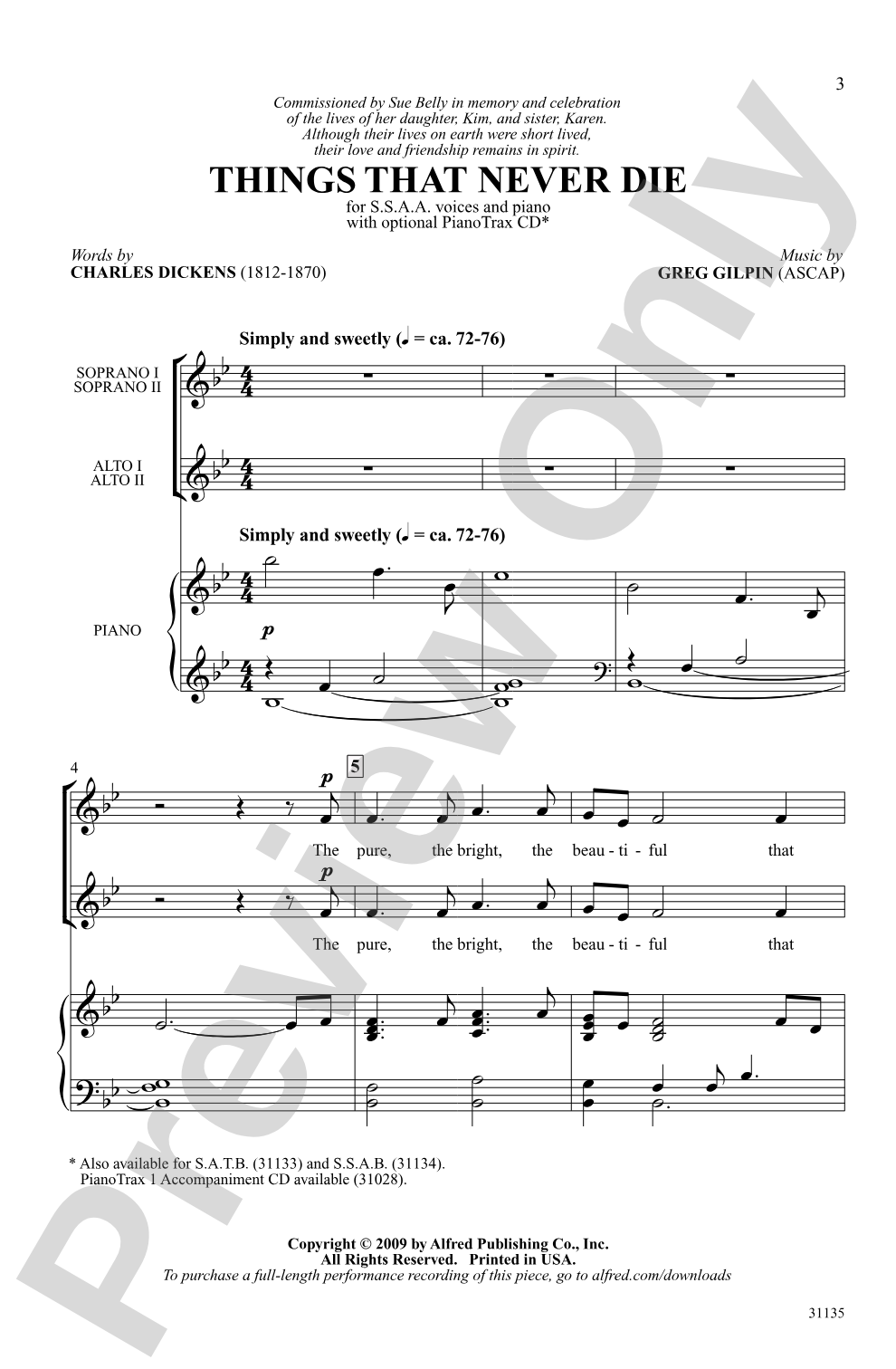
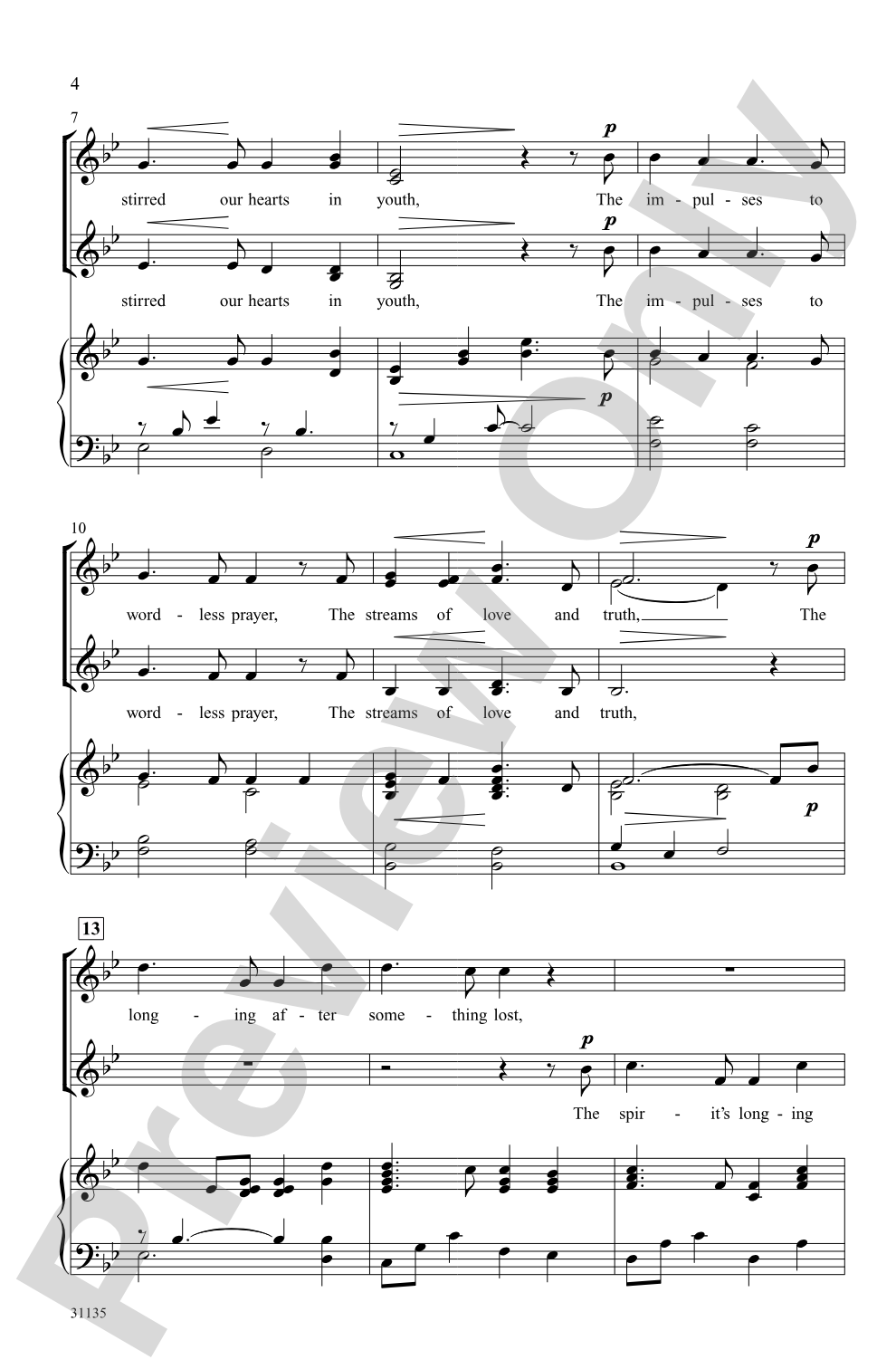

Things That Never Die: SSAA Choral Octavo
Words by Charles Dickens, music by Greg Gilpin
Item: 00-PO-0000798
$1.75
Minimum order quantity: 20 copies
Pickup currently not available
Description
The emotional words of Charles Dickens are paralleled by the powerful music in this sensitive choral for contemporary choirs. Each of the contrasting sections transitions seamlessly to the next. An exquisite work, rich in musicality and poetry. Accompaniment included on PianoTrax 1 CD (00-31028).


Things That Never Die: SSAA Choral Octavo isn't in MakeMusic Cloud just yet...but it could be. Let us know you'd like to see it, and you'll help shape what comes next. In the meantime, start a free trial and dive into thousands of interactive titles your students can play along with today.
Request This Title
Tell us you want it.
Start Your Free Trial
Explore everything that's ready to play right now.
Sample Audio
1
Audio File
--:--
0:00
0:00
Sample Video
No sample videos found.
Additional Details
Series:
Alfred Choral Designs
Publisher:
Alfred Music
Page Count:
12
SKU:
00-PO-0000798
More about this title
About the Composer: Greg Gilpin

Greg Gilpin has established himself as a prominent voice in American choral music through his work as both a composer and conductor. His performances have taken him to some of the world's most prestigious concert halls, from Carnegie Hall and Lincoln Center in New York to the Sydney Opera House and Royal Festival Hall in London. As Director of Educational Choral Publications for Shawnee Press, he shapes the repertoire that choirs across the country perform in rehearsals and on stage.
Beyond his choral work, Gilpin has expanded his creative reach into film scoring, composing the award-winning score for the short film "Rosie's Rescue," and has collaborated on innovative arrangements with accomplished singers. An ASCAP award winner and active member of ACDA and NAfME, Gilpin continues to balance his roles as educator, composer, and conductor while mentoring the next generation of musicians.
Why we love this
Gilpin crafts choral writing that respects the intelligence of contemporary singers while maintaining genuine emotional depth. The seamless transitions between contrasting sections create a through-composed arc that keeps both singers and listeners engaged, making this work compelling enough for concert programming yet accessible enough for developing choirs.
What to expect
The work unfolds with quiet introspection before building moments of intensity, creating an emotional journey that mirrors the gravity of Dickens' text. Rich harmonic writing and lyrical vocal lines invite singers into a space of reflection, while the architecture of the piece suggests something that endures beyond the moment.
Who it's for
This octavo works for intermediate to advanced treble choirs seeking substantial literature that balances artistic growth with performance success. It suits both community choirs and school ensembles (middle school through college) looking for a piece with literary depth and contemporary sensibility.
How to get the most out of it
- Study the text separately before integrating it with the music. Dickens' language carries weight, and singers will deliver it with greater conviction when they understand each phrase's emotional context.
- Balance the SSAA voicing by doubling the second soprano line lightly during exposed passages to ensure harmonic clarity without sacrificing blend.
- Use the PianoTrax accompaniment recording in early rehearsals to establish tempos and phrasing, then gradually reduce its use so singers develop independence in transitions between sections.
- Mark breath points carefully during sectional rehearsals to ensure the ensemble breathes together at phrase boundaries, preserving the continuous musical line Gilpin has written.
How to use it
Program this as a centerpiece of a concert exploring poetry and music, or pair it with other Gilpin settings for a showcase of his choral voice. Its reflective quality also makes it a fitting selection for ceremonies or special occasions where meaningful content and musical craftsmanship serve the moment.
Skills your students will build
- Phrasing through text declamation
- Sectional independence within SSAA voicing
- Reading and singing complex harmonic movement
- Maintaining tonal blend across contrasting musical ideas
- Musicality through dynamic shaping and breath control