
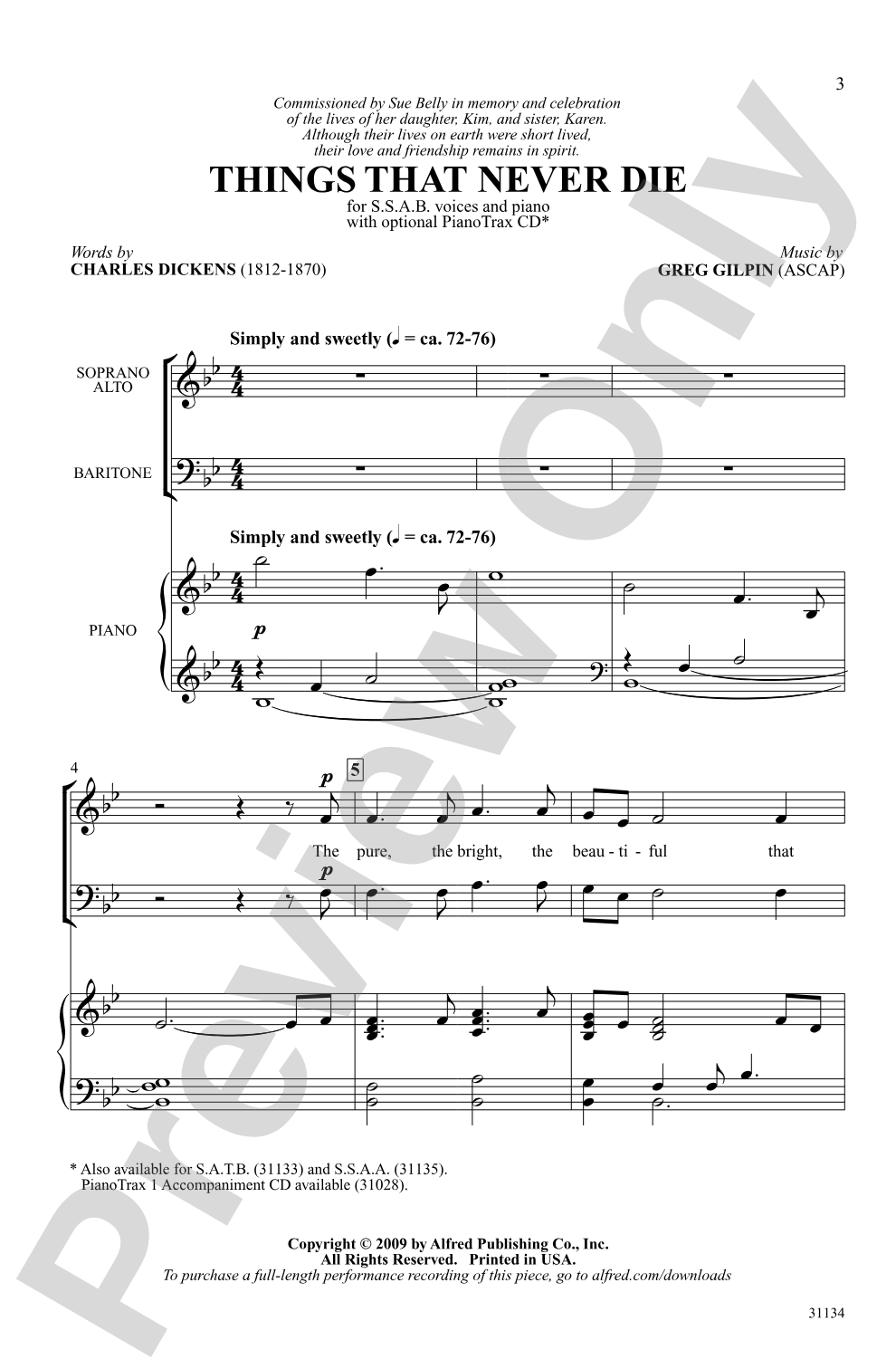

Things That Never Die: SSAB Choral Octavo
Words by Charles Dickens, music by Greg Gilpin
Item: 00-PO-0000797
$1.75
Minimum order quantity: 20 copies
Pickup currently not available
Description
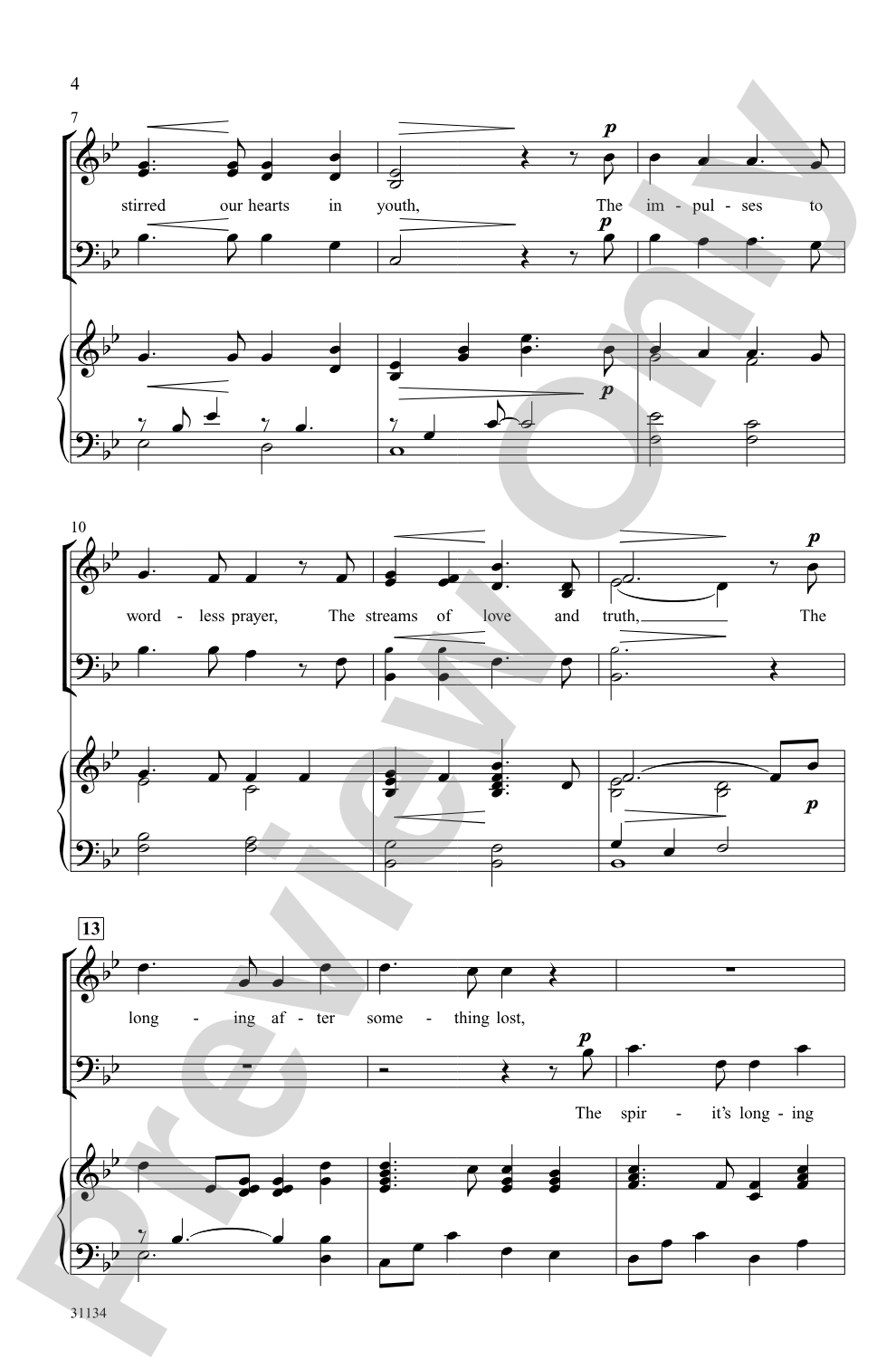
The emotional words of Charles Dickens are paralleled by the powerful music in this sensitive choral for contemporary choirs. Each of the contrasting sections transitions seamlessly to the next. An exquisite work, rich in musicality and poetry. Accompaniment included on PianoTrax 1 CD (00-31028).


Things That Never Die: SSAB Choral Octavo isn't in MakeMusic Cloud just yet...but it could be. Let us know you'd like to see it, and you'll help shape what comes next. In the meantime, start a free trial and dive into thousands of interactive titles your students can play along with today.
Request This Title
Tell us you want it.
Start Your Free Trial
Explore everything that's ready to play right now.
Sample Audio
1
Audio File
--:--
0:00
0:00
Sample Video
No sample videos found.
Additional Details
Series:
Alfred Choral Designs
Publisher:
Alfred Music
Page Count:
12
SKU:
00-PO-0000797
More about this title
About the Composer: Greg Gilpin

Greg Gilpin stands among America's most prolific choral composers, with his works performed at prestigious venues from Carnegie Hall to the Sydney Opera House. An ASCAP award-winning composer and conductor, he has shaped the sound of contemporary choral music while maintaining an active presence on the concert podium and in the recording studio. As Director of Educational Choral Publications for Shawnee Press, he continues to influence the landscape of choral literature available to singers at all levels.
Beyond the musical realm, Gilpin has pursued parallel careers as a financial coach and professional organizer, founding Maestro Organizing and appearing on network television and the series "Hoarders." His 2021 film score for "Rosie's Rescue" earned Best Score recognition, and he collaborated with opera singer Angela Brown on a world premiere arrangement of "What Child is This?" performed by the Indianapolis Symphonic Choir. A committed member of ACDA, NAfME, and Phi Mu Alpha Sinfonia, Gilpin continues to teach, compose, and conduct as choral music finds its footing in the post-pandemic landscape.
Why we love this
Gilpin's setting captures the profound weight of Dickens' words without overwhelming the text. The piece unfolds through clearly defined sections that feel inevitable rather than stitched together, giving singers genuine emotional arc and allowing audiences to absorb the message with clarity. For a choir seeking repertoire that sounds ambitious and moving while remaining accessible, this delivers on both fronts.
What to expect
Rich and introspective, the piece carries a contemplative weight befitting Dickens' reflective prose. The harmonic language feels modern without sacrificing accessibility, and the orchestration of three voices creates a transparent, intimate sound that lets the text land with quiet power.
Who it's for
This octavo suits choirs with solid musicianship and expressive maturity. The three-part voicing (SAB) opens it to mixed ensembles of varying size, and the emotional content rewards singers who can commit to meaningful text delivery alongside accurate part singing.
How to get the most out of it
- Shape phrases around Dickens' language rather than strictly to the musical barlines; let the poetry breathe and guide your phrasing choices.
- Attend carefully to the transitions between sections. Gilpin builds them seamlessly, so avoid any tempo shifts or sudden resets that would undercut the continuity.
- Balance the homophonic and divisi textures by adjusting vibrato and blend; fuller vibrato works in unison passages, but dial it back when voices separate to maintain clarity.
- Use the PianoTrax accompaniment to lock the harmonic context during rehearsals, then work toward independence so singers internalize the supporting harmonic movement.
How to use it
Program this as a centerpiece for a concert exploring themes of legacy, memory, or human resilience. Its length and emotional substance make it effective as a standalone work that can anchor a set of lighter pieces, or pair it with other contemporary choral works that share its thoughtful character.
Skills your students will build
- Shaping longer phrases across multiple systems while respecting poetic syntax
- Balancing divided and unison voicing through dynamic blend
- Reading and sustaining harmonic movement in three-part mixed voicing
- Connecting emotionally to text as a primary driver of musical interpretation