
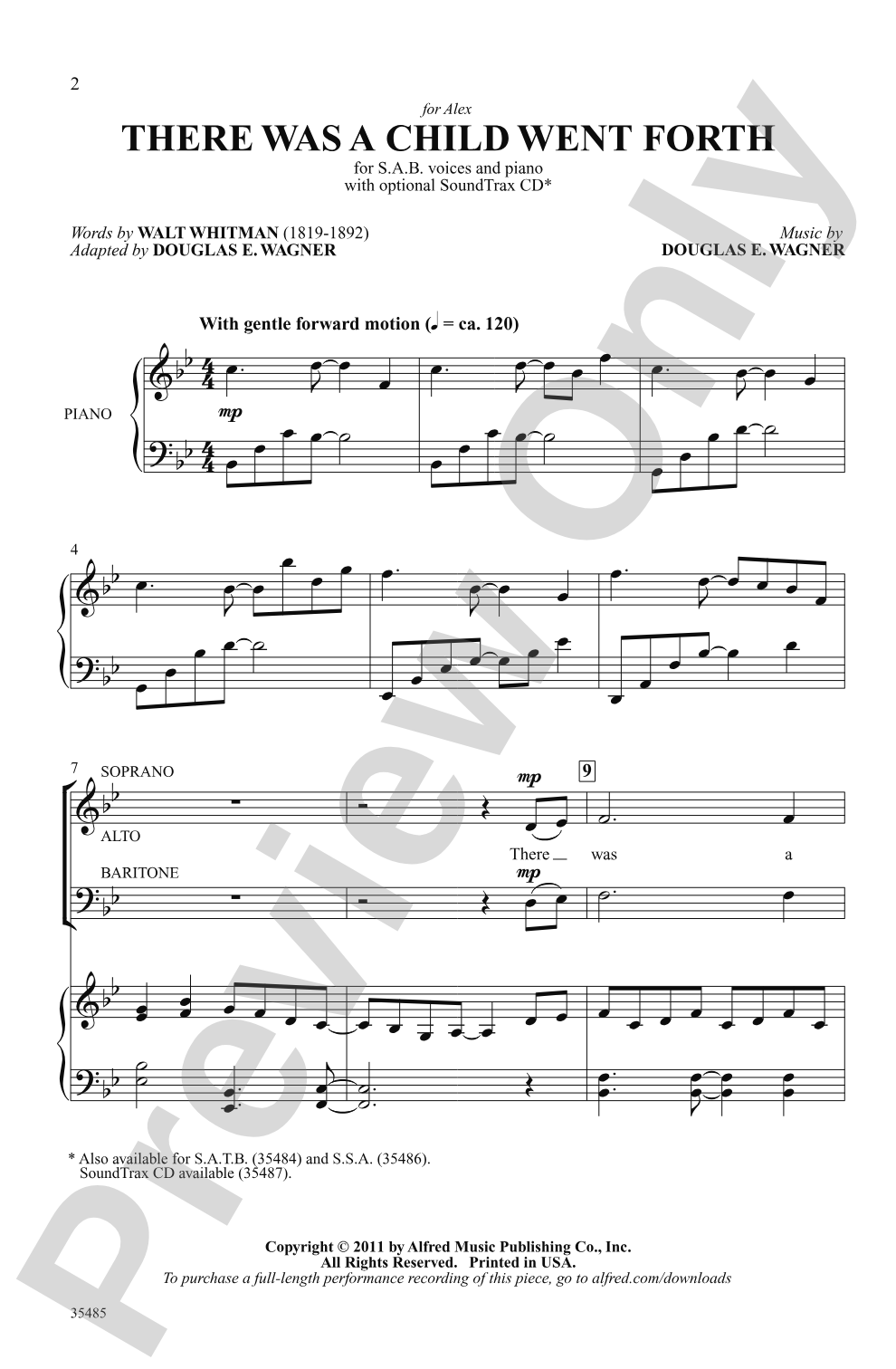
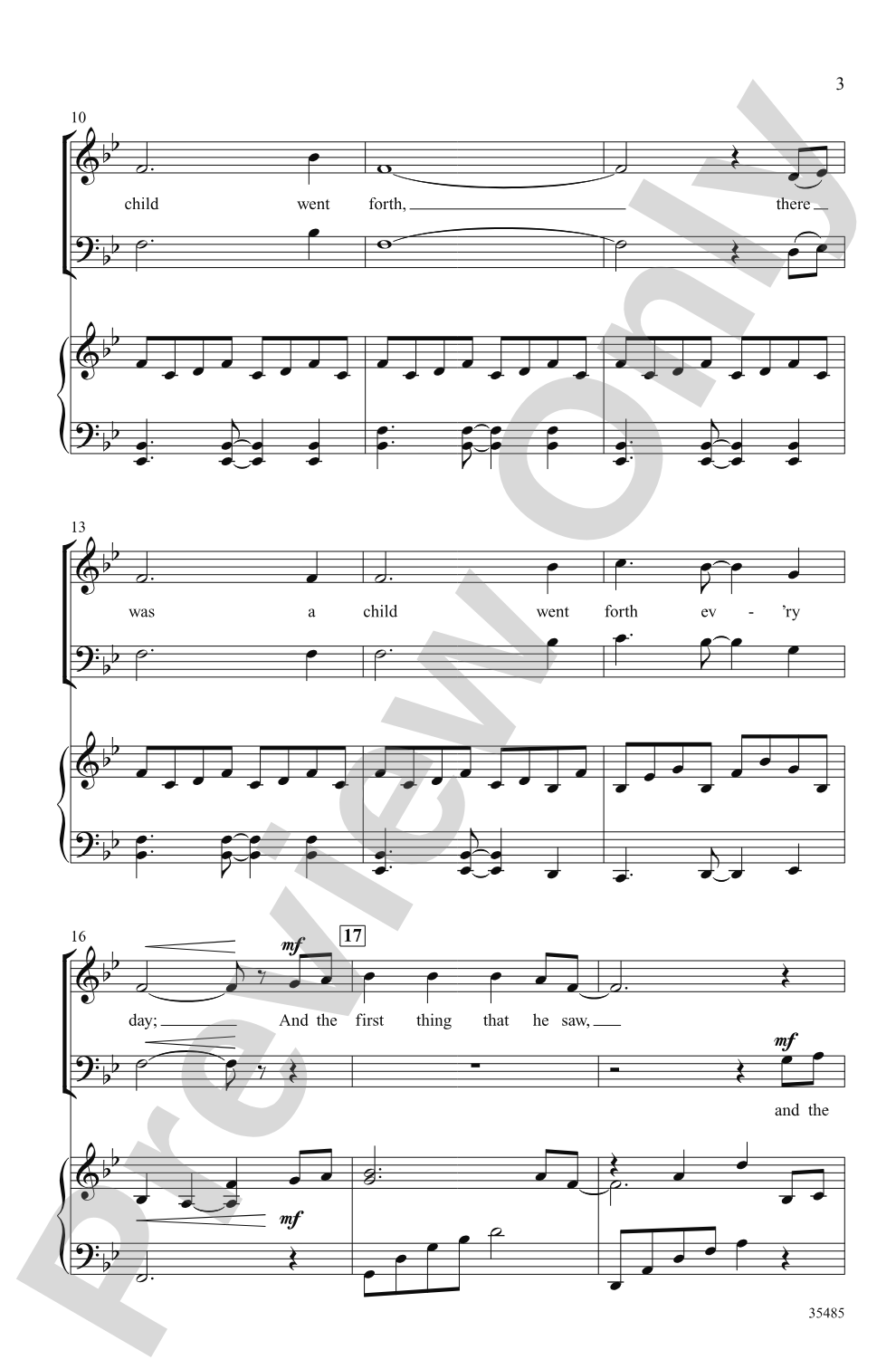
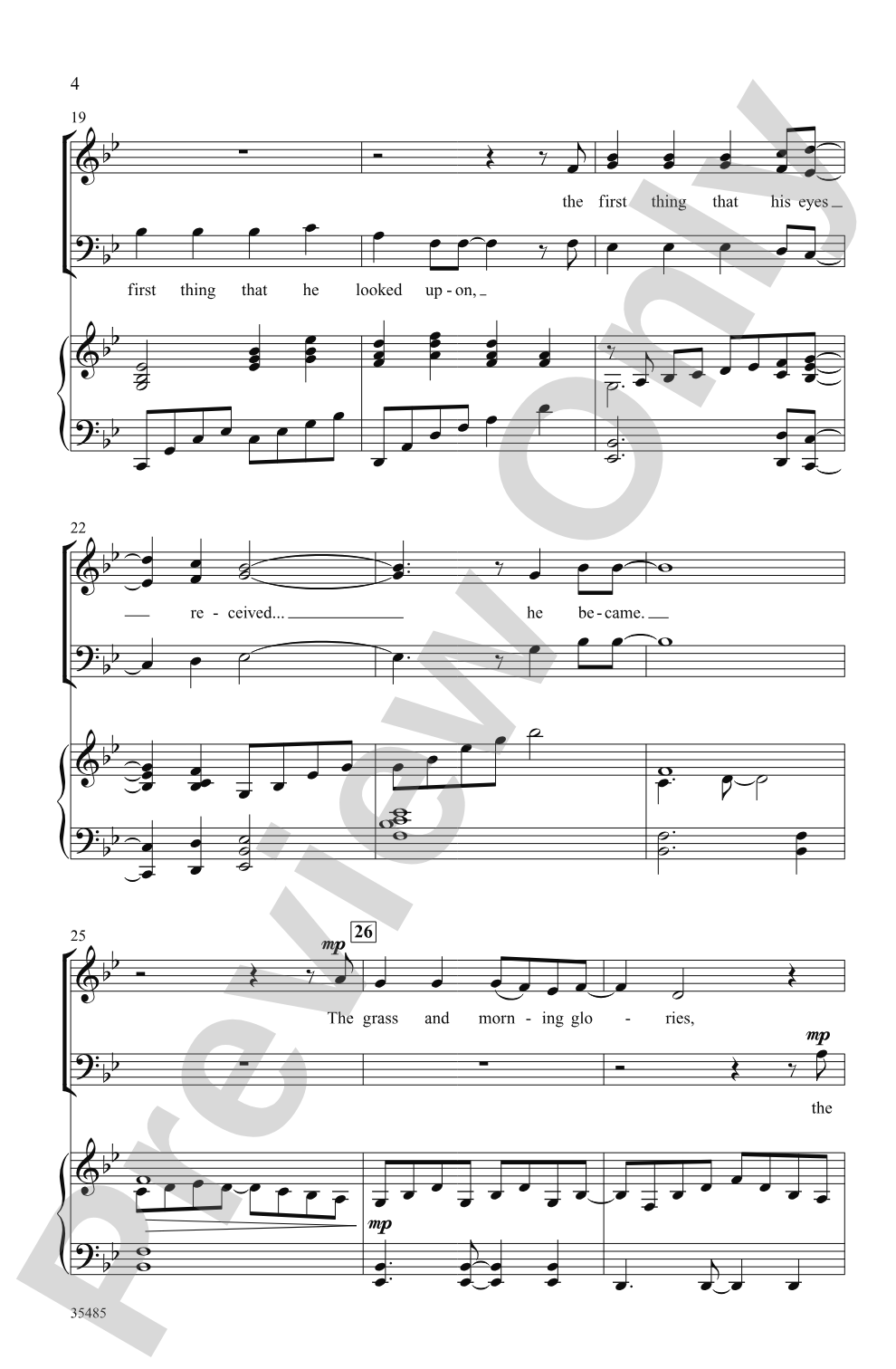

There Was a Child Went Forth: SAB Choral Octavo
Words by Walt Whitman, adapted by Douglas E. Wagner, music by Douglas E. Wagner
Item: 00-PO-0000894
$1.80
Minimum order quantity: 20 copies
Pickup currently not available
Description
The gentle motion of this contemporary concert piece insures a subtle groove beneath the memorable melody. The Whitman text emphasizes how certainly a child is influenced by what he sees. A moving tribute to childhood, teaching, parenting, coming of age.


There Was a Child Went Forth: SAB Choral Octavo isn't in MakeMusic Cloud just yet...but it could be. Let us know you'd like to see it, and you'll help shape what comes next. In the meantime, start a free trial and dive into thousands of interactive titles your students can play along with today.
Request This Title
Tell us you want it.
Start Your Free Trial
Explore everything that's ready to play right now.
Sample Audio
1
Audio File
--:--
0:00
0:00
Sample Video
No sample videos found.
Additional Details
Series:
Alfred Choral Designs
Publisher:
Alfred Music
Page Count:
12
SKU:
00-PO-0000894
More about this title
About the Composer: Douglas E. Wagner

Douglas E. Wagner grew up in Chicago and earned degrees in music from Butler University before spending three decades as a high school music director and administrator. Since 1973, he has composed and arranged more than 3,500 works spanning choir, band, orchestra, handbell ensemble, organ, piano, and voice; his music has sold well over seventeen million copies worldwide and appears regularly in concert halls and broadcasts across North America and internationally.
Now based in Indianapolis, Wagner composes full-time, drawing on his extensive experience in school music to write accessible yet artistically substantive repertoire. His prolific output and consistent engagement with educational musicians have made him one of the most-performed contemporary composers in American schools.
Why we love this
Wagner's setting of Walt Whitman's text captures something real about how children absorb their world—the melody is graceful without being saccharine, and the gentle rhythmic propulsion keeps the piece moving without rush. At SAB voicing, it works perfectly for mixed ensembles where you need something contemporary that feels substantial but won't derail your rehearsal schedule; the recorded accompaniment option also makes this practical for festivals or smaller programs.
What to expect
The gentle motion beneath the melody creates a meditation on childhood—reflective but not maudlin. You hear the influence of contemporary choral writing, but the piece never becomes precious; instead, it feels like a quiet conversation about how formative experience shapes us.
Who it's for
This piece suits mixed choirs at the high school level or adult community choirs looking for contemporary repertoire with literary substance. The SAB voicing accommodates groups with limited tenor resources or younger singers, while the accessible range and straightforward part-writing make it achievable for singers who are still building their sight-reading skills.
How to get the most out of it
- Let the rhythm section anchor the groove subtly; the piece depends on steady support rather than rigid metronomic precision, so allow the singers room to breathe within the pulse.
- Shape the melody with long lines across phrases rather than emphasizing downbeats; Whitman's text flows better when singers connect thoughts rather than hitting each bar line.
- Balance the three parts transparently so the text remains intelligible; at SAB voicing, the alto line can easily disappear if the sopranos and basses are not disciplined about dynamic control.
- Use the recorded accompaniment to lock in ensemble tuning and balance during rehearsals, then transition to live piano or your own accompaniment as confidence builds.
How to use it
Program this piece as the centerpiece of a concert exploring childhood, growth, or teaching themes, or pair it with other contemporary works to demonstrate the range of serious artistic expression available at the high school level. Its 12-page length makes it substantial enough to anchor a mixed concert program without consuming excessive rehearsal time.
Skills your students will build
- Interpreting contemporary art song literature for choir
- Sustaining long vocal lines across multiple phrases
- Balancing three-part mixed voicing with textual clarity
- Responding to recorded accompaniment and ensemble discipline