
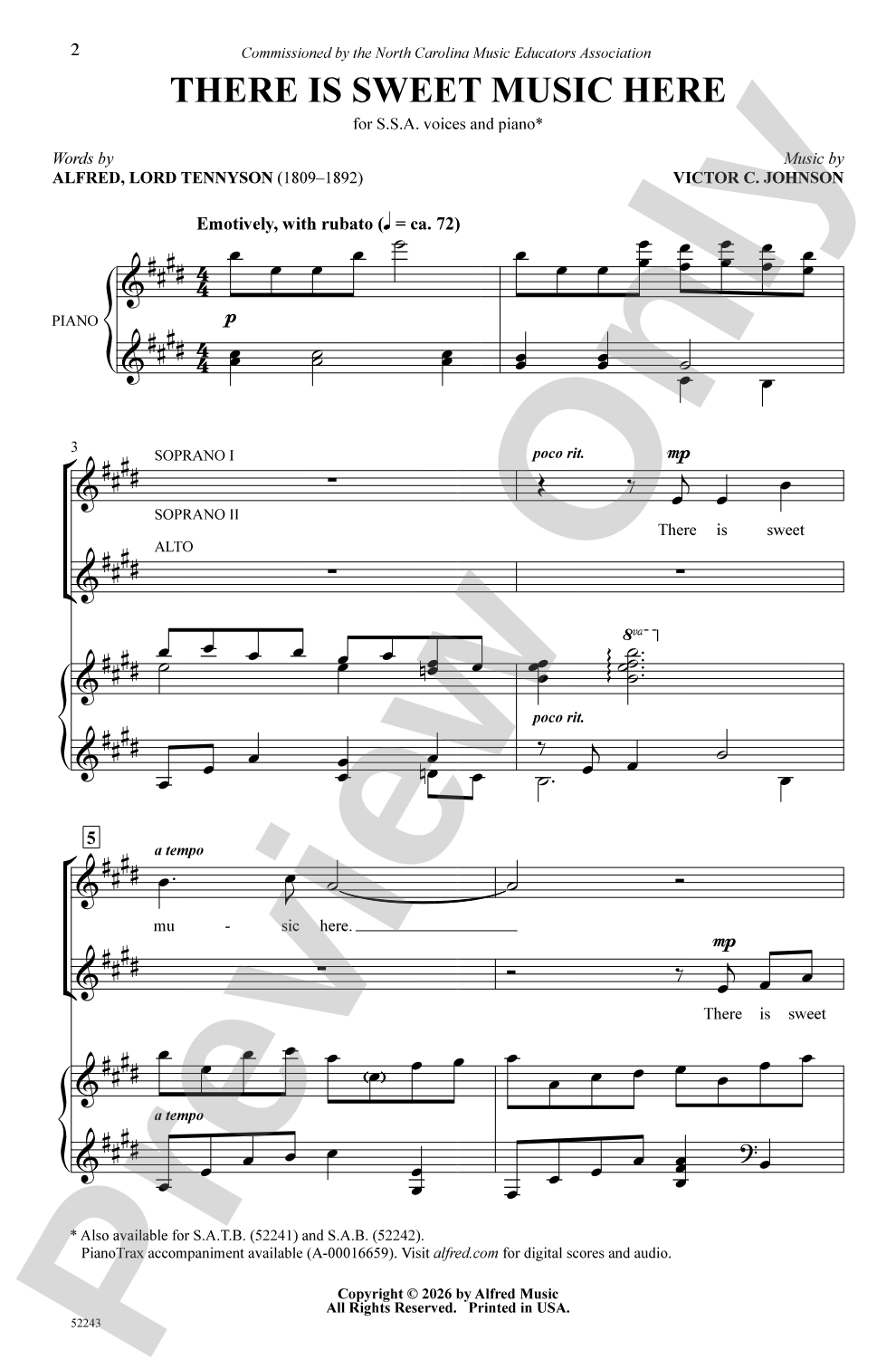

There Is Sweet Music Here: SSA Choral Octavo
Words by Alfred, Lord Tennyson, music by Victor C. Johnson
Item: 00-PO-0007843
$2.50
Minimum order quantity: 20 copies
Pickup currently not available
Description
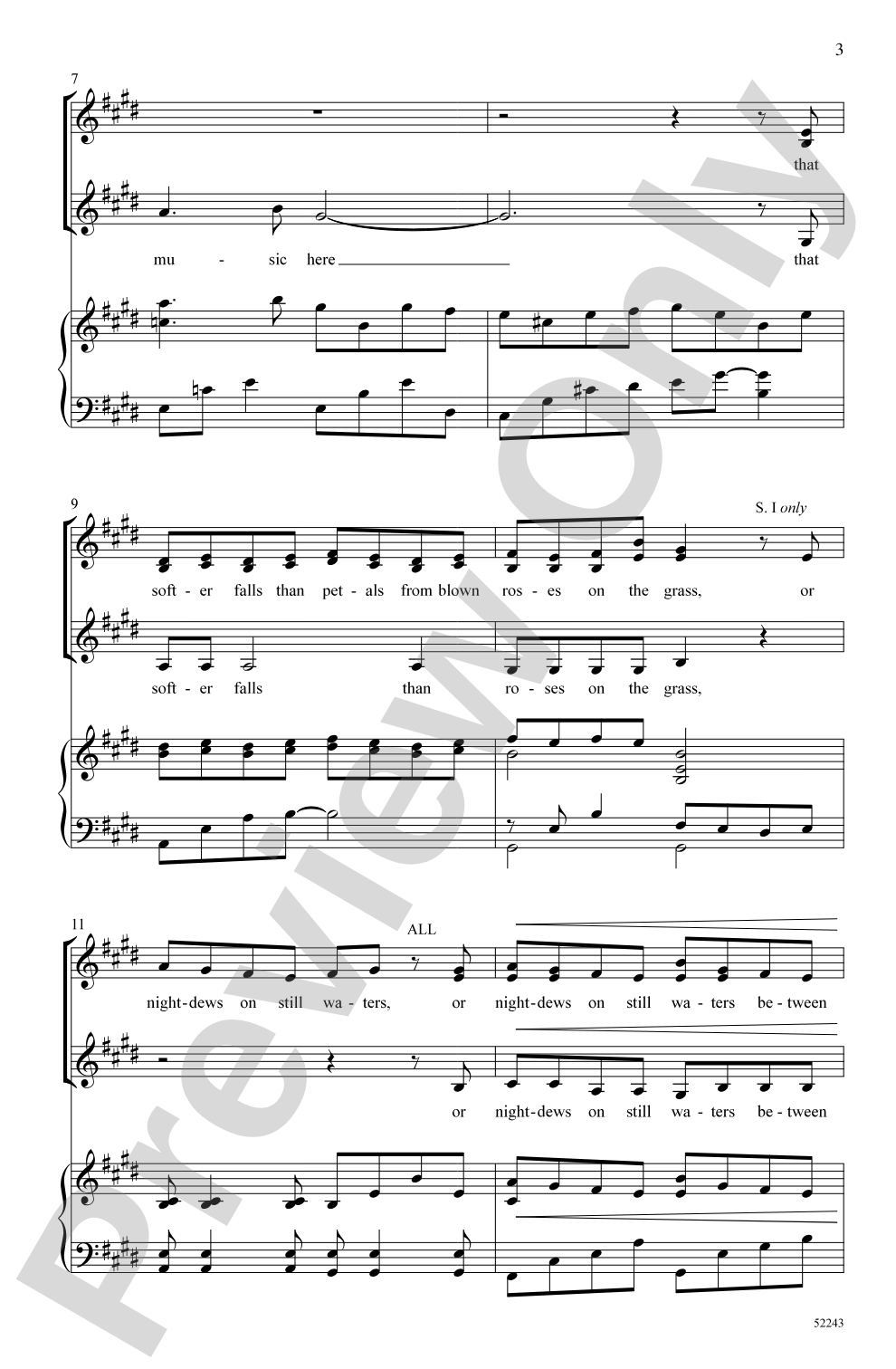
Victor Johnson lends his artistic voice to this beloved Alfred, Lord Tennyson text. A mellifluous melody, warm harmonies, and sensitive syllabic stress bring the alluring poetry to life. An elegant piano accompaniment offers decorative embellishments while providing consistent support for mixed or treble ensembles. Enjoy conducting the nuanced rubato and expressive dynamics.


Discover MakeMusic Cloud: thousands of interactive titles your students can play along with today.
Sample Audio
1
Audio File
--:--
0:00
0:00
Sample Video
Additional Details
Series:
Alfred Choral Designs
Publisher:
Alfred Music
Page Count:
12
SKU:
00-PO-0007843
More about this title
About the Composer: Victor C. Johnson

Victor C. Johnson has established himself as a leading voice in choral music education through his work as School Choral Editor for Sing!, the educational publishing division of Choristers Guild. His catalog includes over 500 published choral works, vocal solo collections, and keyboard pieces that span both concert and educational settings.
Johnson's teaching experience shaped his compositional voice during his 18 years at Ft. Worth Academy of Fine Arts, where he directed multiple ensembles including the Academy Singers and served as Artistic Director of the Singing Girls of Texas and Children's Choir of Texas. Since 2022, he has conducted the Dallas Symphony Children's Chorus Mixed Ensemble, the resident youth choir for the Dallas Symphony Orchestra. His professional memberships include the American Choral Directors Association, Texas Choral Directors Association, American Guild of Organists, and ASCAP.
Why we love this
Johnson captures the romantic sensibility of Tennyson's language without sentimentality. The syllabic text setting allows singers to fully inhabit the poetry, while the piano writing provides just enough decorative detail to hold interest without overwhelming young voices. This is choral writing that trusts the beauty of both the text and the melody.
What to expect
A moment of quiet contemplation set to music. The melody unfolds gently, supported by warm harmonies that shift with understated sophistication. Johnson's approach feels intimate despite the ensemble texture, inviting listeners into the speaker's reverie about an idealized, peaceful place.
Who it's for
Directors of SSA or mixed choral groups looking for literature that honors a significant poetic text. This octavo works equally well for high school and collegiate ensembles, concert choirs, and festival repertoire. Singers who respond to lyrical writing and meaningful text will find rewarding material here.
How to get the most out of it
- Shape phrases around the poetic line rather than harmonic changes; let the Tennyson text breathe and guide your phrasing choices.
- Experiment with tempo rubato in the outer sections to heighten the song's reflective quality; slight ritardandos at phrase endings enhance the lyrical warmth.
- Balance the piano accompaniment carefully; the decorative embellishments should shimmer beneath the vocal line, not compete with it.
- Pay close attention to Johnson's dynamic markings as expressive tools; they're written to support the emotional arc of the poem, not to create sudden shifts.
How to use it
This piece sits comfortably in a concert focused on poetry and song, particularly programs exploring Romantic-era texts or nature imagery. Its reflective character makes it an excellent pairing with other lyrical works; it can serve as a graceful transition between more dramatic repertoire or as a program closer that leaves audiences in a contemplative mood.
Skills your students will build
- Singing syllabically while maintaining legit phrasing across longer phrases
- Responding to rubato and expressive dynamic markings as interpretive tools
- Balancing blend and intonation in SSA voicing while preserving individual vocal beauty
- Understanding how composers set poetry to music with sensitivity to natural speech patterns and emotional emphasis