
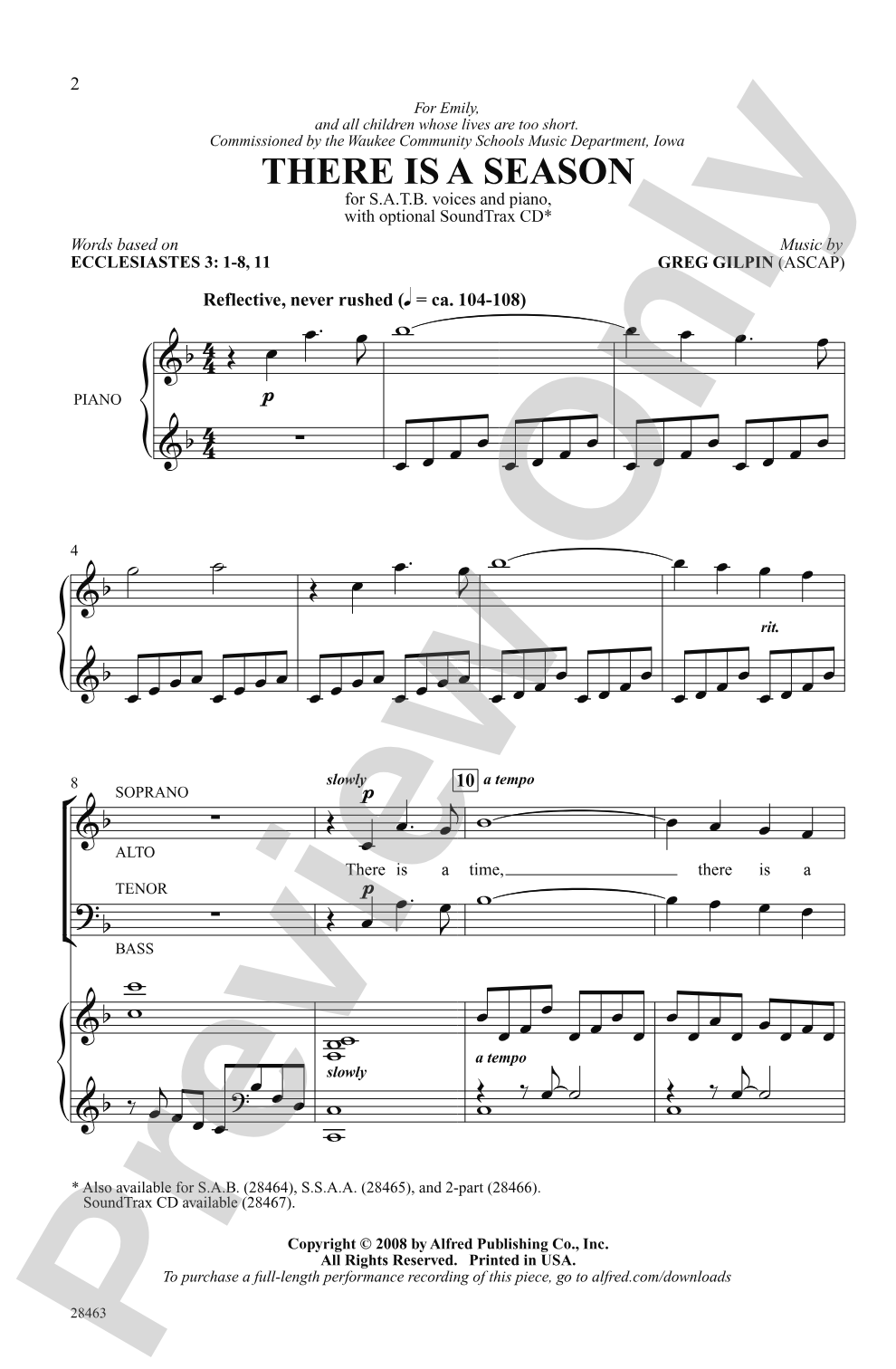
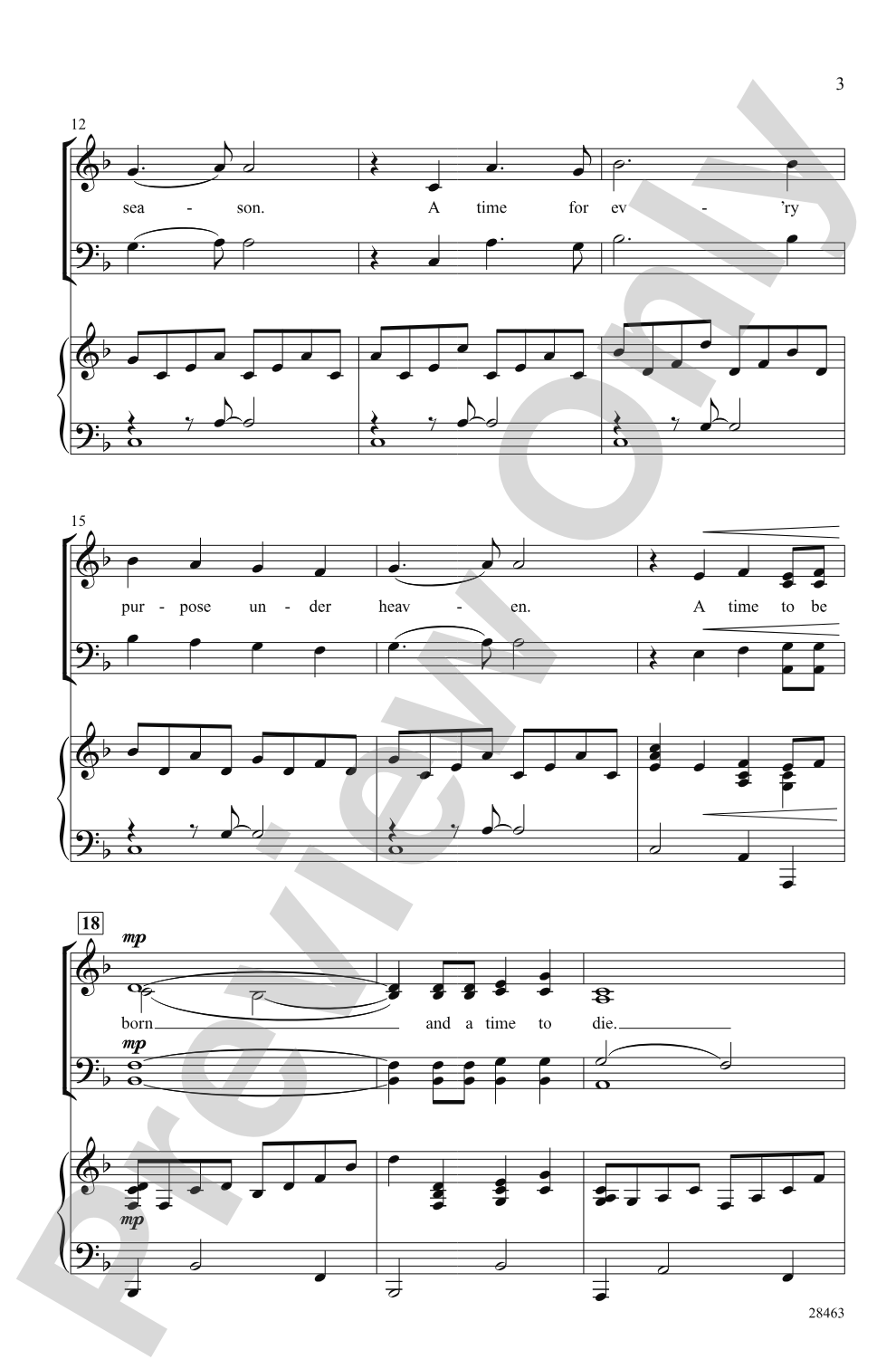

There Is a Season: SATB Choral Octavo
Words based on Ecclesiastes 3:1-8, 11, music by Greg Gilpin
Item: 00-PO-0000448
$1.75
Minimum order quantity: 20 copies
Pickup currently not available
Related Items
There Is a Season: SoundTrax Digital Audio Download |
$24.95
|
View | |
There Is a Season: SAB Choral Octavo |
$1.75
|
View | |
There Is a Season: SSAA Choral Octavo |
$2.25
|
View | |
There Is a Season: 2-Part Choral Octavo |
$1.75
|
View | |
There Is a Season: SATB Choral Octavo |
$1.75
|
View | |
There Is a Season: SAB Choral Octavo |
$1.75
|
View | |
There Is a Season: SSAA Choral Octavo |
$2.25
|
View | |
There Is a Season: 2-Part Choral Octavo |
$1.75
|
View | |
There Is a Season: Choral Octavo SoundTrax CD |
$24.95
|
View |
Description
This stunning setting of an emotional biblical text helps us understand that "there is a time . . . a season . . . for every purpose under heaven." The soaring melody dramatically ebbs and flows throughout, eventually fading at the thoughtful end. A terrific choice for concerts and adjudications, an appropriate choice for life's trying moments.


There Is a Season: SATB Choral Octavo isn't in MakeMusic Cloud just yet...but it could be. Let us know you'd like to see it, and you'll help shape what comes next. In the meantime, start a free trial and dive into thousands of interactive titles your students can play along with today.
Request This Title
Tell us you want it.
Start Your Free Trial
Explore everything that's ready to play right now.
Sample Audio
1
Audio File
--:--
0:00
0:00
Sample Video
No sample videos found.
Additional Details
Series:
Alfred Choral Designs
Publisher:
Alfred Music
Page Count:
8
SKU:
00-PO-0000448
More about this title
About the Composer: Greg Gilpin

Greg Gilpin is an ASCAP award-winning composer and conductor whose choral works are performed across the country and internationally. He has led performances at Carnegie Hall, Lincoln Center, Ryman Auditorium, Sydney Opera House, Royal Festival Hall, and Harpa Concert Hall, establishing himself as a significant voice in contemporary choral music.
Beyond his conducting and composing work, Gilpin serves as Director of Educational Choral Publications for Shawnee Press and has expanded into film scoring, producing a score for the award-winning short film "Rosie's Rescue." He is active in ACDA, NAfME, and Phi Mu Alpha Sinfonia, and continues to champion new choral arrangements alongside respected artists.
Why we love this
Gilpin writes with both emotional restraint and dramatic sweep, allowing the text's spiritual weight to anchor the music rather than overwhelm it. The arc of this piece, building to a powerful moment before settling into reflection, gives directors a structure that feels inevitable rather than imposed, making it rewarding to rehearse and moving to perform.
What to expect
The music moves like a breath, expanding and contracting with natural phrasing rather than mechanical precision. Gilpin's writing has an almost hymnic quality that grounds the soaring soprano line, creating a sense of something both intimate and universal, as if many voices are speaking a private truth aloud.
Who it's for
This piece works for choirs with solid blend and control across all four parts, making it suitable for advanced high school, collegiate, and church choirs. Its emotional maturity and textual depth make it ideal for directors seeking repertoire that speaks to significant moments, whether in concert programming or occasions marked by reflection and change.
How to get the most out of it
- Shape the melody's dynamic contours with intention; the phrase "there is a time" gains power through subtle crescendos rather than sudden volume shifts.
- Balance the parts carefully during the soaring sections so the soprano line remains prominent without forcing; blend is as important as brilliance here.
- Approach the final fade with genuine softness rather than theatrical diminishment; let the choir discover the intimate quality of the ending through sustained, supported singing.
- Use the recorded accompaniment to lock ensemble entrances during the more complex vertical moments, allowing your rehearsal time to focus on interpretive choices.
How to use it
"There Is a Season" functions beautifully as a centerpiece for graduation or memorial concerts, where its contemplative arc provides genuine emotional resonance. It also pairs well in a set with other sacred works that explore time, change, or acceptance, offering singers and audiences a moment of gathered stillness.
Skills your students will build
- Sustaining long vocal lines with consistent breath support and intonation
- Dynamic control through crescendo and diminuendo across full phrases
- Blend and balance in four-part writing, especially soprano and lower voices
- Interpreting text with musical nuance rather than literal expression
- Managing vertical alignment during moments of independent part movement