
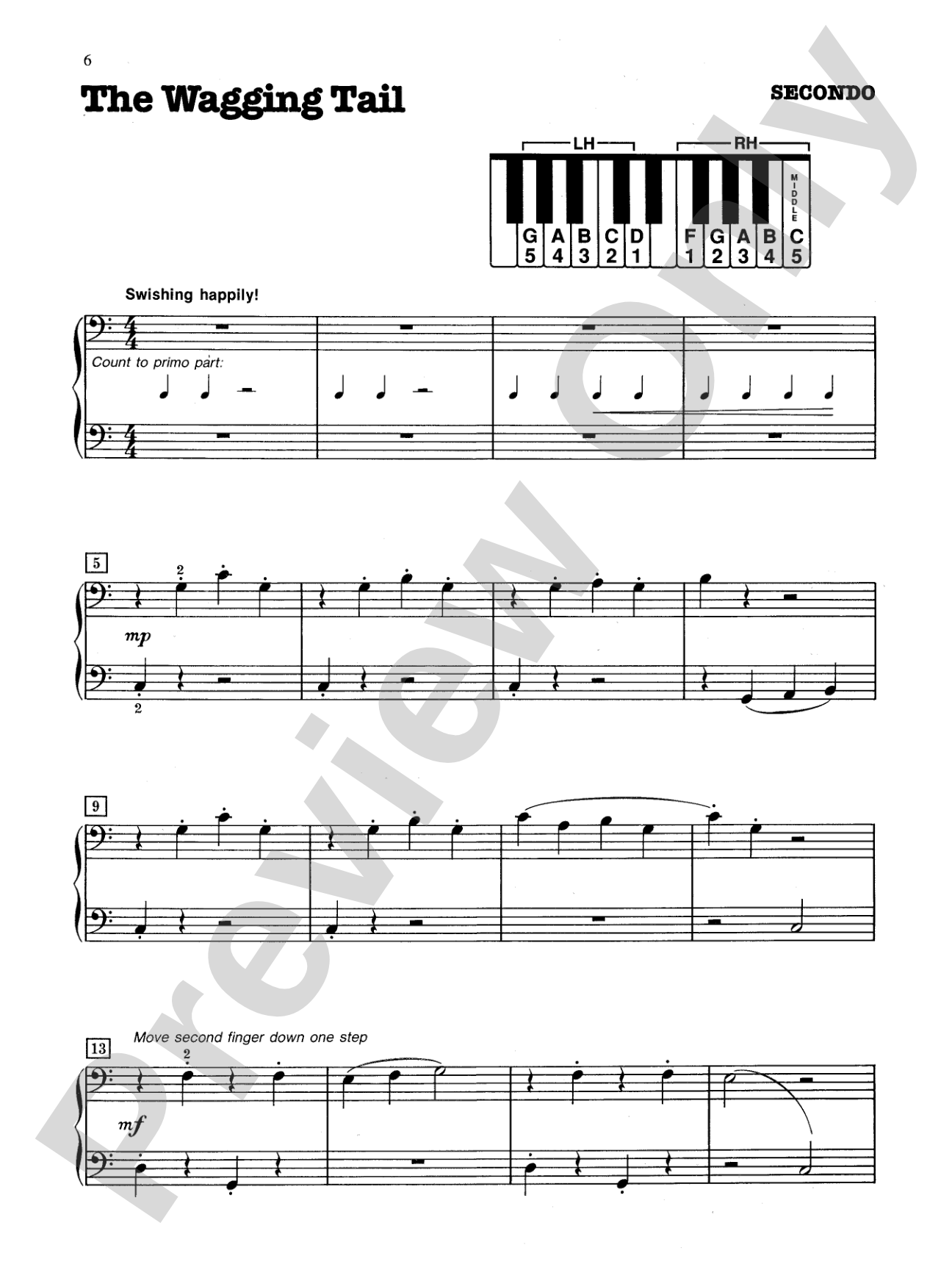

The Wagging Tail - Piano Duet (1 Piano, 4 Hands): Piano Duet (1 Piano, 4 Hands)
Early Elementary Duets for 1 Piano, 4 Paws
By Margaret Goldston
Level: Early Elementary
Item: 00-PS-0017487
$6.99
Pickup currently not available
Related Items
Guard Dog - Piano Duet (1 Piano, 4 Hands): Piano Duet (1 Piano, 4 Hands) |
$4.99
|
View | |
Puppy Love - Piano Duet (1 Piano, 4 Hands): Piano Duet (1 Piano, 4 Hands) |
$4.99
|
View | |
The Bow-Wow Chorus - Piano Duet (1 Piano, 4 Hands): Piano Duet (1 Piano, 4 Hands) |
$4.99
|
View | |
Duets for Dog Lovers: Piano Duet (1 Piano, 4 Hands) Book |
$6.99
|
View |
Description
A collection of elementary duets for one piano and four paws! The primo and secondo parts are equal in difficulty and the hand positions are shown for each piece. Some pieces feature easy position shifts. An indispensible collection to add variety to the lesson plan and help make practicing the piano become less work and more fun! A Federation Festivals 2024-2028 selection.


Discover MakeMusic Cloud: thousands of interactive titles your students can play along with today.
Sample Audio
1
Audio File
--:--
0:00
0:00
Sample Video
No sample videos found.
Additional Details
Publisher:
Alfred Music
Page Count:
20
SKU:
00-PS-0017487
More about this title
About the Composer: Margaret Goldston

Margaret Goldston built her legacy as both a composer and educator, serving students across all ages from her studio in North Carolina. She earned her Bachelor of Music degree in piano performance from Louisiana State University, where she was later honored as School of Music Alumnus of the Year in 1991. Her compositional training came through private study with Pulitzer Prize winner Robert Ward, and her professional contributions earned her the title of Composer of the Year from the North Carolina Federation of Music Clubs in both 1983 and 1994.
Beyond composition, Goldston was a sought-after clinician who led masterclasses and workshops throughout the United States and Canada. Her works have maintained steady representation on major contest lists, including the NFMC Junior Festivals Bulletin, and she received posthumous recognition as a Foundation Fellow by the Music Teachers National Association in 2020. Her pieces continue to serve music education as both performance repertoire and teaching tools.
Why we love this
Goldston understood what makes students eager to practice: genuine music that respects their developing abilities without talking down to them. The equal difficulty between primo and secondo means both players feel invested in the outcome, which transforms duet practice from a obligation into genuine partnership. Twenty pages of variety keeps lesson plans fresh and gives you repertoire that actually sounds like real music, not finger exercises.
What to expect
These pieces capture the playfulness of their titles and subjects without resorting to cuteness. You get straightforward, singable melodies that sit comfortably under the hand, clear harmonic support from the secondo part, and enough musicality to make the experience rewarding for both the student performing and anyone listening.
Who it's for
Piano teachers working with early elementary students who need duet material that actually engages both players equally. Students benefit from playing alongside their teacher or a peer, experiencing the joy of making music together rather than practicing alone. This collection works equally well for students preparing for festival competitions or simply looking for a break from method books.
How to get the most out of it
- Establish the tempo together before you begin. Early elementary pianists often rush when playing with a partner, so a clear starting beat prevents the primo and secondo from pulling in different directions.
- Mark the hand position shifts beforehand so students aren't hunting for them mid-performance. A quick pencil circle around position changes removes a major source of anxiety.
- Practice separately first, then combine only once each part is solid. Duet playing demands focus on two things at once, and students can't develop that skill if either part is still rough.
How to use it
Feature a duet on your annual studio recital as a showcase moment where students perform together, creating a collaborative atmosphere that contrasts with solo performances. Alternately, assign one piece each month as supplementary material to keep students motivated between festival seasons and method book milestones.
Skills your students will build
- Reading and maintaining tempo with a partner
- Playing equal melodic and harmonic roles in ensemble texture
- Managing hand position shifts within continuous playing
- Listening to another part while maintaining focus on their own line
- Interpreting duet scores with independent expression