
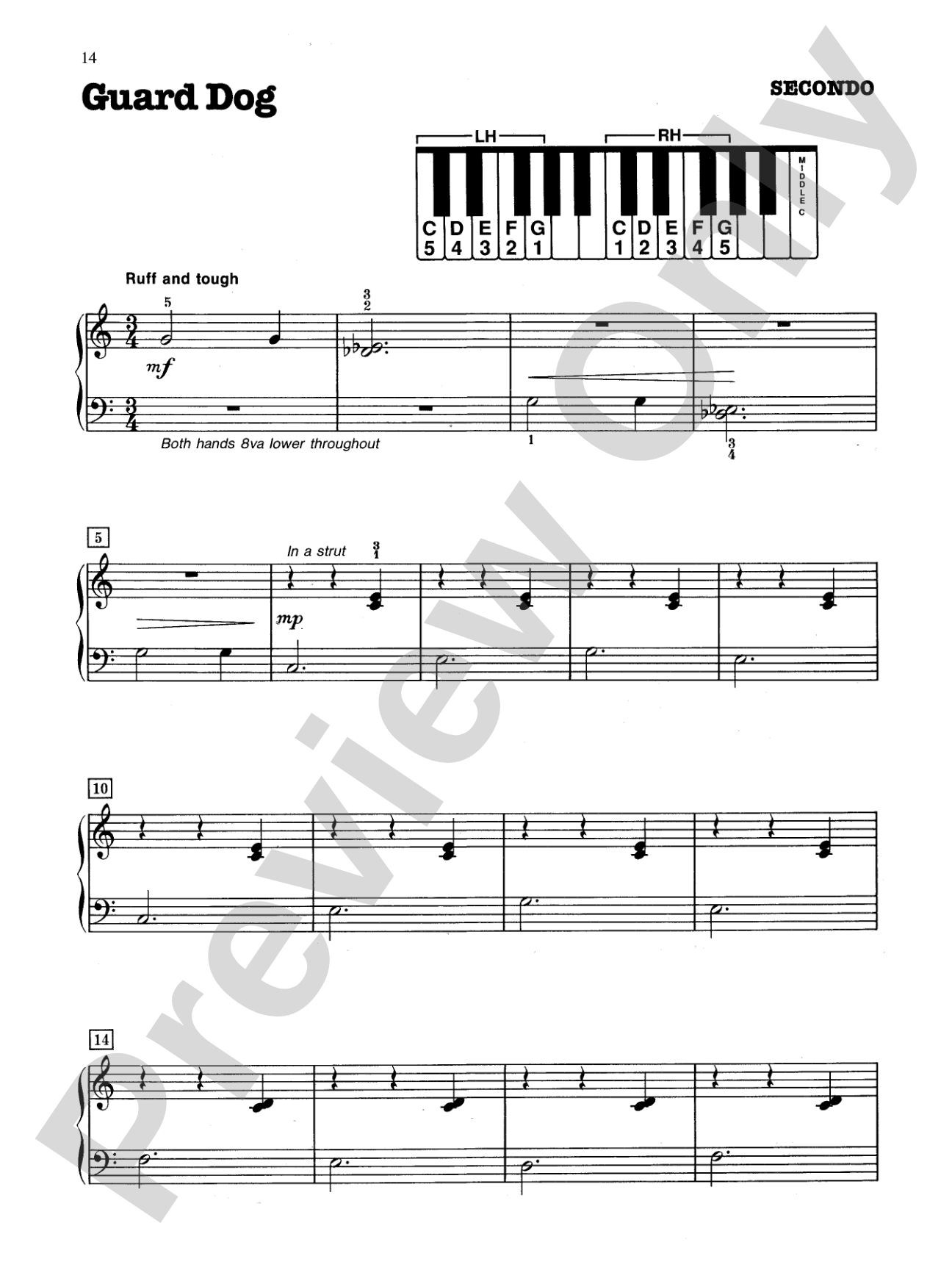

Guard Dog - Piano Duet (1 Piano, 4 Hands): Piano Duet (1 Piano, 4 Hands)
Early Elementary Duets for 1 Piano, 4 Paws
By Margaret Goldston
Level: Early Elementary
Item: 00-PS-0017484
$4.99
Pickup currently not available
Related Items
Puppy Love - Piano Duet (1 Piano, 4 Hands): Piano Duet (1 Piano, 4 Hands) |
$4.99
|
View | |
The Bow-Wow Chorus - Piano Duet (1 Piano, 4 Hands): Piano Duet (1 Piano, 4 Hands) |
$4.99
|
View | |
The Wagging Tail - Piano Duet (1 Piano, 4 Hands): Piano Duet (1 Piano, 4 Hands) |
$6.99
|
View | |
Duets for Dog Lovers: Piano Duet (1 Piano, 4 Hands) Book |
$6.99
|
View |
Description
A collection of elementary duets for one piano and four paws! The primo and secondo parts are equal in difficulty and the hand positions are shown for each piece. Some pieces feature easy position shifts. An indispensible collection to add variety to the lesson plan and help make practicing the piano become less work and more fun! A Federation Festivals 2024-2028 selection.


Discover MakeMusic Cloud: thousands of interactive titles your students can play along with today.
Sample Audio
1
Audio File
--:--
0:00
0:00
Sample Video
No sample videos found.
Additional Details
Publisher:
Alfred Music
Page Count:
20
SKU:
00-PS-0017484
More about this title
About the Composer: Margaret Goldston

Margaret Goldston spent her career building a North Carolina piano studio where she taught students across all ages and levels. She brought serious training to her teaching life, having earned her Bachelor of Music degree in piano performance from Louisiana State University and studied composition privately with Pulitzer Prize winner Robert Ward. Her contributions to music education were recognized repeatedly: the North Carolina Federation of Music Clubs named her Composer of the Year twice (1983 and 1994), and she served as a convention speaker and clinician throughout the United States and Canada.
Goldston's compositional legacy extends well beyond her lifetime. A 1990 commission from Clavier Magazine launched work that would appear consistently on festival and contest lists for decades. After her death in 2003, the Music Teachers National Association honored her as a Foundation Fellow in 2020, cementing her influence on music pedagogy and student repertoire.
Why we love this
Goldston understood exactly what makes piano duet playing rewarding at the early elementary level: equal parts for both players, clear hand position markers, and pieces that sound like real music rather than exercises. These twenty pieces will actually get your students excited about collaborative playing instead of fighting over who gets to play the "fun part."
What to expect
These pieces carry a playful spirit that matches their title. The writing is accessible and unpretentious, with enough melodic interest to keep both players engaged rather than relegating one part to accompaniment duty. Students finish a duet from this collection feeling like they've made music together, not just played their separate lines in proximity.
Who it's for
Early elementary piano students ready to experience ensemble playing without the complexity of coordinating two instruments. This collection works beautifully for studio teachers who want to introduce duet repertoire at the lesson stage, and for group classes where collaborative practice deepens musicianship.
How to get the most out of it
- Establish a consistent pulse together before each piece. Even if the primo and secondo parts don't mirror each other rhythmically, a shared sense of downbeat prevents the performance from fracturing.
- Balance the sound by adjusting bench height and seating distance. The secondo player's lower register can easily overwhelm the primo if both players are pressed against the keys with equal force.
- Rehearse position shifts separately if they appear in your chosen piece. Having each student practice the hand movement alone first removes the pressure of coordinating during ensemble rehearsal.
- Record yourselves playing through the collection. Student pairs often cannot hear their own rhythmic relationships clearly in real time; playback reveals timing issues that feel invisible during performance.
How to use it
Weave duets from this collection into student recitals as a way to showcase ensemble work alongside solos, or use them as warmup repertoire at the start of group classes to build collaborative listening skills. The Federation Festivals 2024-2028 selection designation makes these natural choices for students preparing for contest play.
Skills your students will build
- Ensemble listening and responding to another player's tempo and phrasing
- Reading hand position markers and executing indicated shifts
- Balance between primo and secondo voices
- Coordinating independent rhythmic patterns with a partner
- Sight-reading duet scores that require attention to two staves simultaneously