

The Virgin Mary Had a Baby Boy: 2-Part Choral Octavo
West Indies Carol / arr. Victor C. Johnson
Item: 00-PO-0007110
$2.05
Minimum order quantity: 20 copies
Pickup currently not available
Related Items
The Virgin Mary Had a Baby Boy: PianoTrax Digital Audio Download |
$9.99
|
View | |
The Virgin Mary Had a Baby Boy: SATB Choral Octavo |
$2.05
|
View | |
The Virgin Mary Had a Baby Boy: SAB Choral Octavo |
$2.05
|
View | |
The Virgin Mary Had a Baby Boy: SATB Choral Octavo |
$2.05
|
View | |
The Virgin Mary Had a Baby Boy: SAB Choral Octavo |
$2.05
|
View | |
The Virgin Mary Had a Baby Boy: 2-Part Choral Octavo |
$2.05
|
View |
Description
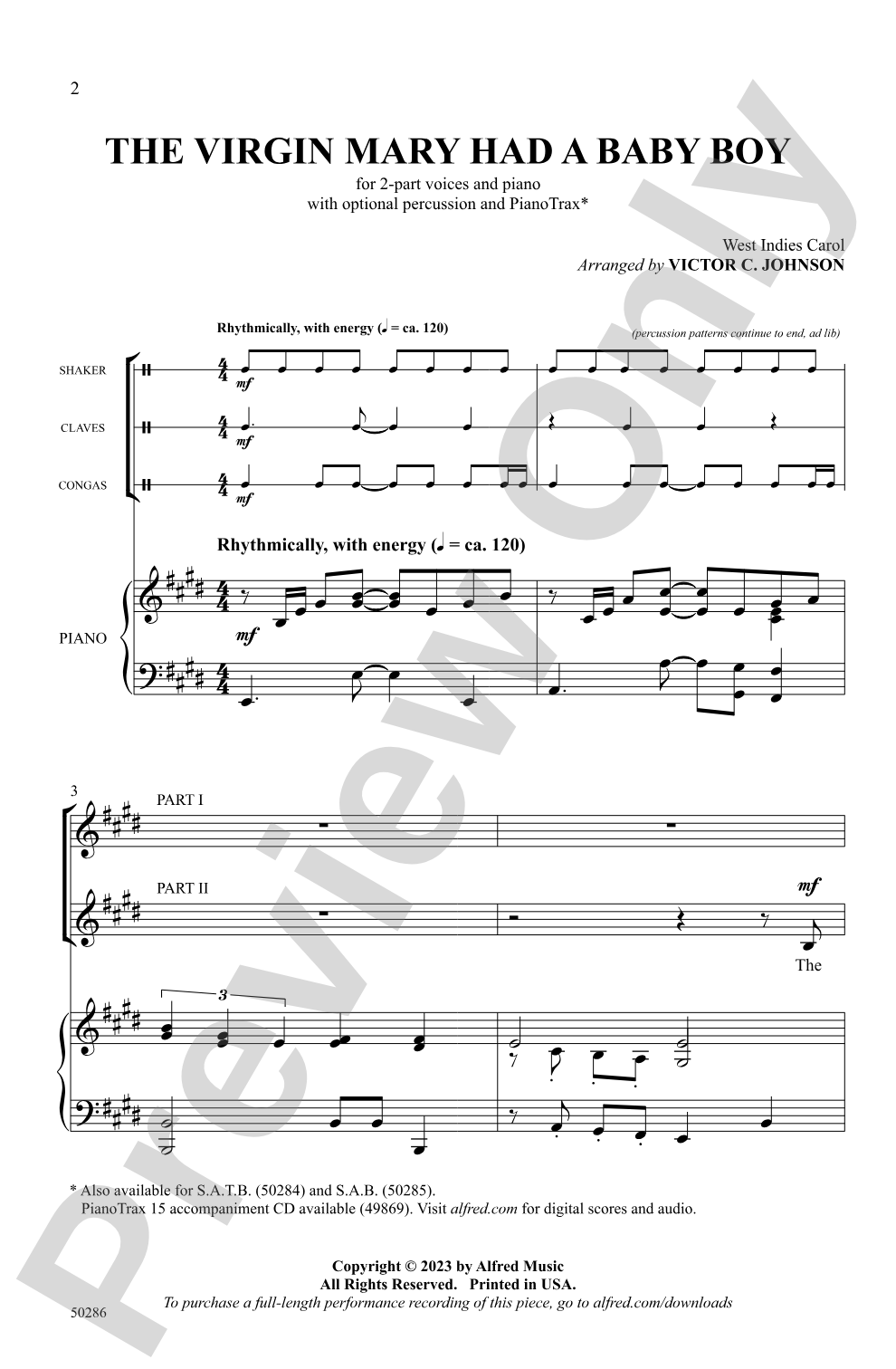
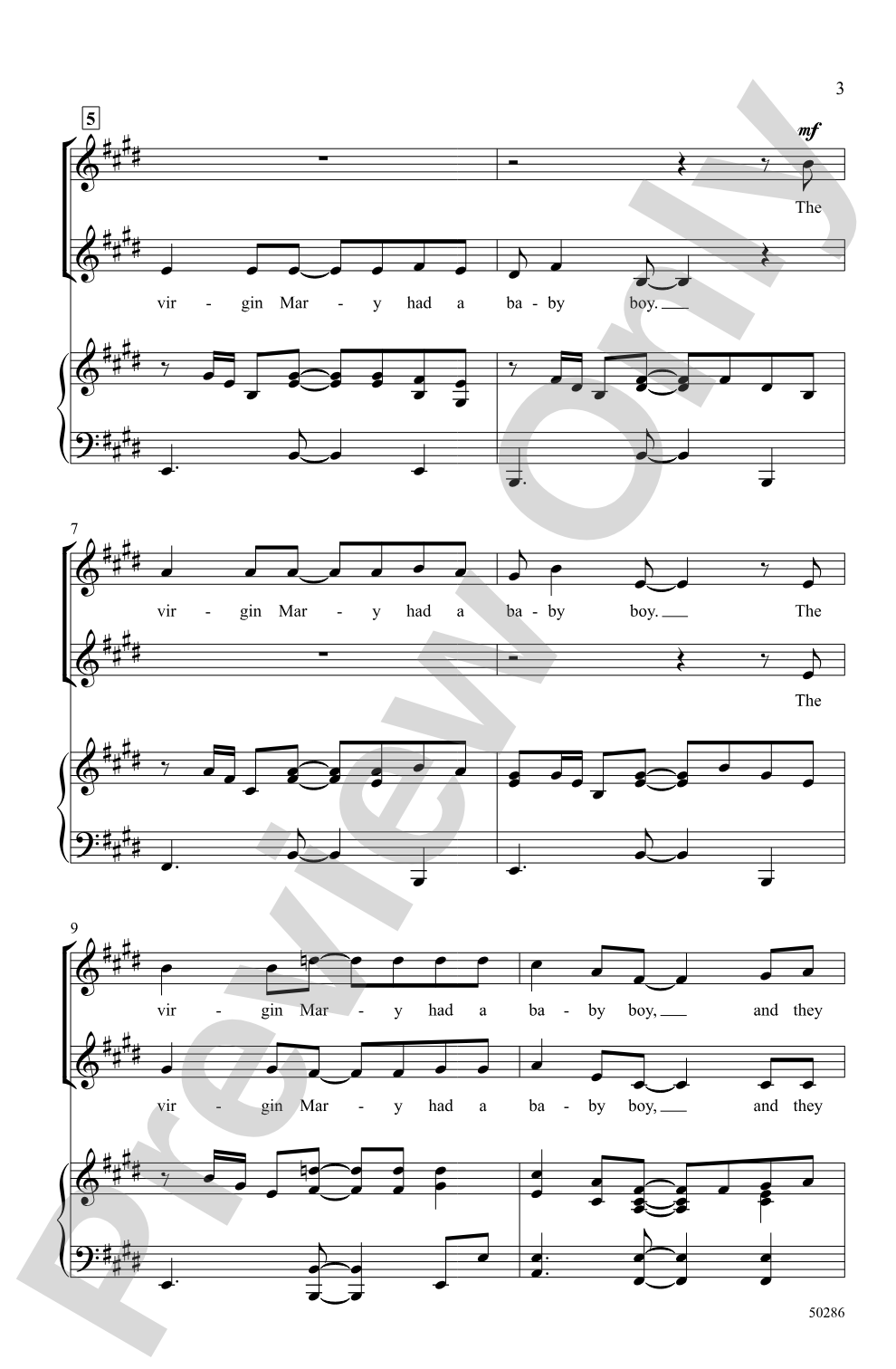
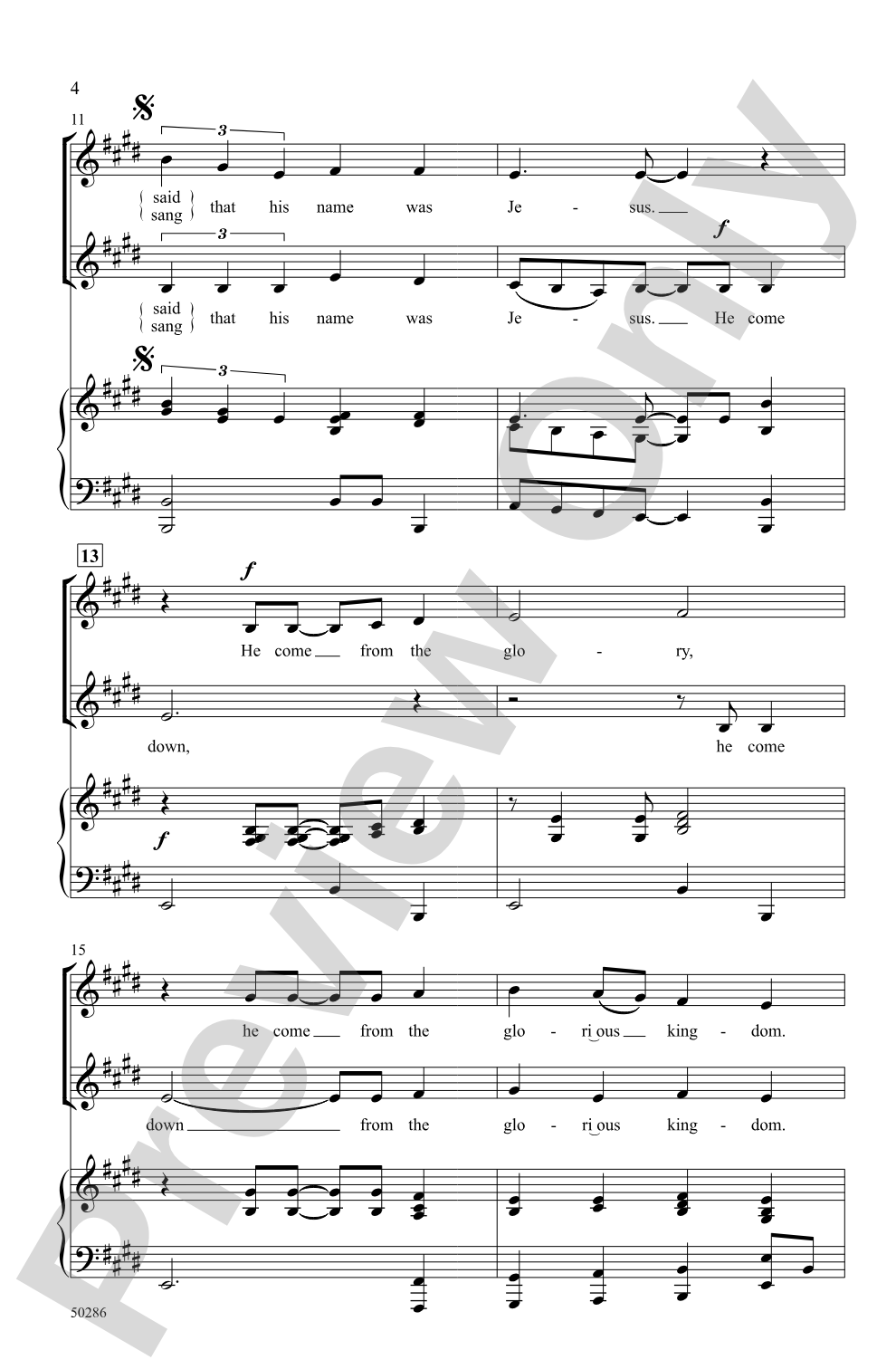
Victor C. Johnson pens a fresh, vibrant arrangement of this favorite West Indies carol. Whether sung in school or church, your lowest voices have a chance to shine, joyfully calling "he come down" to anchor many buoyant refrains. Perform with shaker, claves, and congas to enhance the rhythmic flavor of this bright Caribbean song.


The Virgin Mary Had a Baby Boy: 2-Part Choral Octavo isn't in MakeMusic Cloud just yet...but it could be. Let us know you'd like to see it, and you'll help shape what comes next. In the meantime, start a free trial and dive into thousands of interactive titles your students can play along with today.
Request This Title
Tell us you want it.
Start Your Free Trial
Explore everything that's ready to play right now.
Sample Audio
1
Audio File
--:--
0:00
0:00
Sample Video
Additional Details
Series:
Alfred Choral Designs
Publisher:
Alfred Music
Page Count:
12
SKU:
00-PO-0007110
More about this title
About the Arranger: Victor C Johnson

Victor C. Johnson brings decades of choral directing experience to his prolific arranging work. Based in Dallas, he has composed and arranged over 500 choral pieces, vocal collections, and keyboard works now in publication. From 2000 to 2018, he served as choral director at Ft. Worth Academy of Fine Arts, where he led multiple choirs and helped establish the Singing Girls of Texas and Children's Choir of Texas.
Today, Johnson holds the position of School Choral Editor for Sing!, the educational division of Choristers Guild, and serves as conductor of the Dallas Symphony Children's Chorus Mixed Ensemble. His involvement in professional organizations including the American Choral Directors Association, American Guild of Organists, and Texas Music Educators Association reflects his commitment to advancing choral music at every level.
Why we love this
Johnson captures the infectious rhythmic energy of Caribbean music while keeping the arrangement genuinely accessible for two-part singers. The scaffolding is smart: lower voices get a real melodic anchor with their repeated "he come down" refrains, creating textural depth that feels earned rather than token. This is the kind of seasonal music that sounds like a celebration, not a chore.
What to expect
Warmth and celebration. The arrangement radiates joy without sugar coating the carol; you hear the folk melody's resilience and the cultural roots beneath the brightness. With percussion woven in, it becomes almost tactile, inviting singers and listeners alike into a specific musical world.
Who it's for
Directors working with developing choirs who want to program meaningful seasonal music without compromising musicianship. The two-part voicing welcomes middle school singers and mixed choirs with less experienced singers, while the Caribbean energy and Johnson's skillful arranging keeps everyone engaged. It works equally well in school concerts and worship settings.
How to get the most out of it
- Bring in live percussion (shakers, claves, and congas) early in rehearsal so singers hear the rhythmic framework that drives the piece. These instruments aren't decoration; they're structural.
- Let the lower voices own their material. These refrains are the harmonic foundation; rehearse them with confidence so they anchor the buoyant upper-voice lines rather than sitting underneath them.
- Dig into the Caribbean lilt of the rhythm. This piece breathes differently from typical choral fare; resist conducting it with European symmetry and instead let the syncopation breathe naturally.
How to use it
Pair this with other global or multicultural carols to build a concert around winter music beyond the European tradition, or use it as the opener to a Christmas concert to set an energetic, welcoming tone. The two-part voicing and modest page count (12 pages) make it realistic for schools working with limited rehearsal time before the holiday.
Skills your students will build
- Singing in ensemble with independent melodic lines across two parts
- Responding to and maintaining rhythmic independence alongside percussion
- Singing with Caribbean articulation and rhythmic inflection
- Building confidence in lower voice parts as structural and melodic anchors