
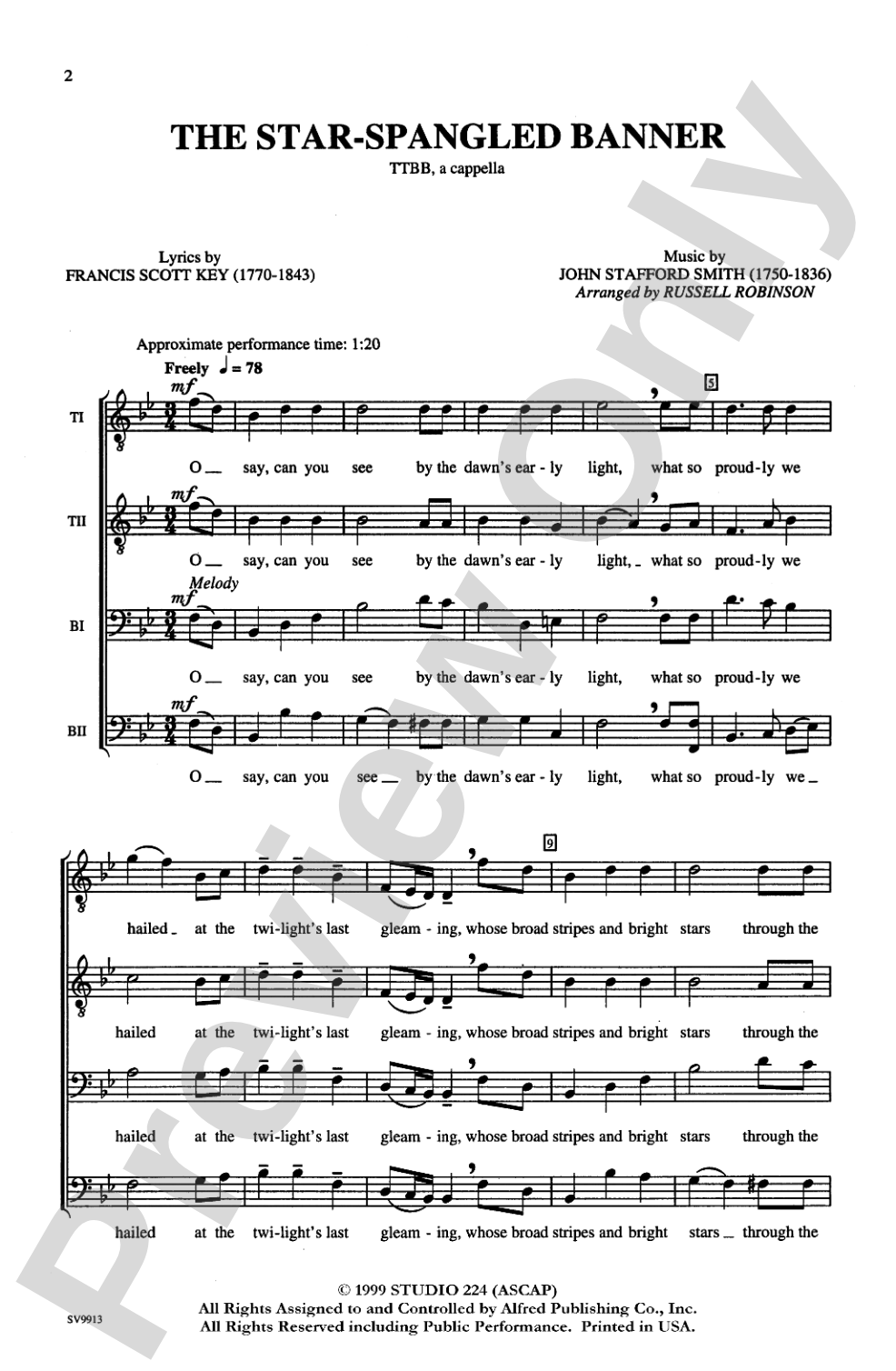

The Star-Spangled Banner: TTBB, a cappella Choral Octavo
Words by Francis Scott Key, music by John Stafford Smith / arr. Russell Robinson
Item: 00-PO-0005301

$2.25
Minimum order quantity: 20 copies
Pickup currently not available
Related Items
The Star-Spangled Banner: SATB, a cappella Choral Octavo |
$2.05
|
View | |
The Star-Spangled Banner: SSAA, a cappella Choral Octavo |
$2.25
|
View | |
The Star-Spangled Banner: 3-Part Mixed, a cappella Choral Octavo |
$2.40
|
View | |
The Star-Spangled Banner: 2-Part Choral Octavo |
$2.00
|
View | |
The Star-Spangled Banner: SoundTrax Digital Audio Download |
$27.99
|
View | |
The Star-Spangled Banner: SATB, a cappella Choral Octavo |
$2.05
|
View | |
The Star-Spangled Banner: TTBB, a cappella Choral Octavo |
$2.25
|
View | |
The Star-Spangled Banner: SSAA, a cappella Choral Octavo |
$2.25
|
View | |
The Star-Spangled Banner: 3-Part Mixed, a cappella Choral Octavo |
$2.40
|
View | |
The Star-Spangled Banner: 2-Part Choral Octavo |
$2.30
|
View | |
The Star-Spangled Banner: Choral Octavo SoundTrax CD |
$27.99
|
View |
Description
A must-have for every choral library! This full-sounding, uncomplicated setting of our national anthem will come in handy on many occasions for years to come. Dr. Robinson's very practical, straightforward arrangement is easy to prepare and inspiring to sing! Perform the SATB, 3-part, SSAA, and TTBB editions a cappella, the 2-part edition accompanied by a piano, or combine any voicing with Michael J. Miller's grade two band arrangement (00-46623) for a grand effect.


Don't just read it, hear it, play along with it, and watch your students grow with it. In MakeMusic Cloud, The Star-Spangled Banner: TTBB, a cappella Choral Octavo comes alive with professional accompaniment, adjustable tempo, and built-in practice tools that turn solo practice into real progress.
Open in the Player
Jump straight in and assign it today.
Start Your Free Trial
Open this title and explore the full library in minutes.
Sample Audio
1
Audio File
--:--
0:00
0:00
Sample Video
No sample videos found.
Additional Details
Series:
Alfred Archive Edition: Studio PR Catalog
Publisher:
Alfred Music
Page Count:
4
SKU:
00-PO-0005301
More about this title
About the Composer: John Stafford Smith
John Stafford Smith (1750-1836) was an English composer and organist whose most enduring legacy is a single melody. Though he composed numerous works across sacred and secular genres, his tune "Anacreon in Heaven" has outlived all his other compositions by centuries, becoming the musical foundation for America's national anthem when Francis Scott Key set words to it in 1814. Smith's original melody, created around 1773-1775 for a London social club, was elegant and singable enough to survive that transformation intact.
In American music education, Smith remains relevant precisely because his melody has become inseparable from national identity. Teachers and directors encounter his work whenever they program patriotic music, making him a historical figure students should recognize even if they never learn another piece bearing his name.
Why we love this
Russell Robinson's arrangement strips away the vocal gymnastics and awkward transitions that plague many versions of this anthem, leaving you with a setting that sits naturally in male voices and actually breathes. The straightforward harmonic language means your singers can focus on delivering the text with clarity rather than struggling through an overwrought arrangement, making it genuinely useful for the fourth of July, opening ceremonies, and other formal occasions where you need something reliable.
What to expect
Stately without being stiff. The four-part texture creates a warm, resonant sound that feels ceremonial and grounded, honoring the anthem's historical weight while remaining accessible enough that singers maintain musicianship rather than strain. There's genuine dignity in voices blending smoothly through this familiar melody.
Who it's for
Male voice choirs, barbershop ensembles, men's colleges groups, and any director needing a patriotic piece that honors the melody without compromising singability. This arrangement works equally well for mixed repertoire rehearsals where you want material your male singers can prepare with confidence.
How to get the most out of it
- Shape the melody with gentle dynamic arcs rather than hitting every note at the same volume; the anthem's emotional power comes from phrasing, not loudness.
- Address the interval leap in the opening phrase deliberately during rehearsal; male singers often rush through the awkward skip, so isolate and sing through it slowly as a section.
- Balance full-voice passages against moments where the lower voices support without overwhelming, ensuring the tune remains audible even in four-part harmony.
- Mark your entrances clearly in a cappella singing; without instrumental support, vertical alignment depends entirely on singers watching each other and entering together.
How to use it
Program this for patriotic concert seasons, Memorial Day and Veterans Day observances, or formal civic events where a national anthem is required. Pair it with other secular choral works to build a program that celebrates American identity, or use it as a concert opener to set a formal tone. Its four-page length makes it manageable alongside longer works in a single rehearsal block.
Skills your students will build
- Singing the national anthem with proper melodic shape and historical awareness
- Four-part harmonic balance in male voices
- Maintaining rhythmic stability in a cappella singing without instrumental reference
- Clarity of diction in patriotic text
- Vertical alignment and ensemble listening skills