
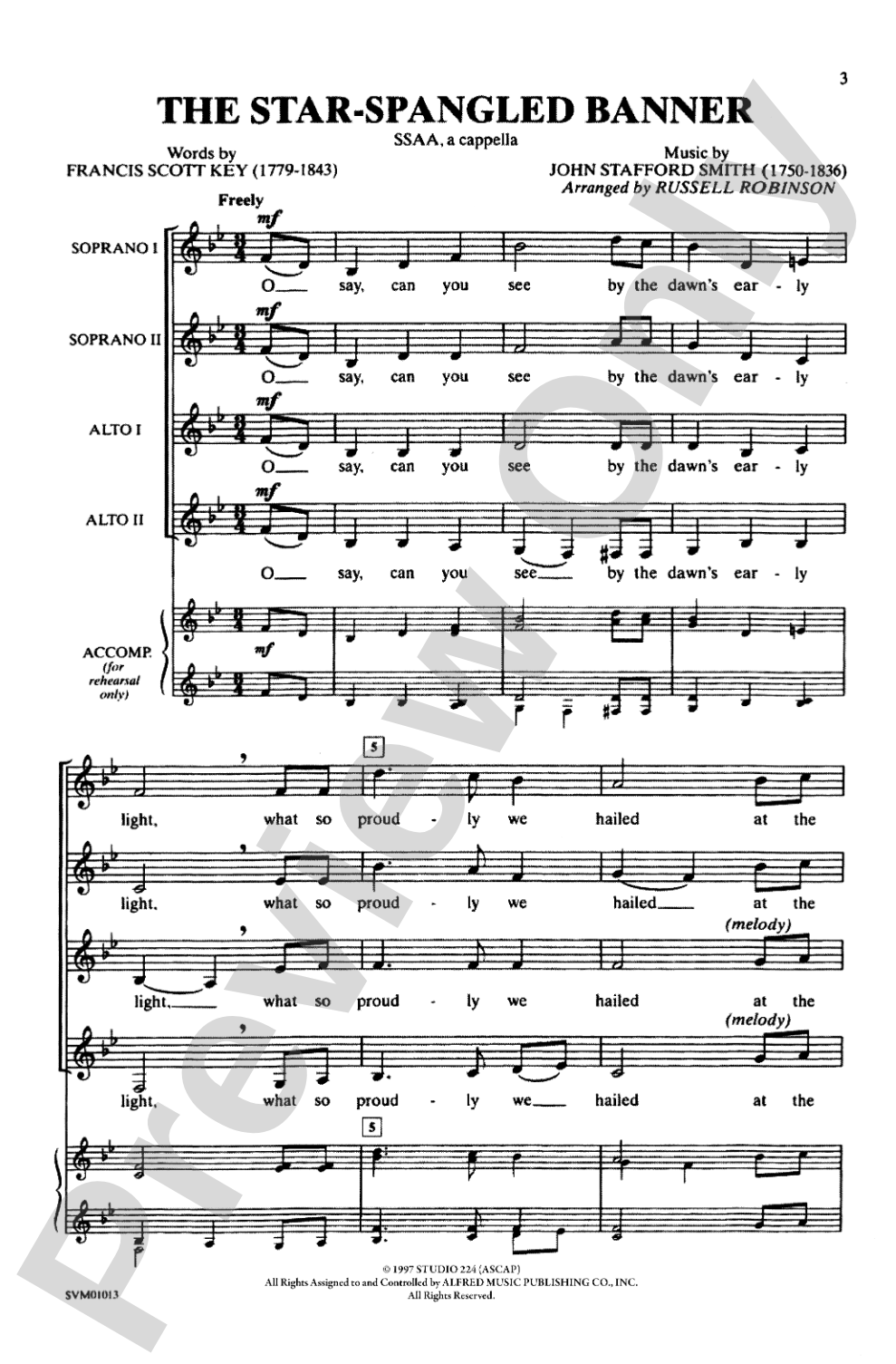

The Star-Spangled Banner: SSAA, a cappella Choral Octavo
Words by Francis Scott Key, music by John Stafford Smith / arr. Russell Robinson
Level: Moderate
Item: 00-PO-0003084

$2.25
Minimum order quantity: 20 copies
Pickup currently not available
Related Items
The Star-Spangled Banner: SATB, a cappella Choral Octavo |
$2.05
|
View | |
The Star-Spangled Banner: TTBB, a cappella Choral Octavo |
$2.25
|
View | |
The Star-Spangled Banner: 3-Part Mixed, a cappella Choral Octavo |
$2.40
|
View | |
The Star-Spangled Banner: 2-Part Choral Octavo |
$2.00
|
View | |
The Star-Spangled Banner: SoundTrax Digital Audio Download |
$27.99
|
View | |
The Star-Spangled Banner: SATB, a cappella Choral Octavo |
$2.05
|
View | |
The Star-Spangled Banner: TTBB, a cappella Choral Octavo |
$2.25
|
View | |
The Star-Spangled Banner: SSAA, a cappella Choral Octavo |
$2.25
|
View | |
The Star-Spangled Banner: 3-Part Mixed, a cappella Choral Octavo |
$2.40
|
View | |
The Star-Spangled Banner: 2-Part Choral Octavo |
$2.30
|
View | |
The Star-Spangled Banner: Choral Octavo SoundTrax CD |
$27.99
|
View |
Description
A must-have for every choral library! This full-sounding, uncomplicated setting of our national anthem will come in handy on many occasions for years to come. Dr. Robinson's very practical, straightforward arrangement is easy to prepare and inspiring to sing! Perform the SATB, 3-part, SSAA, and TTBB editions a cappella, the 2-part edition accompanied by a piano, or combine any voicing with Michael J. Miller's grade two band arrangement (00-46623) for a grand effect.


Don't just read it, hear it, play along with it, and watch your students grow with it. In MakeMusic Cloud, The Star-Spangled Banner: SSAA, a cappella Choral Octavo comes alive with professional accompaniment, adjustable tempo, and built-in practice tools that turn solo practice into real progress.
Open in the Player
Jump straight in and assign it today.
Start Your Free Trial
Open this title and explore the full library in minutes.
Sample Audio
1
Audio File
--:--
0:00
0:00
Sample Video
No sample videos found.
Additional Details
Series:
Alfred Archive Edition: Studio PR Catalog
Publisher:
Alfred Music
Page Count:
8
SKU:
00-PO-0003084
More about this title
About the Composer: John Stafford Smith
John Stafford Smith (1750-1836) was an English composer and organist whose career spanned the late eighteenth and early nineteenth centuries. Though he wrote numerous hymns, glees, and vocal works that were popular in his time, he is remembered today almost entirely for composing the melody that would become "The Star-Spangled Banner." The tune, originally called "To Anacreon in Heaven," first appeared as the melody for a London social club's song in the 1770s, decades before Francis Scott Key set it to his famous poem.
Why we love this
Robinson's arrangement cuts through the complexity that often surrounds this anthem. By keeping the voicing straightforward and the part-writing singable, he makes it genuinely accessible for treble choirs without sacrificing the dignity the piece demands. The flexibility to perform it a cappella or to layer it with a band arrangement gives you real programming options throughout the year.
What to expect
This is patriotic music stripped of unnecessary flourish. The sopranos carry the familiar melody with clarity while the lower voices provide supportive harmony that feels natural and inevitable rather than contrived. Sung well, it conveys dignity and broad appeal without demanding dramatic interpretation.
Who it's for
Treble choirs at the middle school and high school level will find this arrangement both achievable and rewarding. Directors looking for a serviceable national anthem that doesn't require an advanced ensemble will appreciate how quickly this can be performance-ready.
How to get the most out of it
- Anchor the harmony with your altos; their stability will support the sopranos' melodic line and prevent the piece from drifting sharp.
- Shape the phrase arcs generously. Even though the arrangement sits comfortably, resist the impulse to rush through long note values; let the anthem breathe.
- If you perform this with the band arrangement, schedule sectional rehearsals with the instrumental players early so your singers can hear how their part sits within the fuller texture.
How to use it
This octavo works for civic ceremonies, school assemblies, and Fourth of July performances. You might also open a patriotic or American music concert with this arrangement, then follow with more elaborate or contemporary works that build on the foundation this anthem provides.
Skills your students will build
- Singing sustained, supported tones without fatigue
- Maintaining harmonic accuracy across sustained notes and slower tempos
- Balancing individual part integrity with ensemble blend
- Understanding how arrangement affects the perceived difficulty and sound of familiar melodies