
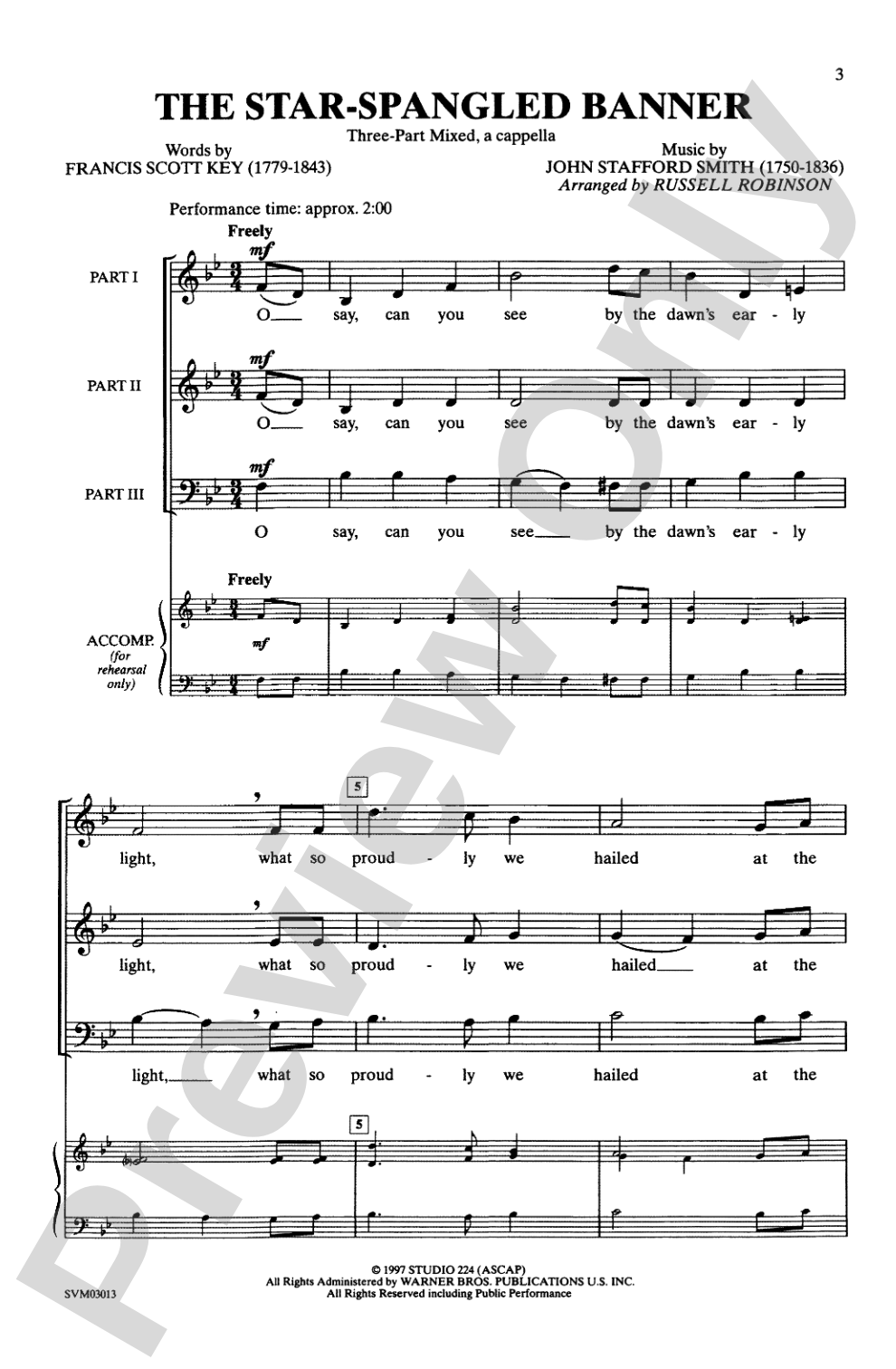

The Star-Spangled Banner: 3-Part Mixed, a cappella Choral Octavo
Words by Francis Scott Key, music by John Stafford Smith / arr. Russell Robinson
Level: Moderate
Item: 00-PO-0003548

$2.40
Minimum order quantity: 10 copies
Please note: Under U.S. copyright law, you must purchase the exact number of copies needed for your ensemble. Printing, duplicating or sharing additional copies is strictly prohibited.
Pickup currently not available
Related Items
The Star-Spangled Banner: SATB, a cappella Choral Octavo |
$2.05
|
View | |
The Star-Spangled Banner: TTBB, a cappella Choral Octavo |
$2.25
|
View | |
The Star-Spangled Banner: SSAA, a cappella Choral Octavo |
$2.25
|
View | |
The Star-Spangled Banner: 2-Part Choral Octavo |
$2.00
|
View | |
The Star-Spangled Banner: SoundTrax Digital Audio Download |
$27.99
|
View | |
The Star-Spangled Banner: SATB, a cappella Choral Octavo |
$2.05
|
View | |
The Star-Spangled Banner: TTBB, a cappella Choral Octavo |
$2.25
|
View | |
The Star-Spangled Banner: SSAA, a cappella Choral Octavo |
$2.25
|
View | |
The Star-Spangled Banner: 3-Part Mixed, a cappella Choral Octavo |
$2.40
|
View | |
The Star-Spangled Banner: 2-Part Choral Octavo |
$2.30
|
View | |
The Star-Spangled Banner: Choral Octavo SoundTrax CD |
$27.99
|
View |
Description
A must-have for every choral library! This full-sounding, uncomplicated setting of our national anthem will come in handy on many occasions for years to come. Dr. Robinson's very practical, straightforward arrangement is easy to prepare and inspiring to sing! Perform the SATB, 3-part, SSAA, and TTBB editions a cappella, the 2-part edition accompanied by a piano, or combine any voicing with Michael J. Miller's grade two band arrangement (00-46623) for a grand effect.


Don't just read it, hear it, play along with it, and watch your students grow with it. In MakeMusic Cloud, The Star-Spangled Banner: 3-Part Mixed, a cappella Choral Octavo comes alive with professional accompaniment, adjustable tempo, and built-in practice tools that turn solo practice into real progress.
Open in the Player
Jump straight in and assign it today.
Start Your Free Trial
Open this title and explore the full library in minutes.
Sample Audio
1
Audio File
--:--
0:00
0:00
Sample Video
No sample videos found.
Additional Details
Publisher:
Alfred Music
Page Count:
8
SKU:
00-PO-0003548
More about this title
About the Composer: John Stafford Smith
John Stafford Smith (1750-1819) was an English organist and composer whose melodic gift secured his place in musical history long after his death. Though he composed numerous anthems, glees, and instrumental works during his lifetime, his legacy rests almost entirely on a single tune: the melody he composed around 1773 that would eventually become "The Star-Spangled Banner." Smith served as a church musician and composer in London, contributing to the English glee tradition that flourished in the late 18th century.
Smith's melody first appeared with the text "To Anacreon in Heaven," a patriotic song of a London gentlemen's club. When Francis Scott Key penned his poem during the War of 1812, the familiar tune provided the perfect vehicle for his words, and Smith's composition became inseparable from American identity. For music educators, Smith's original melody stands as a masterclass in singable, memorable composition: it sits comfortably in the voice, builds naturally toward climactic moments, and contains enough melodic interest to sustain repeated hearings without fatigue.
Why we love this
Robinson's arrangement respects the anthem's inherent power while making it genuinely accessible for developing singers. The 3-part writing avoids the harmonic complexity that can bog down patriotic arrangements, allowing the melody to remain clear and the text to land with impact. This is the version you'll actually use year after year, whether for July 4th concerts, civic events, or moments when your program needs to open with dignity and purpose.
What to expect
The piece carries the weight and dignity the anthem demands while remaining grounded in genuine vocal comfort. You'll notice how the three-part texture lets harmony emerge without complexity, creating moments of richness that feel earned rather than imposed. Singing this arrangement builds a sense of collective pride in the group, the kind of feeling that comes from performing something meaningful without struggling through the mechanics of it.
Who it's for
This arrangement serves choirs at any point in their development, from high school ensembles encountering the anthem for the first time to established community and church choirs seeking a refreshed take on an essential repertoire piece. Conductors who want their singers to experience patriotic music that feels singable rather than stagy will find Robinson's straightforward writing meets that need perfectly.
How to get the most out of it
- Shape the melody through the text rather than holding every note with equal weight. Let the natural stress of the words guide your phrasing, especially through climactic moments like "the rocket's red glare."
- Balance your middle voices carefully in the lower register. A cappella singing exposes weak harmonic support, so ensure your second voice has consistent tone and blend without oversinging.
- Move the tempo deliberately through the second half of the anthem. The arc from "whose broad stripes" toward the final phrase requires slightly increased momentum to maintain engagement without rushing.
- Establish pitch clearly before the first entrance. Without instrumental support, your opening unison or chord must be locked in solidly so the whole group can commit to steady intonation throughout.
How to use it
Robinson's version anchors patriotic concert programs and civic ceremonies where you need immediate impact without requiring extensive rehearsal time. It works equally well as a concert opener that sets a formal tone or as part of a larger patriotic set. Consider pairing it with Robinson's other standard arrangements or with instrumental versions for flexibility in seasonal programming.
Skills your students will build
- Sustaining pitch accuracy without instrumental reference
- Blending middle voices in three-part harmony
- Interpreting text-driven phrasing in patriotic music
- Maintaining steady intonation through extended phrases
- Balancing unison and harmonic passages within a single piece