

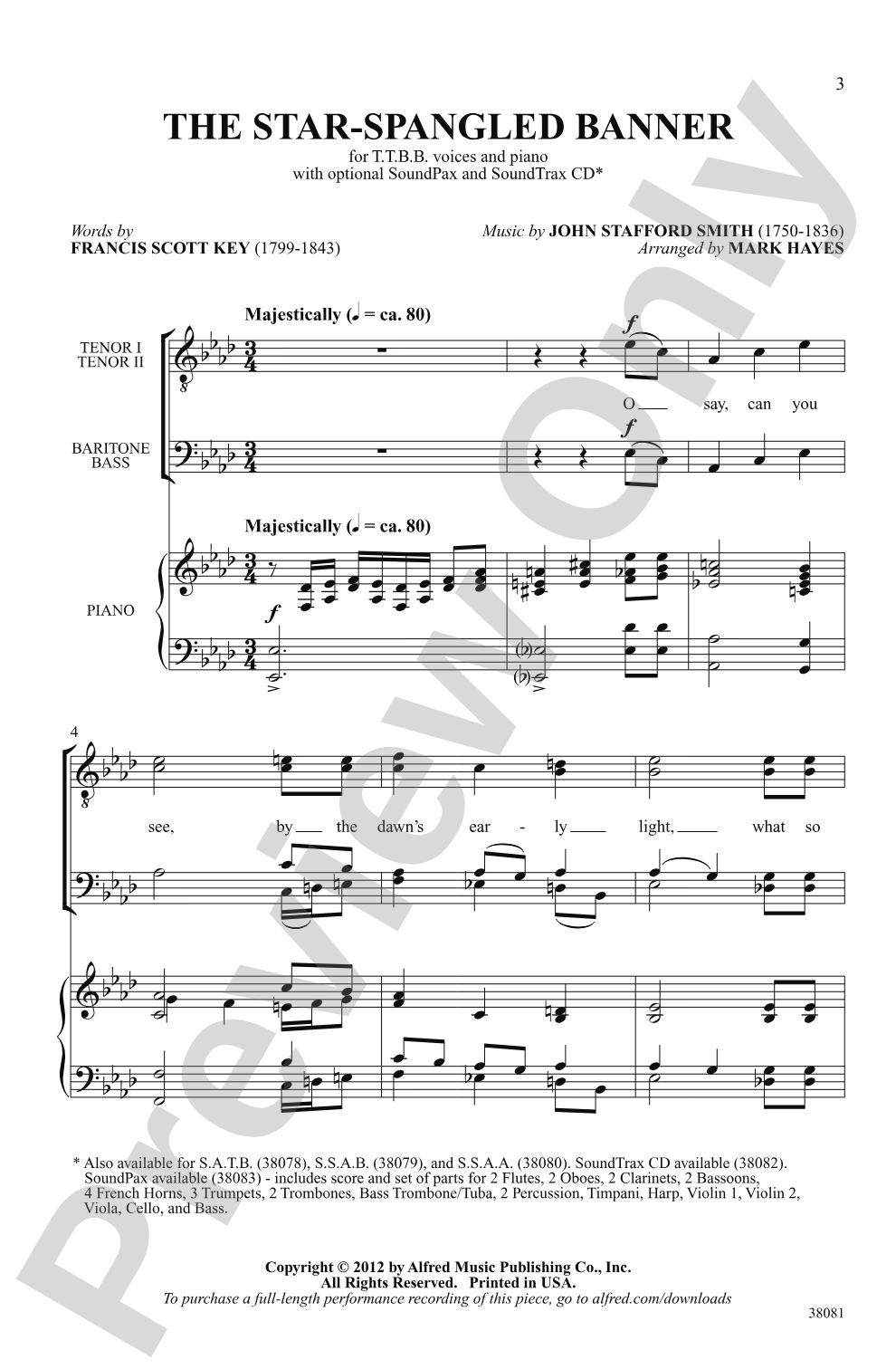

The Star-Spangled Banner: TTBB Choral Octavo
Words by Francis Scott Key, music by John Stafford Smith / arr. Mark Hayes
Item: 00-PO-0001375

$1.80
Minimum order quantity: 20 copies
Pickup currently not available
Related Items
The Star-Spangled Banner: SATB Choral Octavo |
$2.05
|
View | |
The Star-Spangled Banner: SSAB Choral Octavo |
$1.80
|
View | |
The Star-Spangled Banner: SSAA Choral Octavo |
$1.80
|
View | |
The Star-Spangled Banner: Choral SoundPax |
$50.00
|
View | |
The Star-Spangled Banner: SoundTrax Digital Audio Download |
$27.99
|
View | |
The Star-Spangled Banner: SATB Choral Octavo |
$2.40
|
View | |
The Star-Spangled Banner: SSAB Choral Octavo |
$1.80
|
View | |
The Star-Spangled Banner: TTBB Choral Octavo |
$1.80
|
View | |
The Star-Spangled Banner: Choral Octavo SoundTrax CD |
$27.99
|
View | |
The Star-Spangled Banner: Choral SoundPax |
$50.00
|
View |
Description
An exhilarating tour-de-force setting of our National Anthem. The sizable full orchestration, impressive piano accompaniment, and resounding choral parts emanate unwavering patriotism. Mark's arrangement works equally well in the concert hall, sanctuary, gym, or stadium.


Don't just read it, hear it, play along with it, and watch your students grow with it. In MakeMusic Cloud, The Star-Spangled Banner: TTBB Choral Octavo comes alive with professional accompaniment, adjustable tempo, and built-in practice tools that turn solo practice into real progress.
Open in the Player
Jump straight in and assign it today.
Start Your Free Trial
Open this title and explore the full library in minutes.
Sample Audio
1
Audio File
--:--
0:00
0:00
Sample Video
No sample videos found.
Additional Details
Series:
Alfred Choral Designs
Publisher:
Alfred Music
Page Count:
8
SKU:
00-PO-0001375
More about this title
About the Composer: John Stafford Smith
John Stafford Smith (1750-1819) was an English composer and organist whose melodic gift secured him a lasting place in music history, despite a relatively modest output. He composed the tune now known as "The Star-Spangled Banner" around 1773-1774, originally titled "To Anacreon in Heaven," as the signature melody for a London gentlemen's club. Smith's straightforward harmonic language and singable melodic contour made his compositions ideal for both amateur and professional musicians of his era.
Why we love this
Mark Hayes's orchestration captures the anthem's ceremonial weight without sacrificing accessibility for TTBB ensembles. The arrangement balances impressive moments for concert venues with the flexibility to work in stadiums and sanctuaries, making it genuinely useful across performance contexts rather than a one-occasion piece.
What to expect
The piece radiates ceremonial dignity while remaining grounded and singable, the soaring melodic line supported by solid harmonic progressions underneath. Broad phrases and full-voiced moments create a sense of collective resonance, honoring both the gravity of the text and the occasion itself.
Who it's for
TTBB choirs performing in concert halls, patriotic events, summer festivals, and special occasions benefit from this accessible yet musically satisfying setting. High school, college, and community ensembles wanting a substantial national anthem arrangement that doesn't require soloists or smaller subsets will find this particularly valuable.
How to get the most out of it
- Establish a strong, unified sound on the opening unison passage; the lower voices anchor the patriotic foundation that upper voices build upon.
- Shape the dynamic arc across all four voice parts so the piece gains intensity gradually rather than spiking suddenly, letting the accompaniment support rather than overshadow the voices.
- If using the recorded accompaniment, start rehearsals without it so singers lock the melodic and harmonic content first, then add the track once parts are secure.
How to use it
Position this as an opening or closing statement for patriotic concerts, Fourth of July celebrations, or civic events where the anthem carries particular weight. It works equally well as a standalone performance or as the capstone to a program exploring American choral traditions.
Skills your students will build
- managing phrase length and breath placement across expansive melodic lines
- balancing four independent voice parts while maintaining textual clarity on a familiar patriotic text
- responding to dynamic and tempo indications that shape ceremonial character
- adapting performance style across different acoustical and performance contexts