

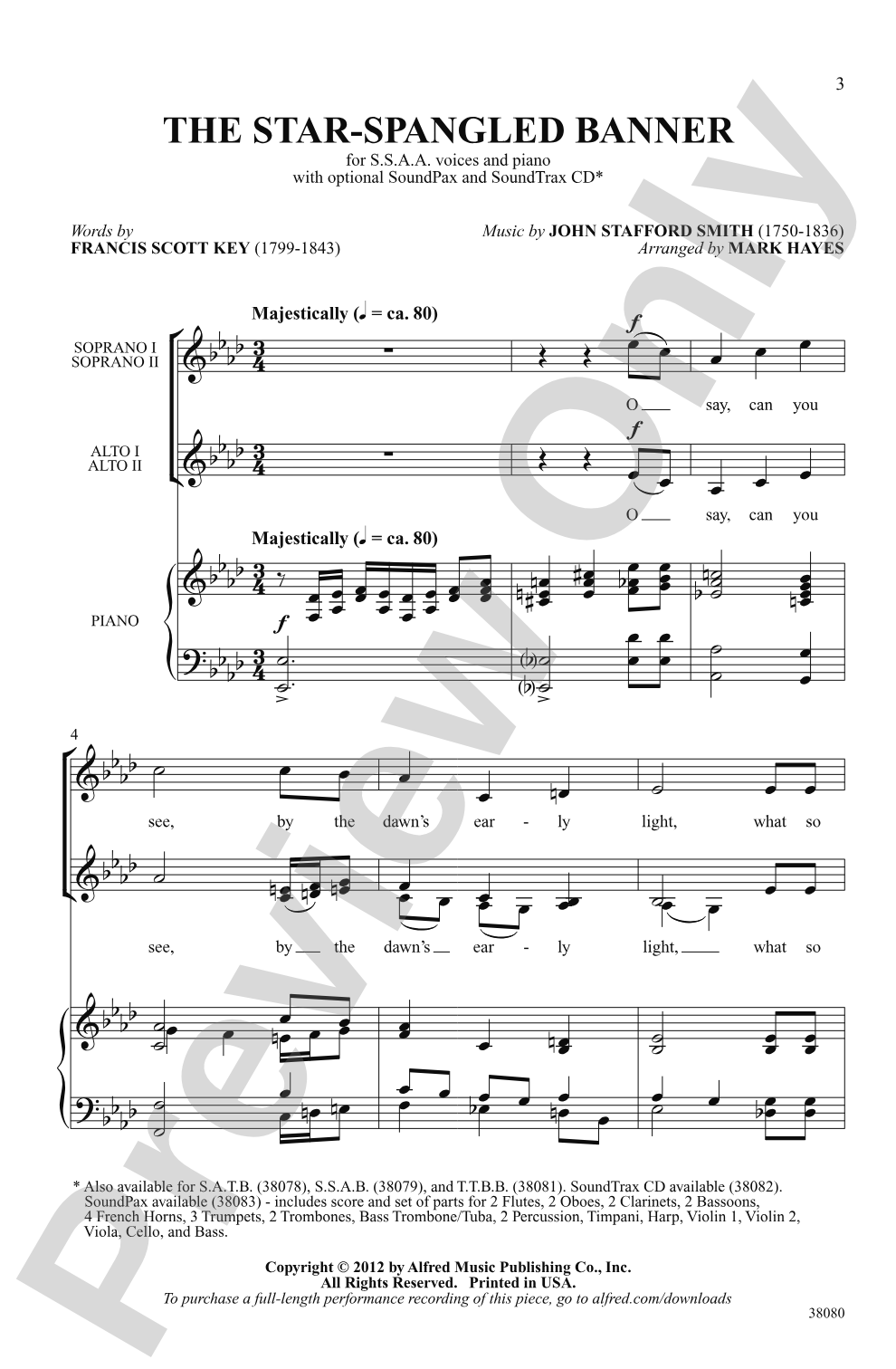

The Star-Spangled Banner: SSAA Choral Octavo
Words by Francis Scott Key, music by John Stafford Smith / arr. Mark Hayes
Item: 00-PO-0001374

$1.80
Minimum order quantity: 20 copies
Pickup currently not available
Related Items
The Star-Spangled Banner: SATB Choral Octavo |
$2.05
|
View | |
The Star-Spangled Banner: SSAB Choral Octavo |
$1.80
|
View | |
The Star-Spangled Banner: TTBB Choral Octavo |
$1.80
|
View | |
The Star-Spangled Banner: Choral SoundPax |
$50.00
|
View | |
The Star-Spangled Banner: SoundTrax Digital Audio Download |
$27.99
|
View | |
The Star-Spangled Banner: SATB Choral Octavo |
$2.40
|
View | |
The Star-Spangled Banner: SSAB Choral Octavo |
$1.80
|
View | |
The Star-Spangled Banner: TTBB Choral Octavo |
$1.80
|
View | |
The Star-Spangled Banner: Choral Octavo SoundTrax CD |
$27.99
|
View | |
The Star-Spangled Banner: Choral SoundPax |
$50.00
|
View |
Description
An exhilarating tour-de-force setting of our National Anthem. The sizable full orchestration, impressive piano accompaniment, and resounding choral parts emanate unwavering patriotism. Mark's arrangement works equally well in the concert hall, sanctuary, gym, or stadium.


Don't just read it, hear it, play along with it, and watch your students grow with it. In MakeMusic Cloud, The Star-Spangled Banner: SSAA Choral Octavo comes alive with professional accompaniment, adjustable tempo, and built-in practice tools that turn solo practice into real progress.
Open in the Player
Jump straight in and assign it today.
Start Your Free Trial
Open this title and explore the full library in minutes.
Sample Audio
1
Audio File
--:--
0:00
0:00
Sample Video
No sample videos found.
Additional Details
Series:
Alfred Choral Designs
Publisher:
Alfred Music
Page Count:
8
SKU:
00-PO-0001374
More about this title
About the Composer: John Stafford Smith
John Stafford Smith (1750-1836) was an English composer and musicologist whose melodic gifts shaped American musical identity long after his lifetime. Though he composed numerous vocal works, songs, and glees during his career, his most enduring legacy arrived through accident of history: his tune "Anacreon in Heaven," originally written for a London social club, became the melody for "The Star-Spangled Banner" when Francis Scott Key set his poem to it in 1814.
Why we love this
Mark Hayes's arrangement captures the grandeur this melody deserves without requiring a full orchestra in your rehearsal room. The SSAA voicing sits naturally for many treble choirs, and his piano writing is substantial enough to feel celebratory while remaining accessible. This is the arrangement that actually works in your gym, sanctuary, and concert hall without compromise.
What to expect
Stately and stirring, with moments of genuine lyricism alongside bold unison passages that let the choir's full voice ring out. The arrangement respects the melody's singability while giving it orchestral ambition, creating something that feels both familiar and freshly conceived.
Who it's for
Directors of treble choirs, mixed choirs with strong soprano and alto sections, and community ensembles preparing for civic events, holiday concerts, and seasonal programming. This works equally well for high school choirs, college treble ensembles, and church music programs.
How to get the most out of it
- Balance the inner voices carefully during unison passages so the outer voices don't overshadow the foundational harmony underneath.
- The recorded accompaniment gives you a flexible rehearsal tool, but consider one full run-through with piano alone to build the choir's independence before leaning on the recording.
- Approach the national anthem with vocal warmth rather than military stiffness; this arrangement invites musicality that deepens patriotic sentiment.
- Mark precise dynamic transitions during the key modulations so the arrangement's structural turns feel intentional and not accidental.
How to use it
Open a 4th of July concert or patriotic program with this; its theatrical confidence sets an energetic tone. It also works powerfully as a closing piece that sends the audience home with shared conviction. For a mixed concert, program it alongside lighter American songs to show the range of this tradition.
Skills your students will build
- Balancing inner voices in four-part writing
- Singing extended ranges with control and warmth
- Projecting text with patriotic conviction
- Following dynamic and tempo changes in orchestral arrangements
- Working with recorded accompaniment in rehearsal