
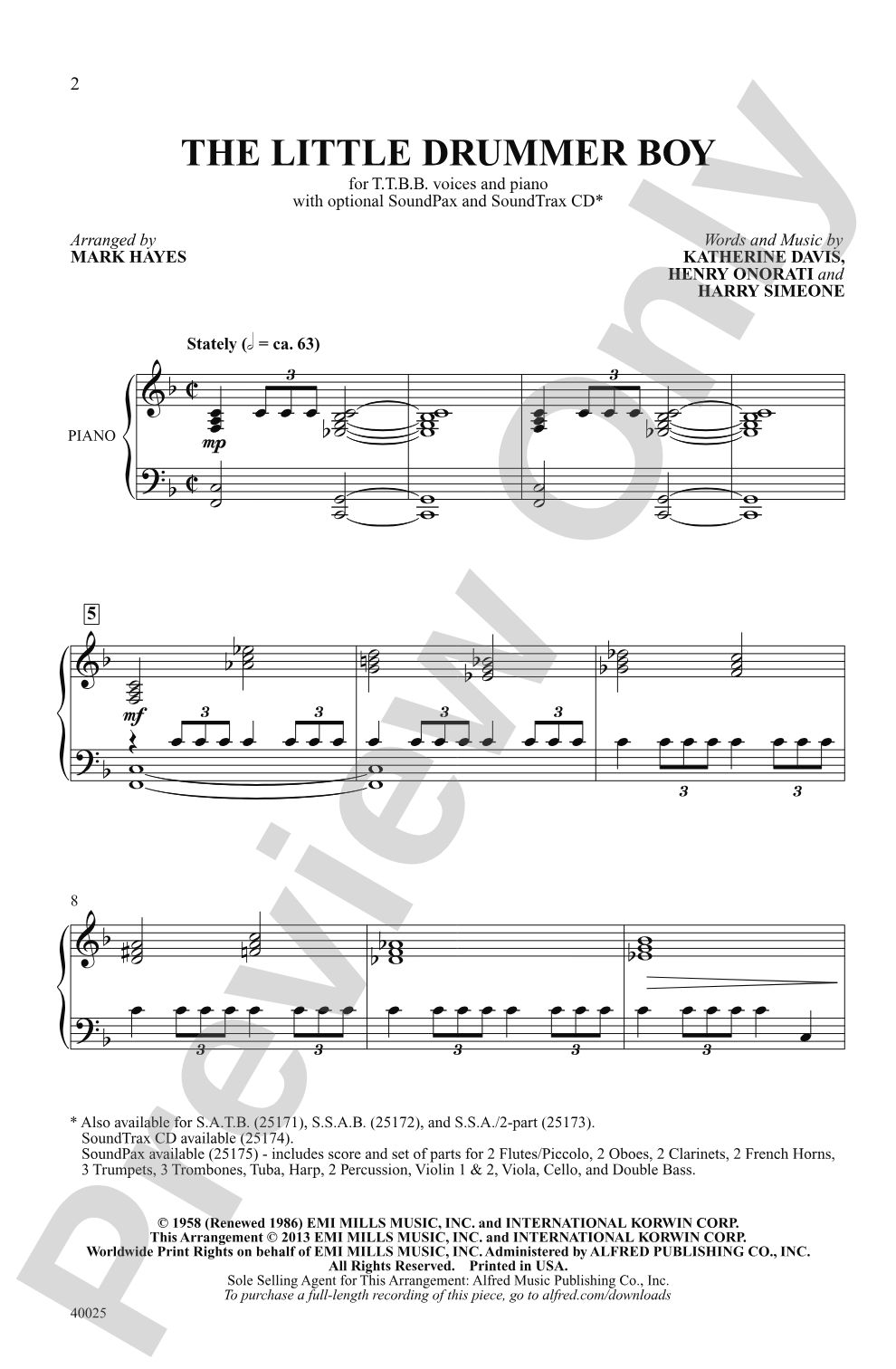
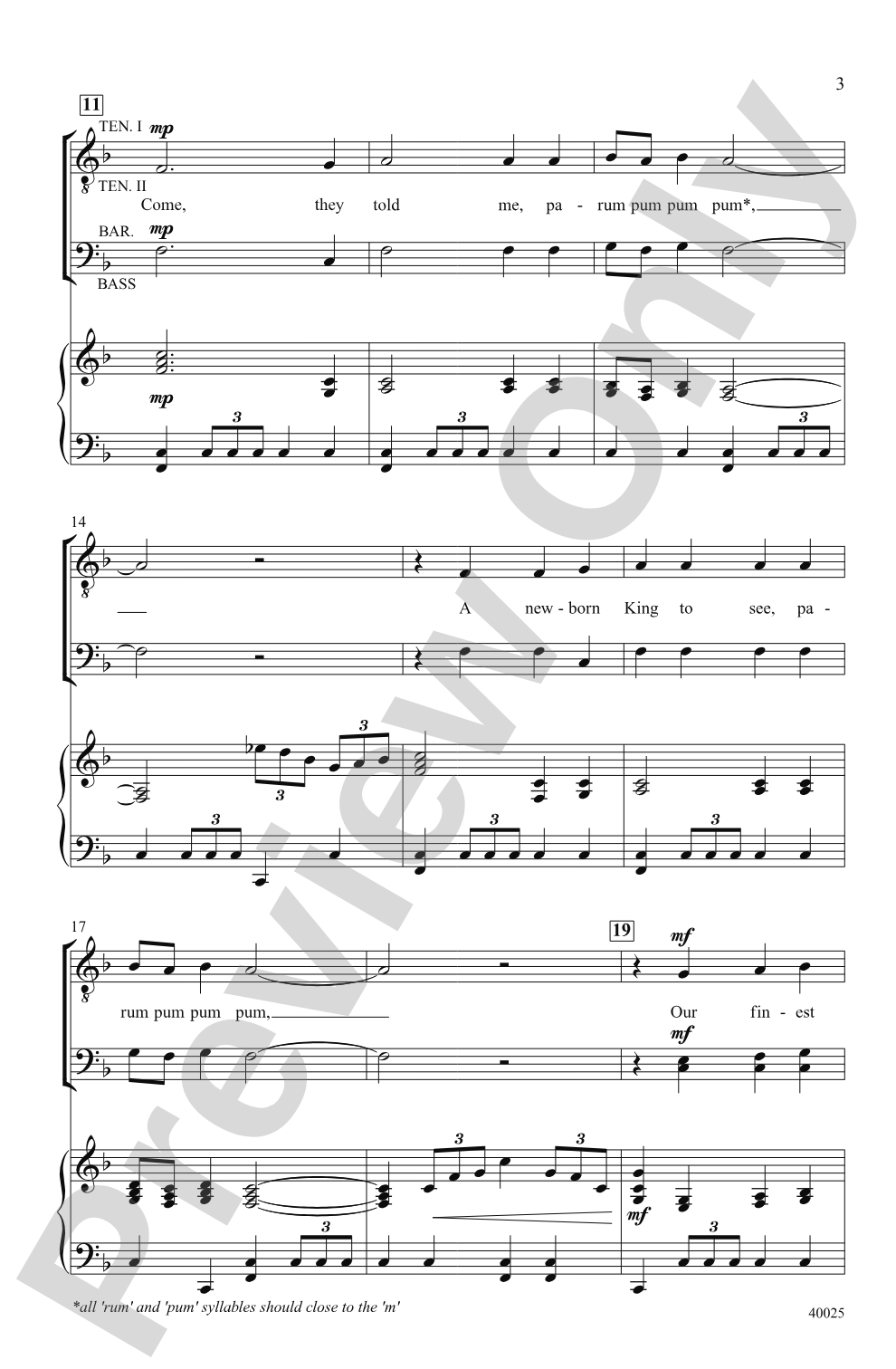
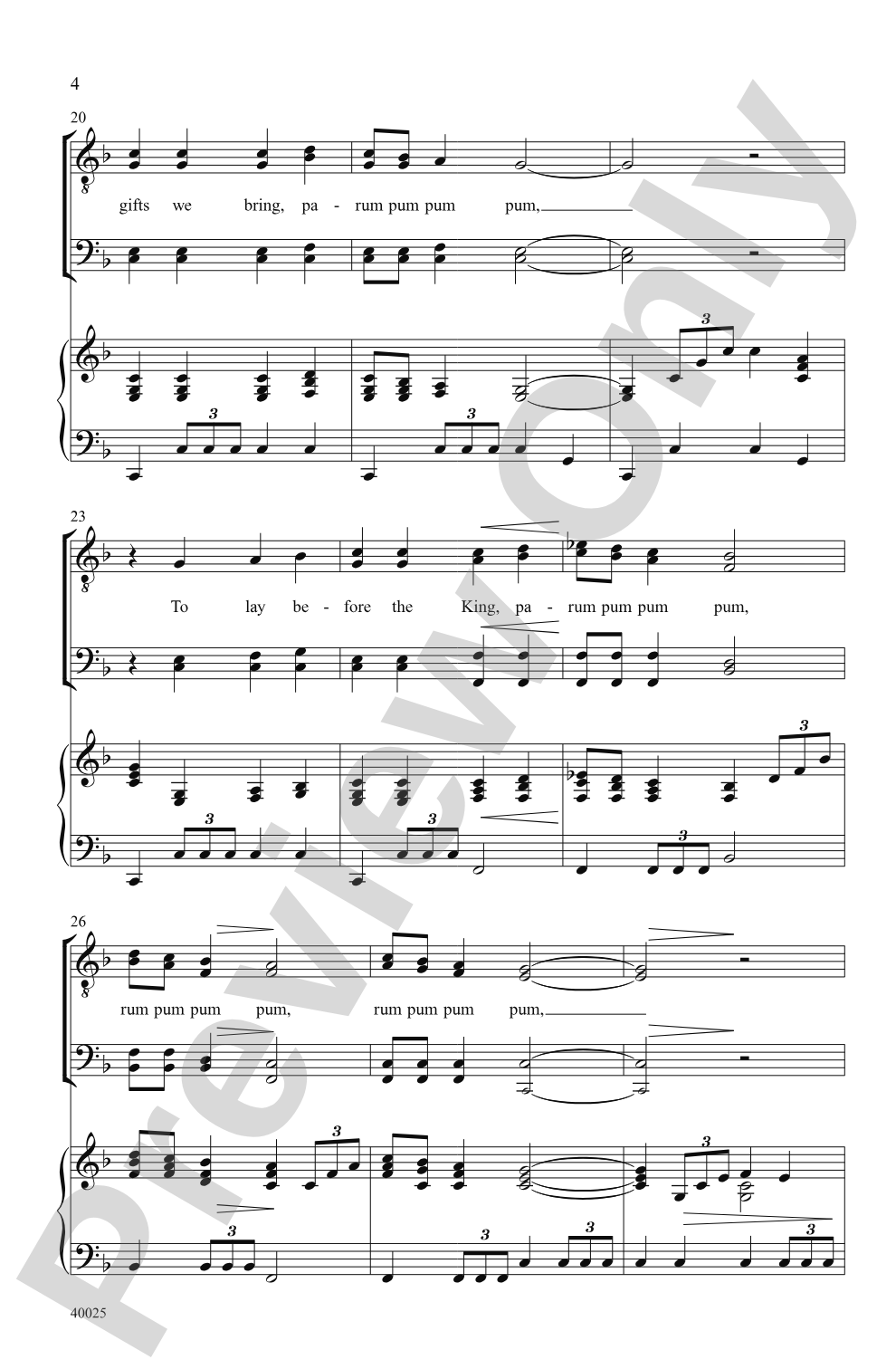

The Little Drummer Boy: TTBB Choral Octavo
Words and music by Katherine K. Davis, Henry Onorati, and Harry Simeone / arr. Mark Hayes
Item: 00-PO-0001750
$2.00
Minimum order quantity: 20 copies
Pickup currently not available
Related Items
The Little Drummer Boy: SATB Choral Octavo |
$2.25
|
View | |
The Little Drummer Boy: SSAB Choral Octavo |
$2.95
|
View | |
The Little Drummer Boy: SSA / 2-Part Choral Octavo |
$2.95
|
View | |
The Little Drummer Boy: SoundTrax Digital Audio Download |
$27.99
|
View | |
The Little Drummer Boy: SATB Choral Octavo |
$2.25
|
View | |
The Little Drummer Boy: SSA / 2-Part Choral Octavo |
$2.95
|
View | |
The Little Drummer Boy: TTBB Choral Octavo |
$2.00
|
View | |
The Little Drummer Boy: Choral Octavo SoundTrax CD |
$27.99
|
View | |
The Little Drummer Boy: Choral SoundPax |
$50.00
|
View |
Description
Now available for men, this arrangement respects the simplicity of this beloved holiday classic, yet still makes it soar. A must!


The Little Drummer Boy: TTBB Choral Octavo isn't in MakeMusic Cloud just yet...but it could be. Let us know you'd like to see it, and you'll help shape what comes next. In the meantime, start a free trial and dive into thousands of interactive titles your students can play along with today.
Request This Title
Tell us you want it.
Start Your Free Trial
Explore everything that's ready to play right now.
Sample Audio
1
Audio File
--:--
0:00
0:00
Sample Video
No sample videos found.
Additional Details
Series:
Alfred Pop Choral Series
Publisher:
Alfred Music
Page Count:
16
SKU:
00-PO-0001750
More about this title
About the Composer: Katherine K. Davis
Katherine K. Davis composed "The Little Drummer Boy" in 1941, creating one of the most recognizable Christmas melodies in American popular culture. Her gift for crafting memorable, singable lines made her a prolific composer across multiple genres, from sacred choral music to secular holiday favorites. Davis understood how a simple, direct melody could carry profound emotional weight, a principle that has kept her work alive in rehearsal rooms and concert halls for over eight decades.
Her collaboration with Henry Onorati and Harry Simeone on this song resulted in a piece that has become a holiday standard, recorded by countless artists and arranged for virtually every vocal and instrumental combination. Davis's legacy in music education rests on her ability to write music that connects performers and audiences alike, regardless of their musical training.
Why we love this
Mark Hayes brings fresh musicality to this evergreen without stripping away what makes it work: the melody remains instantly recognizable, yet the TTBB voicing opens this piece to men's choirs that rarely get holiday arrangements this substantial and singable. The arrangement respects the carol's emotional core while giving mature male voices real harmonic interest, making it a genuine concert piece rather than a novelty number.
What to expect
Warm and nostalgic with a contemporary polish. The arrangement honors the childlike simplicity at the song's heart while surrounding it with rich harmonic color and a subtle contemporary groove that makes it feel current without losing its timeless charm.
Who it's for
Men's choirs looking for holiday repertoire that respects their voices and offers genuine musical substance. Community choirs, church choirs, barbershop groups, and college men's ensembles will find this arrangement equally at home in a Christmas concert or a casual holiday gathering.
How to get the most out of it
- Balance the melody line across your soloists or leading voices so the tune cuts through the lower harmony parts, especially in the verses where thicker voicing can obscure the familiar tune.
- Shape the dynamic arc carefully through the middle section; resist the urge to push too hard too early, saving your full power for the final chorus where the arrangement blooms.
- Lean into the rhythmic pocket of the accompaniment rather than fighting it; this arrangement sits comfortably in a pop/contemporary style that benefits from a relaxed, conversational feel.
How to use it
Place this in the second half of a holiday concert, after you've established the season's sacred or traditional mood. It serves as a perfect bridge piece that signals a shift toward celebratory pops repertoire while remaining instantly recognizable to your audience. Works equally well as a closing number if you want to send listeners out humming.
Skills your students will build
- Blending voices across upper and lower parts to balance a melody line
- Navigating contemporary rhythmic feels and syncopation in a choral context
- Sustaining musicality in widely-known repertoire without oversinging
- Reading harmonic parts that support rather than double the melody