
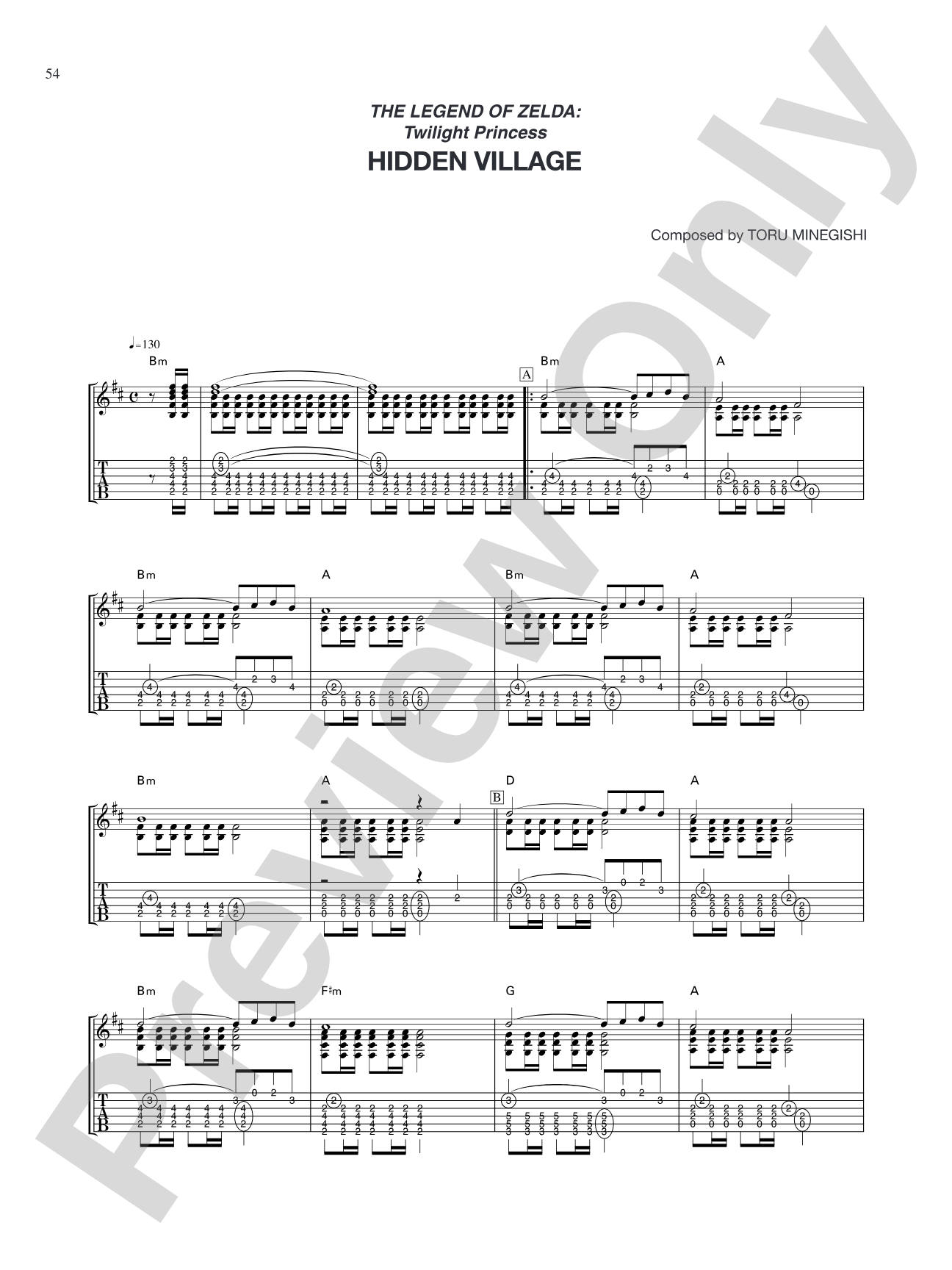

The Legend of Zelda™: Twilight Princess Hidden Village: Guitar Tab
By Koji Kondo, Kozue Ishikawa, Toru Minegishi, Kenta Nagata, Akito Nakatsuka, Asuka Ohta, Manaka Tominaga, and Hajime Wakai
Item: 00-PS-0015244
$4.99
One moment…
Related Items
The Legend of Zelda™ Title Theme: Guitar Tab |
$4.99
|
View | |
The Legend of Zelda™ Main Theme: Guitar Tab |
$4.99
|
View | |
Zelda II™: The Adventure of Link™ Title Theme: Guitar Tab |
$4.99
|
View | |
Zelda II™: The Adventure of Link™ Palace Music: Guitar Tab |
$4.99
|
View | |
The Legend of Zelda™: A Link to the Past™ Title Screen: Guitar Tab |
$4.99
|
View | |
The Legend of Zelda™: A Link to the Past™ Hyrule Castle Music: Guitar Tab |
$4.99
|
View | |
The Legend of Zelda™: A Link to the Past™ Main Theme: Guitar Tab |
$4.99
|
View | |
The Legend of Zelda™: A Link to the Past™ The Dark World: Guitar Tab |
$4.99
|
View | |
The Legend of Zelda™: Link's Awakening™ Main Theme: Guitar Tab |
$4.99
|
View | |
The Legend of Zelda™: Ocarina of Time™ Title Theme: Guitar Tab |
$4.99
|
View | |
The Legend of Zelda™: Ocarina of Time™ Princess Zeldas Theme: Guitar Tab |
$4.99
|
View | |
The Legend of Zelda™: Ocarina of Time™ Hyrule Field: Guitar Tab |
$4.99
|
View | |
The Legend of Zelda™: Ocarina of Time™ Lost Woods: Guitar Tab |
$4.99
|
View | |
The Legend of Zelda™: Ocarina of Time™ Song of Storms: Guitar Tab |
$4.99
|
View | |
The Legend of Zelda™: Ocarina of Time™ Gerudo Valley: Guitar Tab |
$4.99
|
View | |
The Legend of Zelda™: Majora's Mask™ Prelude of Majoras Mask: Guitar Tab |
$4.99
|
View | |
The Legend of Zelda™: Majora's Mask™ Termina Field: Guitar Tab |
$4.99
|
View | |
The Legend of Zelda™: The Wind Waker™ Main Theme: Guitar Tab |
$4.99
|
View | |
The Legend of Zelda™: The Wind Waker™ Dragon Roost Island: Guitar Tab |
$4.99
|
View | |
The Legend of Zelda™: The Wind Waker™ Molgera: Guitar Tab |
$4.99
|
View | |
The Legend of Zelda™: The Wind Waker™ Ocean Theme: Guitar Tab |
$4.99
|
View | |
The Legend of Zelda™: Four Swords Adventures Village of the Blue Maiden Restored: Guitar Tab |
$4.99
|
View | |
The Legend of Zelda™: Four Swords Adventures Field Theme: Guitar Tab |
$4.99
|
View | |
The Legend of Zelda™: Twilight Princess Hyrule Field Main Theme: Guitar Tab |
$4.99
|
View | |
The Legend of Zelda™: Twilight Princess Midnas Lament: Guitar Tab |
$4.99
|
View | |
The Legend of Zelda™: Phantom Hourglass Cielas Parting Words: Guitar Tab |
$4.99
|
View | |
The Legend of Zelda™: Spirit Tracks Title Theme: Guitar Tab |
$4.99
|
View | |
The Legend of Zelda™: Spirit Tracks Field Theme: Guitar Tab |
$4.99
|
View | |
The Legend of Zelda™: Spirit Tracks Train Travel: Guitar Tab |
$4.99
|
View | |
The Legend of Zelda™ Tri Force Fanfare: Guitar Tab |
$4.99
|
View | |
The Legend of Zelda™ Correct Solution: Guitar Tab |
$4.99
|
View | |
The Legend of Zelda™ Whistle of Warp: Guitar Tab |
$4.99
|
View | |
The Legend of Zelda™ Series for Guitar: Guitar TAB Book |
$16.99
|
View |
Description
Video game soundtracks both old and new feature work by some of the greatest composers of our time. Orchestras all over the world play entire concerts of video game music. This collection of themes from The Legend of Zelda™ series is arranged for solo guitar performance with full notation and TAB. Each song is arranged in easy guitar keys at an easy--intermediate level, and all pieces are suitable for recitals, concerts, and solo performances. There are 33 songs drawn from The Legend of Zelda™, Zelda II™ - The Adventure of Link™, The Legend of Zelda™: A Link to the Past™, The Legend of Zelda™: Link's Awakening™, The Legend of Zelda™: Ocarina of Time™, The Legend of Zelda™: Majora's Mask™, The Legend of Zelda™: The Wind Waker™, The Legend of Zelda™: Four Swords Adventures, The Legend of Zelda™: Twilight Princess, The Legend of Zelda™: Phantom Hourglass, and The Legend of Zelda™, Spirit Tracks.
"Best in Show" Award at Winter NAMM 2012 presented by Music Inc. magazine.


"Best in Show" Award at Winter NAMM 2012 presented by Music Inc. magazine.
The Legend of Zelda™: Twilight Princess Hidden Village: Guitar Tab isn't in MakeMusic Cloud just yet...but it could be. Let us know you'd like to see it, and you'll help shape what comes next. In the meantime, start a free trial and dive into thousands of interactive titles your students can play along with today.
Request This Title
Tell us you want it.
Start Your Free Trial
Explore everything that's ready to play right now.
Sample Audio
No sample audio found.
Sample Video
Additional Details
Publisher:
Alfred Music
Page Count:
64
SKU:
00-PS-0015244
More about this title
About the Composer: Toru Minegishi
Toru Minegishi has been a key voice in Nintendo's music composition team for over two decades, crafting soundtracks that define some of gaming's most beloved franchises. His work on The Legend of Zelda series demonstrates a mastery of orchestral writing adapted for interactive media, with melodies that are both memorable and structurally sophisticated enough to sustain repeated listening across different game contexts.
Minegishi's compositional approach balances accessibility with harmonic depth. His themes work equally well in their original orchestral form and in these guitar arrangements, revealing how thoughtfully constructed his melodic and harmonic choices are. For music educators, his body of work illustrates how compelling music transcends its original medium.
Why we love this
This collection captures some of the most musically rewarding themes from a legendary game series, and the guitar arrangements preserve their character without oversimplifying. The breadth of material spanning multiple Zelda titles means you can program recognizable, engaging music that resonates with audiences while giving guitarists a genuine technical and musical challenge. Students encounter real compositional techniques here, not just fingering patterns.
What to expect
These arrangements breathe with the wonder and adventure of the original games. You'll find moments of quiet introspection, passages of heroic momentum, and sections that shimmer with harmonic color. The guitar's natural resonance complements themes that were written to feel both intimate and grand.
Who it's for
Intermediate guitarists who want recital-worthy repertoire beyond classical method books. Students need solid position knowledge and the ability to read TAB fluently alongside standard notation, but the arrangements avoid excessive technical virtuosity in favor of musical storytelling. This is ideal for players eager to perform music they genuinely care about.
How to get the most out of it
- Study the harmonic movement in passages that sit across string changes; many of these themes use unexpected chromatic motion that demands precise intonation and smooth position shifts.
- Approach the melodic phrasing as you would a vocal line. These themes are singing in nature, so resist rushing quick note sequences and shape the longer lines with intentional breath.
- Use the full range of dynamics marked in the TAB. The difference between pizzicato interjections and sustained melody matters to how a listener follows the song's emotional arc.
- When a theme recurs in different arrangements within this book, compare versions to understand how key choice and register affect the mood. This awareness deepens your interpretation of each performance.
How to use it
Feature individual pieces on recitals where you want to bridge classical and contemporary repertoire, or program a set of 2-3 connected themes to create a thematic arc within a concert. This collection also works well as a supplementary performance resource for students who need motivation to practice consistent technique work; seeing their favorite game music in notation often reignites practice commitment.
Skills your students will build
- Reading standard notation and TAB simultaneously
- Executing smooth position shifts across multiple strings
- Shaping long melodic phrases with intentional phrasing and dynamics
- Interpreting harmonic context to inform intonation choices
- Navigating key changes and transpositions within a single arrangement
- Managing technical demands at intermediate level without sacrificing musicality