
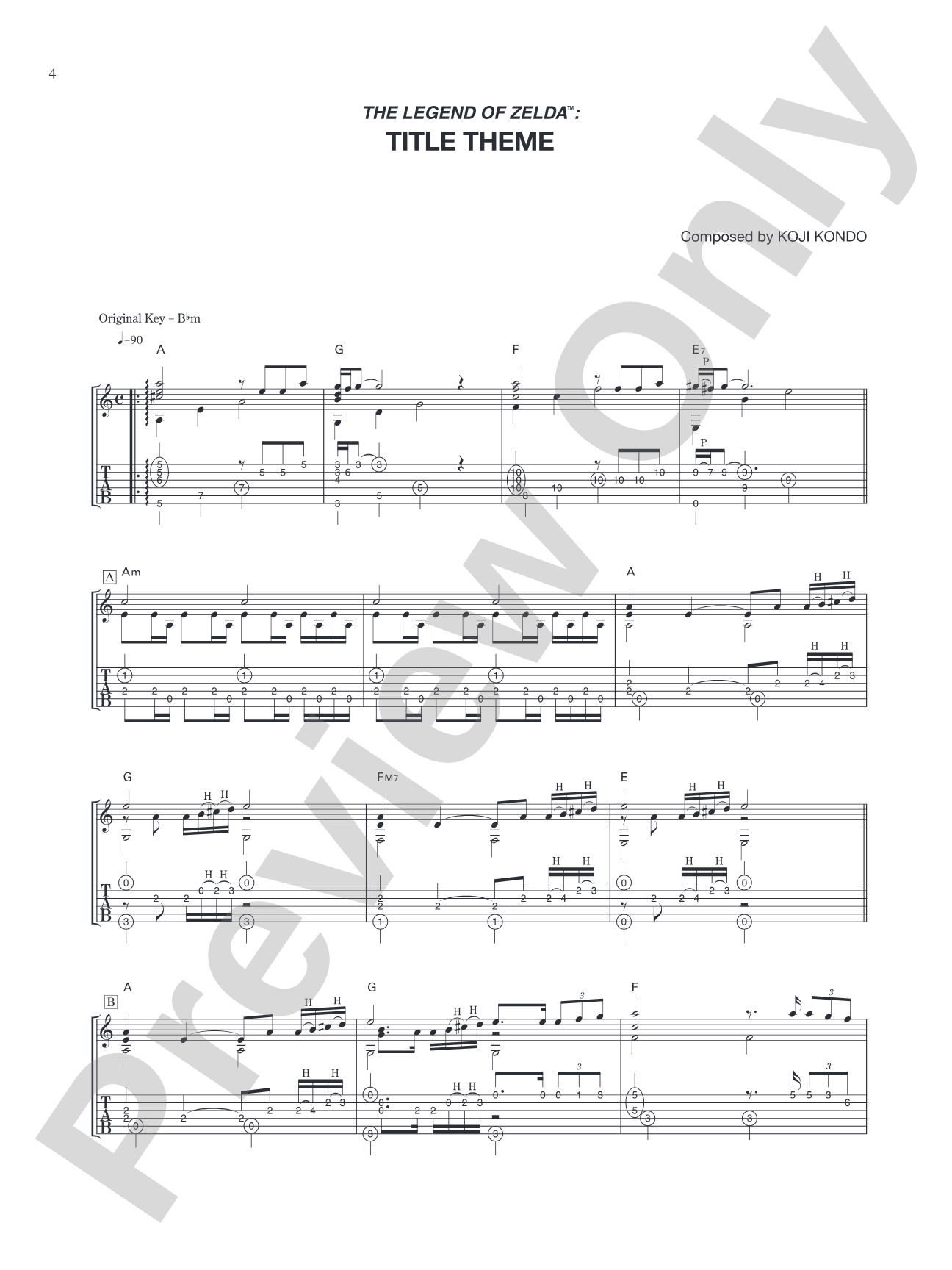

The Legend of Zelda™ Title Theme: Guitar Tab
By Koji Kondo, Kozue Ishikawa, Toru Minegishi, Kenta Nagata, Akito Nakatsuka, Asuka Ohta, Manaka Tominaga, and Hajime Wakai
Item: 00-PS-0015220
$4.99
One moment…
Related Items
The Legend of Zelda™ Main Theme: Guitar Tab |
$4.99
|
View | |
Zelda II™: The Adventure of Link™ Title Theme: Guitar Tab |
$4.99
|
View | |
Zelda II™: The Adventure of Link™ Palace Music: Guitar Tab |
$4.99
|
View | |
The Legend of Zelda™: A Link to the Past™ Title Screen: Guitar Tab |
$4.99
|
View | |
The Legend of Zelda™: A Link to the Past™ Hyrule Castle Music: Guitar Tab |
$4.99
|
View | |
The Legend of Zelda™: A Link to the Past™ Main Theme: Guitar Tab |
$4.99
|
View | |
The Legend of Zelda™: A Link to the Past™ The Dark World: Guitar Tab |
$4.99
|
View | |
The Legend of Zelda™: Link's Awakening™ Main Theme: Guitar Tab |
$4.99
|
View | |
The Legend of Zelda™: Ocarina of Time™ Title Theme: Guitar Tab |
$4.99
|
View | |
The Legend of Zelda™: Ocarina of Time™ Princess Zeldas Theme: Guitar Tab |
$4.99
|
View | |
The Legend of Zelda™: Ocarina of Time™ Hyrule Field: Guitar Tab |
$4.99
|
View | |
The Legend of Zelda™: Ocarina of Time™ Lost Woods: Guitar Tab |
$4.99
|
View | |
The Legend of Zelda™: Ocarina of Time™ Song of Storms: Guitar Tab |
$4.99
|
View | |
The Legend of Zelda™: Ocarina of Time™ Gerudo Valley: Guitar Tab |
$4.99
|
View | |
The Legend of Zelda™: Majora's Mask™ Prelude of Majoras Mask: Guitar Tab |
$4.99
|
View | |
The Legend of Zelda™: Majora's Mask™ Termina Field: Guitar Tab |
$4.99
|
View | |
The Legend of Zelda™: The Wind Waker™ Main Theme: Guitar Tab |
$4.99
|
View | |
The Legend of Zelda™: The Wind Waker™ Dragon Roost Island: Guitar Tab |
$4.99
|
View | |
The Legend of Zelda™: The Wind Waker™ Molgera: Guitar Tab |
$4.99
|
View | |
The Legend of Zelda™: The Wind Waker™ Ocean Theme: Guitar Tab |
$4.99
|
View | |
The Legend of Zelda™: Four Swords Adventures Village of the Blue Maiden Restored: Guitar Tab |
$4.99
|
View | |
The Legend of Zelda™: Four Swords Adventures Field Theme: Guitar Tab |
$4.99
|
View | |
The Legend of Zelda™: Twilight Princess Hyrule Field Main Theme: Guitar Tab |
$4.99
|
View | |
The Legend of Zelda™: Twilight Princess Hidden Village: Guitar Tab |
$4.99
|
View | |
The Legend of Zelda™: Twilight Princess Midnas Lament: Guitar Tab |
$4.99
|
View | |
The Legend of Zelda™: Phantom Hourglass Cielas Parting Words: Guitar Tab |
$4.99
|
View | |
The Legend of Zelda™: Spirit Tracks Title Theme: Guitar Tab |
$4.99
|
View | |
The Legend of Zelda™: Spirit Tracks Field Theme: Guitar Tab |
$4.99
|
View | |
The Legend of Zelda™: Spirit Tracks Train Travel: Guitar Tab |
$4.99
|
View | |
The Legend of Zelda™ Tri Force Fanfare: Guitar Tab |
$4.99
|
View | |
The Legend of Zelda™ Correct Solution: Guitar Tab |
$4.99
|
View | |
The Legend of Zelda™ Whistle of Warp: Guitar Tab |
$4.99
|
View | |
The Legend of Zelda™ Series for Guitar: Guitar TAB Book |
$16.99
|
View |
Description
Video game soundtracks both old and new feature work by some of the greatest composers of our time. Orchestras all over the world play entire concerts of video game music. This collection of themes from The Legend of Zelda™ series is arranged for solo guitar performance with full notation and TAB. Each song is arranged in easy guitar keys at an easy--intermediate level, and all pieces are suitable for recitals, concerts, and solo performances. There are 33 songs drawn from The Legend of Zelda™, Zelda II™ - The Adventure of Link™, The Legend of Zelda™: A Link to the Past™, The Legend of Zelda™: Link's Awakening™, The Legend of Zelda™: Ocarina of Time™, The Legend of Zelda™: Majora's Mask™, The Legend of Zelda™: The Wind Waker™, The Legend of Zelda™: Four Swords Adventures, The Legend of Zelda™: Twilight Princess, The Legend of Zelda™: Phantom Hourglass, and The Legend of Zelda™, Spirit Tracks.
"Best in Show" Award at Winter NAMM 2012 presented by Music Inc. magazine.


"Best in Show" Award at Winter NAMM 2012 presented by Music Inc. magazine.
The Legend of Zelda™ Title Theme: Guitar Tab isn't in MakeMusic Cloud just yet...but it could be. Let us know you'd like to see it, and you'll help shape what comes next. In the meantime, start a free trial and dive into thousands of interactive titles your students can play along with today.
Request This Title
Tell us you want it.
Start Your Free Trial
Explore everything that's ready to play right now.
Sample Audio
No sample audio found.
Sample Video
Additional Details
Publisher:
Alfred Music
Page Count:
64
SKU:
00-PS-0015220
More about this title
About the Composer: Koji Kondo
Koji Kondo shaped video game music as an art form during his decades at Nintendo, beginning with the original Donkey Kong arcade game in 1981 and continuing through the entire evolution of interactive entertainment. His work on The Legend of Zelda series established a template for how game music could carry narrative weight, build atmosphere, and achieve emotional resonance within the constraints of limited hardware, influencing composers across the industry.
Kondo's compositions balance accessibility with sophistication, creating melodies that lodge instantly in memory while supporting complex harmonic and structural development. For music educators, his work demonstrates how thematic writing can engage listeners across age groups and skill levels, making his music invaluable for repertoire exploration in contemporary contexts.
Why we love this
This collection captures iconic themes that students recognize and connect with emotionally, which transforms their engagement with the instrument. The arrangements sit comfortably on the fingerboard in accessible keys while preserving the melodic integrity that made these pieces memorable in the first place.
What to expect
These themes carry the emotional landscape of their original games: the sense of adventure and exploration, moments of quiet reflection, and triumphant fanfares. On guitar, they translate into warm, resonant melodies that feel both intimate and heroic, depending on the arrangement and your interpretation.
Who it's for
Guitar students at easy-intermediate level who want repertoire that feels contemporary and personally meaningful, as well as recital performers seeking pieces that audiences genuinely recognize and enjoy. Teachers can use these arrangements to motivate students through music they already love while building technical and musical skills in a natural context.
How to get the most out of it
- Sustain the melodic lines with consistent tone quality, especially in passages where the theme moves slower. The familiarity of the tune can tempt rushing; let the melody breathe.
- Pay attention to dynamic shaping within each phrase. Even at easy-intermediate level, subtle volume changes between sections will make the piece feel more complete and less like a literal transcription.
- Use the TAB as a shortcut to accuracy, but refer to the standard notation to understand the rhythmic relationships and phrasing. This reinforces your reading skills across both systems.
- When moving between positions, plan your fingering ahead of time rather than relying solely on what the tab suggests. This builds left-hand efficiency and prepares you for sight-reading unfamiliar arrangements.
How to use it
Slot one or two of these pieces into a recital to create a program section that feels fresh and connects with listeners across generations. The sheer variety of moods and styles across 33 arrangements means you can craft a complete solo guitar recital around this book, mixing different tempos and emotional textures.
Skills your students will build
- Reading guitar TAB and standard notation together
- Playing melodies across different positions on the neck
- Dynamic control and phrase shaping in single-line arrangements
- Sustaining clean tone during finger transitions and position shifts
- Interpreting written arrangements to add musicality beyond note accuracy