
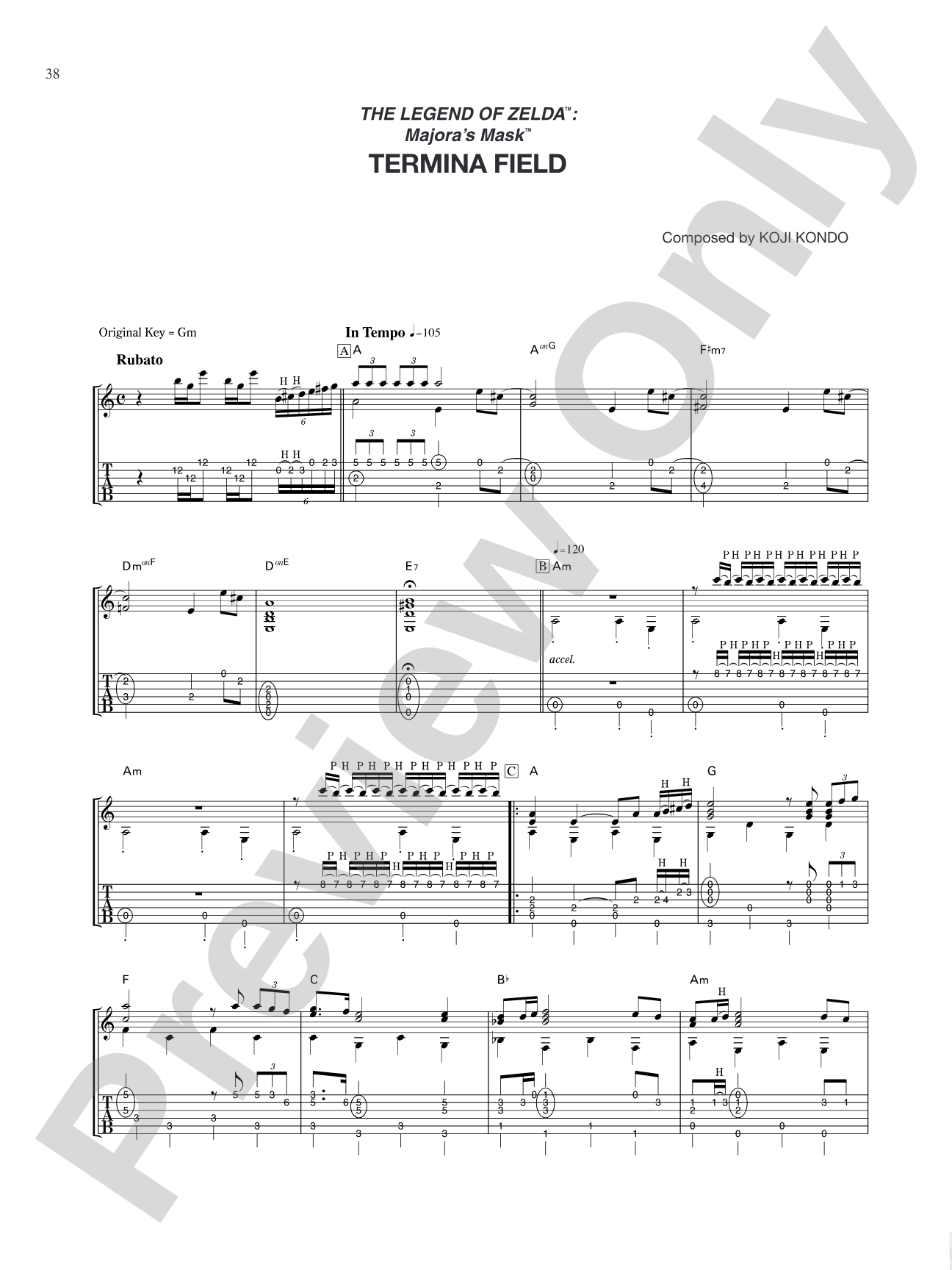

The Legend of Zelda™: Majora's Mask™ Termina Field: Guitar Tab
By Koji Kondo, Kozue Ishikawa, Toru Minegishi, Kenta Nagata, Akito Nakatsuka, Asuka Ohta, Manaka Tominaga, and Hajime Wakai
Item: 00-PS-0015236
$4.99
One moment…
Related Items
The Legend of Zelda™ Title Theme: Guitar Tab |
$4.99
|
View | |
The Legend of Zelda™ Main Theme: Guitar Tab |
$4.99
|
View | |
Zelda II™: The Adventure of Link™ Title Theme: Guitar Tab |
$4.99
|
View | |
Zelda II™: The Adventure of Link™ Palace Music: Guitar Tab |
$4.99
|
View | |
The Legend of Zelda™: A Link to the Past™ Title Screen: Guitar Tab |
$4.99
|
View | |
The Legend of Zelda™: A Link to the Past™ Hyrule Castle Music: Guitar Tab |
$4.99
|
View | |
The Legend of Zelda™: A Link to the Past™ Main Theme: Guitar Tab |
$4.99
|
View | |
The Legend of Zelda™: A Link to the Past™ The Dark World: Guitar Tab |
$4.99
|
View | |
The Legend of Zelda™: Link's Awakening™ Main Theme: Guitar Tab |
$4.99
|
View | |
The Legend of Zelda™: Ocarina of Time™ Title Theme: Guitar Tab |
$4.99
|
View | |
The Legend of Zelda™: Ocarina of Time™ Princess Zeldas Theme: Guitar Tab |
$4.99
|
View | |
The Legend of Zelda™: Ocarina of Time™ Hyrule Field: Guitar Tab |
$4.99
|
View | |
The Legend of Zelda™: Ocarina of Time™ Lost Woods: Guitar Tab |
$4.99
|
View | |
The Legend of Zelda™: Ocarina of Time™ Song of Storms: Guitar Tab |
$4.99
|
View | |
The Legend of Zelda™: Ocarina of Time™ Gerudo Valley: Guitar Tab |
$4.99
|
View | |
The Legend of Zelda™: Majora's Mask™ Prelude of Majoras Mask: Guitar Tab |
$4.99
|
View | |
The Legend of Zelda™: The Wind Waker™ Main Theme: Guitar Tab |
$4.99
|
View | |
The Legend of Zelda™: The Wind Waker™ Dragon Roost Island: Guitar Tab |
$4.99
|
View | |
The Legend of Zelda™: The Wind Waker™ Molgera: Guitar Tab |
$4.99
|
View | |
The Legend of Zelda™: The Wind Waker™ Ocean Theme: Guitar Tab |
$4.99
|
View | |
The Legend of Zelda™: Four Swords Adventures Village of the Blue Maiden Restored: Guitar Tab |
$4.99
|
View | |
The Legend of Zelda™: Four Swords Adventures Field Theme: Guitar Tab |
$4.99
|
View | |
The Legend of Zelda™: Twilight Princess Hyrule Field Main Theme: Guitar Tab |
$4.99
|
View | |
The Legend of Zelda™: Twilight Princess Hidden Village: Guitar Tab |
$4.99
|
View | |
The Legend of Zelda™: Twilight Princess Midnas Lament: Guitar Tab |
$4.99
|
View | |
The Legend of Zelda™: Phantom Hourglass Cielas Parting Words: Guitar Tab |
$4.99
|
View | |
The Legend of Zelda™: Spirit Tracks Title Theme: Guitar Tab |
$4.99
|
View | |
The Legend of Zelda™: Spirit Tracks Field Theme: Guitar Tab |
$4.99
|
View | |
The Legend of Zelda™: Spirit Tracks Train Travel: Guitar Tab |
$4.99
|
View | |
The Legend of Zelda™ Tri Force Fanfare: Guitar Tab |
$4.99
|
View | |
The Legend of Zelda™ Correct Solution: Guitar Tab |
$4.99
|
View | |
The Legend of Zelda™ Whistle of Warp: Guitar Tab |
$4.99
|
View | |
The Legend of Zelda™ Series for Guitar: Guitar TAB Book |
$16.99
|
View |
Description
Video game soundtracks both old and new feature work by some of the greatest composers of our time. Orchestras all over the world play entire concerts of video game music. This collection of themes from The Legend of Zelda™ series is arranged for solo guitar performance with full notation and TAB. Each song is arranged in easy guitar keys at an easy--intermediate level, and all pieces are suitable for recitals, concerts, and solo performances. There are 33 songs drawn from The Legend of Zelda™, Zelda II™ - The Adventure of Link™, The Legend of Zelda™: A Link to the Past™, The Legend of Zelda™: Link's Awakening™, The Legend of Zelda™: Ocarina of Time™, The Legend of Zelda™: Majora's Mask™, The Legend of Zelda™: The Wind Waker™, The Legend of Zelda™: Four Swords Adventures, The Legend of Zelda™: Twilight Princess, The Legend of Zelda™: Phantom Hourglass, and The Legend of Zelda™, Spirit Tracks.
"Best in Show" Award at Winter NAMM 2012 presented by Music Inc. magazine.


"Best in Show" Award at Winter NAMM 2012 presented by Music Inc. magazine.
The Legend of Zelda™: Majora's Mask™ Termina Field: Guitar Tab isn't in MakeMusic Cloud just yet...but it could be. Let us know you'd like to see it, and you'll help shape what comes next. In the meantime, start a free trial and dive into thousands of interactive titles your students can play along with today.
Request This Title
Tell us you want it.
Start Your Free Trial
Explore everything that's ready to play right now.
Sample Audio
No sample audio found.
Sample Video
Additional Details
Publisher:
Alfred Music
Page Count:
64
SKU:
00-PS-0015236
More about this title
About the Composer: Koji Kondo
Koji Kondo shaped video game music as an art form during his decades at Nintendo. His work spans from the original 1985 Super Mario Bros. to The Legend of Zelda series, establishing compositional techniques that influenced an entire medium and proved that interactive music could carry the same emotional weight as traditional concert repertoire.
Kondo's melodies are built for accessibility and memory. Guitarists will notice how his themes sit naturally on fretted instruments, use clear harmonic structures, and reward expressive playing without demanding virtuosity. His arrangements for this collection reflect careful consideration of what makes a piece singable, playable, and emotionally resonant for solo performers.
Why we love this
Termina Field captures the unsettling, time-conscious atmosphere of Majora's Mask through an arrangement that's genuinely playable at the intermediate level. The tab layout is clean and accurate, making it accessible to guitarists who learn by ear or tab preference, while the full notation keeps the piece legitimate for music readers. This is the kind of contemporary solo literature that keeps students engaged because it lives in their cultural world.
What to expect
Termina Field carries the weight of a ticking clock. The arrangement preserves the original's minor-key unease and rhythmic urgency, translating the game's temporal anxiety into guitar texture. Even at an accessible level, the piece demands focus and control to convey that specific kind of dread.
Who it's for
Guitarists at the easy-intermediate level who want engaging recital material outside the traditional classical and fingerstyle canon. Solo performers and students in guitar lessons will find genuine artistic value here alongside the fun factor of playing a piece they already know and care about.
How to get the most out of it
- Pay attention to the rhythmic pulse and uneven note groupings that suggest the game's time-pressure mechanic; these create tension in the melody even when you're playing at a moderate tempo.
- Shape the phrasing to highlight the theme's repetitive structure rather than let it flatten; small dynamic variations between statements keep the listener engaged.
- Use sustain carefully where the arrangement indicates it, particularly in the lower voices, to support the melody without muddying the texture.
- Balance finger noise and fret squeak as expressive tools. In a game arrangement, some of that grit serves the character rather than working against it.
How to use it
Program this as a standalone recital piece or pair it with other game music arrangements for a thematic concert. It also works well as a milestone piece for students who have grounded themselves in classical repertoire and are ready to own something contemporary and culturally relevant.
Skills your students will build
- Reading full notation and TAB simultaneously
- Playing repeated melodic figures with rhythmic precision
- Managing sustain and dynamics in minor keys
- Conveying emotional mood through arrangement interpretation
- Navigating easy guitar keys with clean intonation