
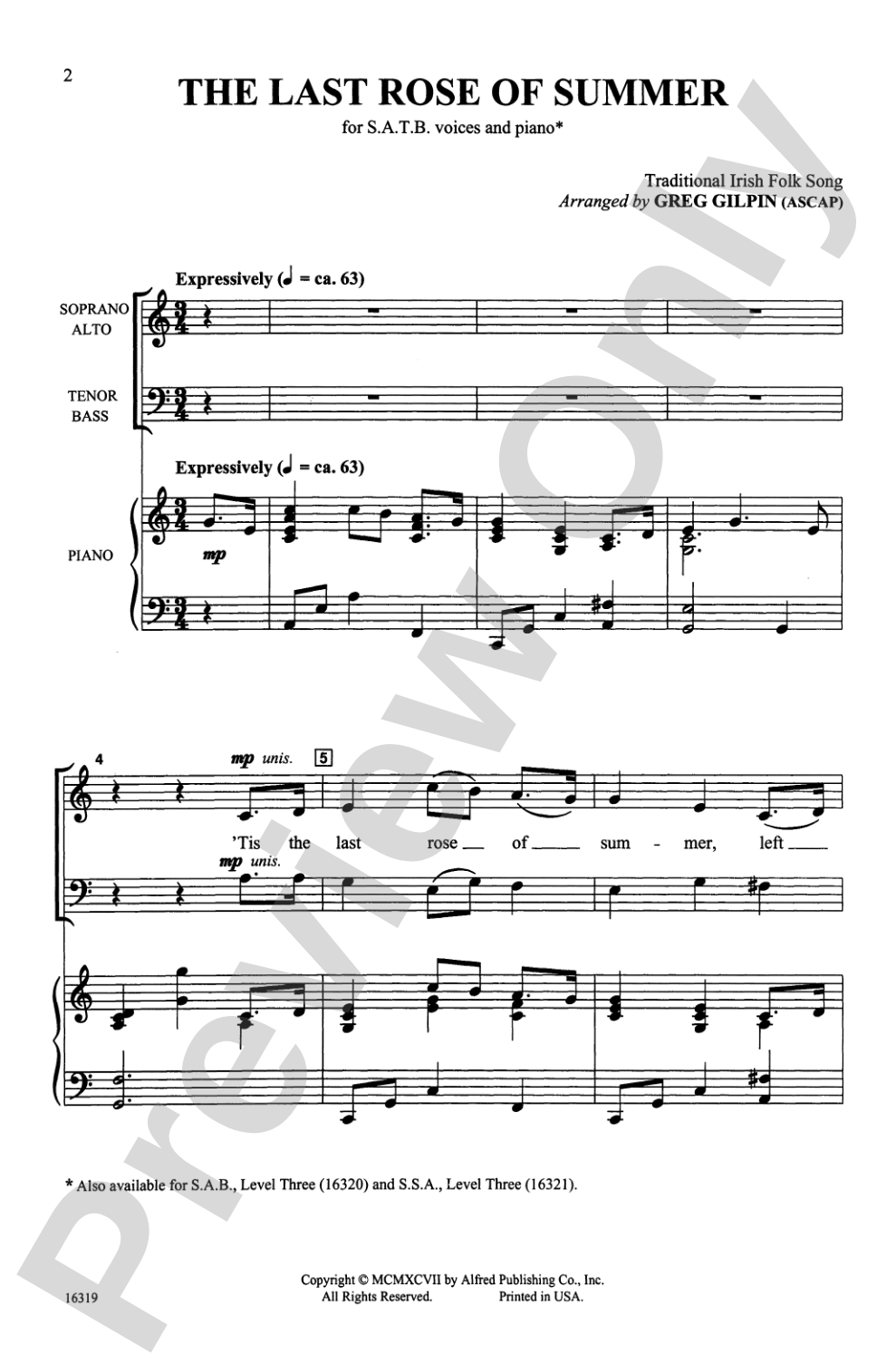

The Last Rose of Summer: SATB Choral Octavo
Arr. Greg Gilpin
Item: 00-PO-0003963
$2.25
Minimum order quantity: 20 copies
Pickup currently not available
Description
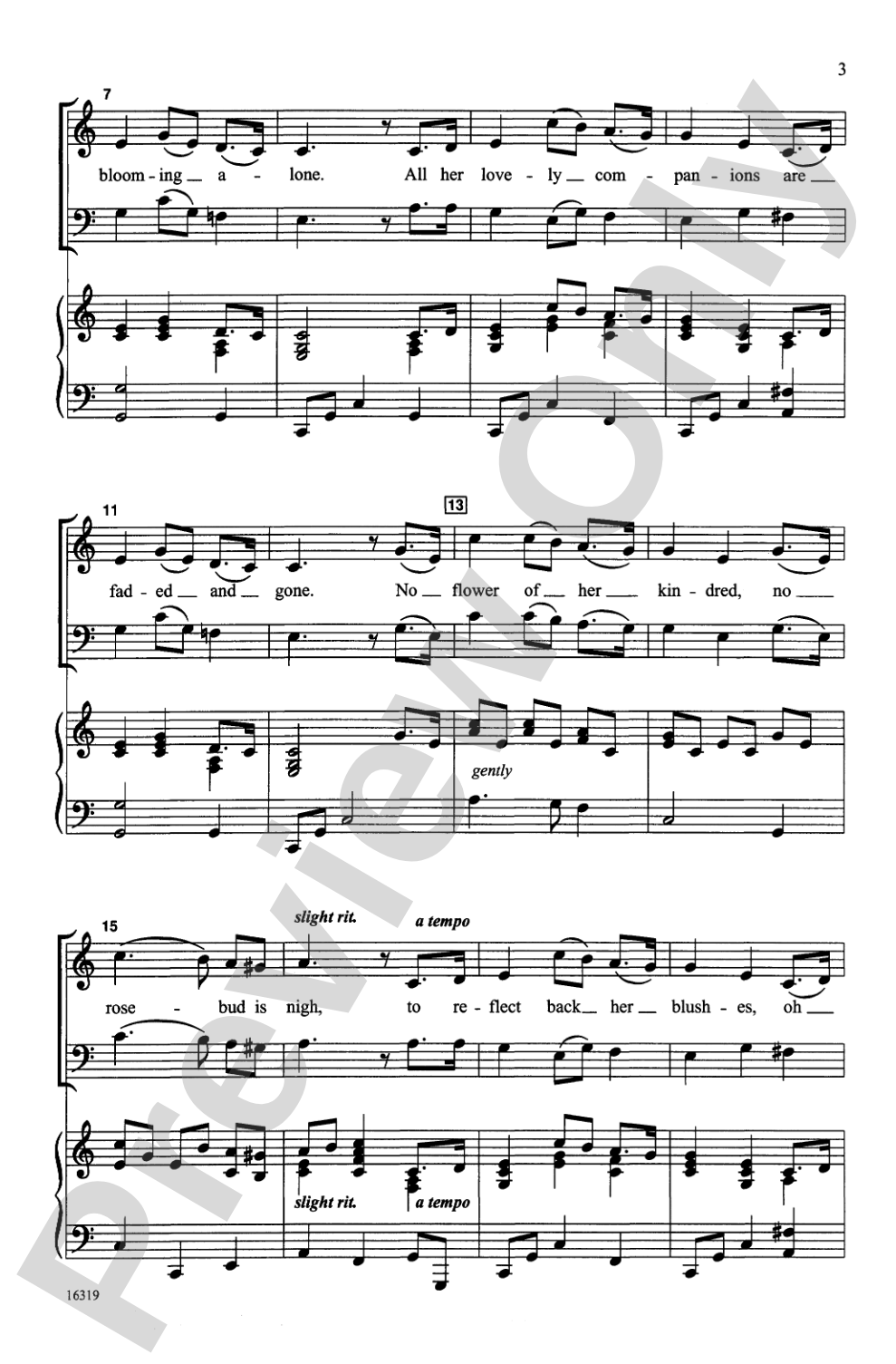
A tender and graceful arrangement by Greg Gilpin of a captivating Irish ballad. This simple, yet deceptively subtle arrangement includes quite a bit of unison and 2-part writing, saving the mixed part writing for powerful effect. The piano accompaniment is a classic and adds much to this arrangement's appeal.


The Last Rose of Summer: SATB Choral Octavo isn't in MakeMusic Cloud just yet...but it could be. Let us know you'd like to see it, and you'll help shape what comes next. In the meantime, start a free trial and dive into thousands of interactive titles your students can play along with today.
Request This Title
Tell us you want it.
Start Your Free Trial
Explore everything that's ready to play right now.
Sample Audio
No sample audio found.
Sample Video
No sample videos found.
Additional Details
Series:
Alfred Archive Edition: Alfred Choral Designs
Publisher:
Alfred Music
Page Count:
8
SKU:
00-PO-0003963
More about this title
About the Arranger: Greg Gilpin

Greg Gilpin holds deep roots in both the choral and recording worlds. An ASCAP award-winning arranger and conductor, he has led performances at Carnegie Hall, Lincoln Center, Ryman Auditorium, Sydney Opera House, Royal Festival Hall, and Harpa Concert Hall. Beyond the concert stage, Gilpin serves as Director of Educational Choral Publications for Shawnee Press and maintains an active career as a composer, recording producer, and musician.
Gilpin's creative reach extends across multiple disciplines. In 2021, he composed the score for the award-winning short film "Rosie's Rescue" and collaborated with opera singer Angela Brown on a new arrangement of "What Child is This?" premiered by Ms. Brown and the Indianapolis Symphonic Choir. He holds membership in ACDA, NAfME, SAG-AFTRA, and is a Life Loyal Member of Phi Mu Alpha Sinfonia.
Why we love this
Gilpin's restraint here is what makes this arrangement sing. By layering unison and two-part sections throughout, he builds genuine dramatic tension before unleashing the full four-part writing at moments that matter. The piano part carries real musical weight without overwhelming the voices, and the result sits perfectly in that sweet spot between accessible and sophisticated.
What to expect
Tender and reflective, with the intimate warmth of a folk tradition heard through a cultivated musical lens. The arrangement breathes with natural phrasing, allowing the Irish melody to unfold without artifice, while Gilpin's piano accompaniment grounds the piece in quiet dignity.
Who it's for
Choirs seeking a proven contest or festival selection that honors a beloved traditional melody while offering genuine artistic depth. This arrangement rewards both developing and experienced ensembles with straightforward sections that build confidence and sophisticated harmonic moments that challenge musicianship.
How to get the most out of it
- Protect the vulnerability of the unison and two-part sections by keeping the tone open and unforced; these moments need simplicity to land their emotional impact before the mixed writing returns.
- Balance the piano accompaniment carefully so it supports rather than drives the phrase; let the voices own the melody in the unison passages.
- Shape the harmonic moments when four-part writing arrives by thinking of them as deliberate shifts in emotional landscape, not as the default texture.
How to use it
Program this as a showcase for your choir's ability to shift texture and mood. It works beautifully in a set of folk or multicultural selections, and its moderate demands make it an ideal choice for festival competition or a concert program that values emotional resonance over technical fireworks.
Skills your students will build
- Singing sustained, open unison lines with unified tone and breath control
- Balancing two-part writing with clear harmonic awareness
- Transitioning smoothly between sparse and full textures
- Shaping phrases in a folk tradition while maintaining musical sophistication
- Blending voices around the piano accompaniment without oversinging