
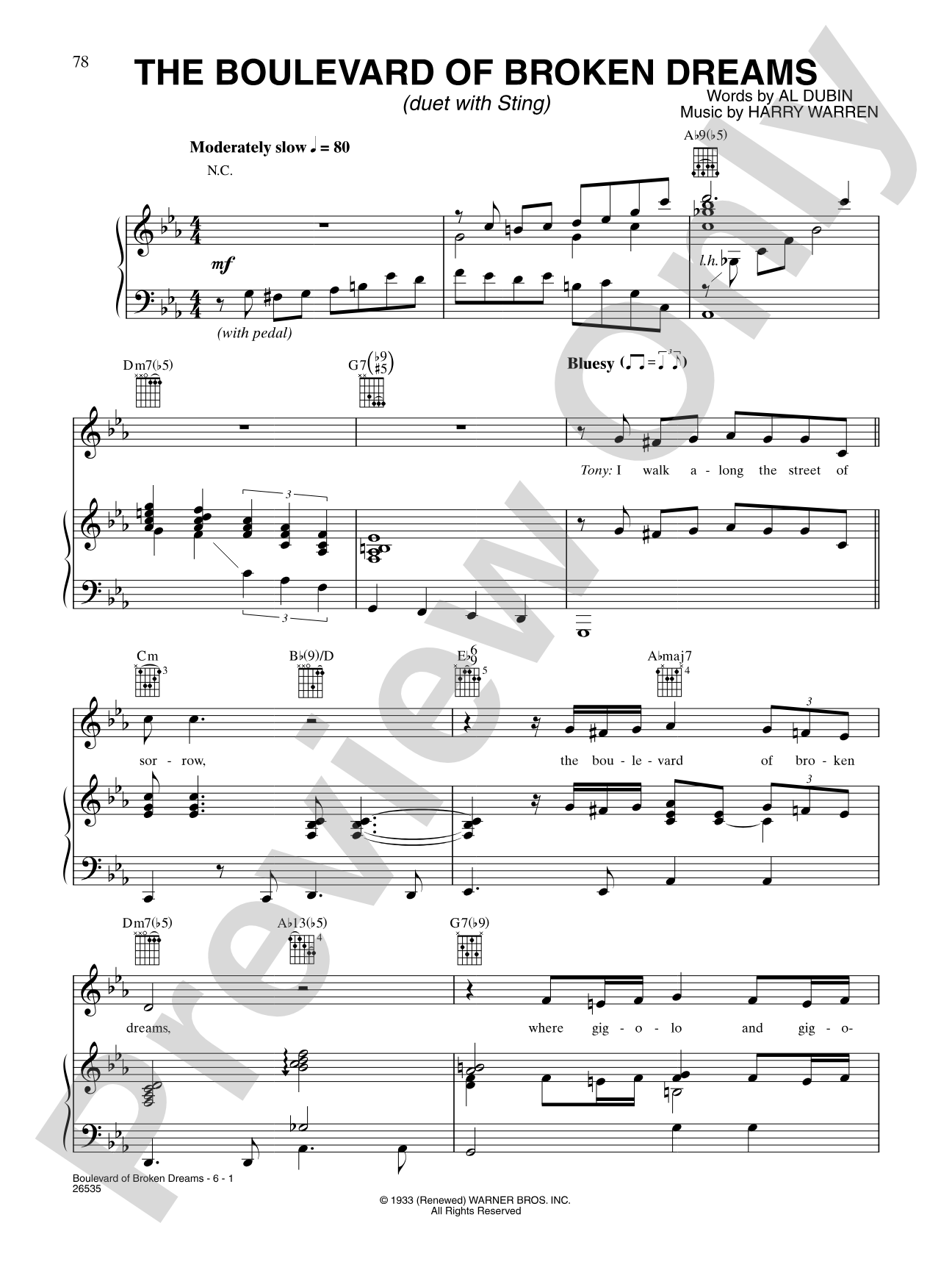
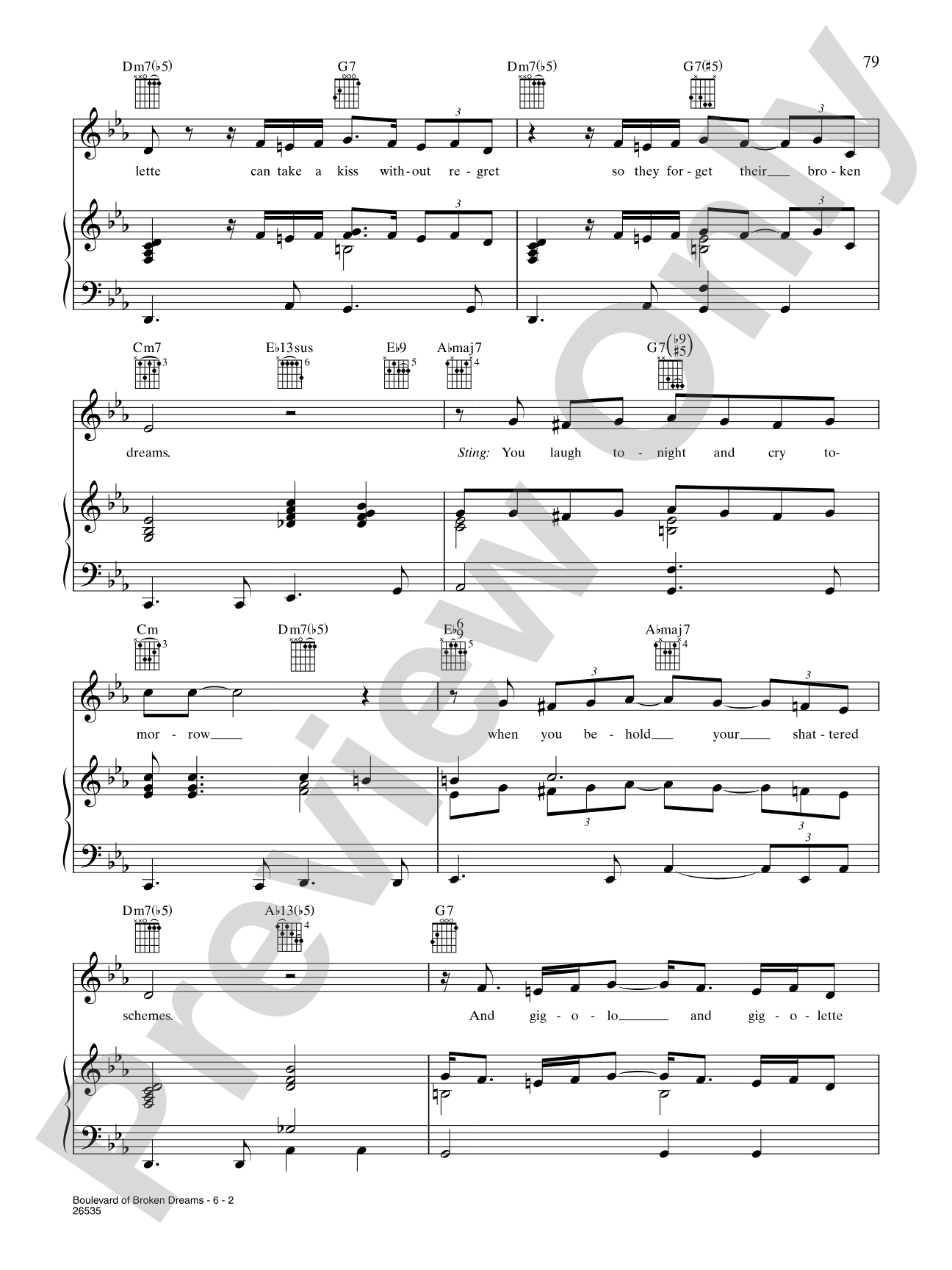

The Boulevard Of Broken Dreams (from "Moulin Rouge"): Piano/Vocal/Chords
Tony Bennett
Item: 00-PSP-000143
$5.99
One moment…
Related Items
Lullaby Of Broadway (From "Gold Diggers Of 1935"): Lead Sheet |
$4.99
|
View | |
Are You Havin' Any Fun? (from "Geoger White's Scandals"): Piano/Vocal/Chords |
$4.99
|
View | |
How Do You Keep The Music Playing? (from "Best Friends"): Piano/Vocal/Chords |
$5.99
|
View | |
I Wanna Be Around: Piano/Vocal/Chords |
$4.99
|
View | |
If I Ruled The World (from "Pickwick"): Piano/Vocal/Chords |
$4.99
|
View | |
Just In Time: Piano/Vocal/Chords |
$4.99
|
View | |
Lullaby Of Broadway (from "Gold Diggers of 1935"): Piano/Vocal/Chords |
$9.99
|
View | |
Put On A Happy Face (from "Bye, Bye, Birdie"): Piano/Vocal/Chords |
$4.99
|
View | |
Rags To Riches: Piano/Vocal/Chords |
$4.99
|
View | |
The Good Life: Piano/Vocal/Chords |
$4.99
|
View |
Description
Alfred is pleased to release the album-matching folio for Tony Bennett's Duets -- An American Classic. Duets -- An American Classic features Tony Bennett singing classic songs with some of the most famous vocalists in the world. This book provides the lyrics along with piano and chord arrangement for all the songs on the record. Titles: Lullaby of Broadway (w/the Dixie Chicks) * Smile (w/Barbara Streisand) * Put on a Happy Face (w/James Taylor) * The Very Thought of You (w/Paul McCartney) * The Shadow of Your Smile (w/Juanes) * Rags to Riches (w/Elton John) * The Good Life (w/Billy Joel) * Cold, Cold Heart (w/Tim McGraw) * The Best is Yet to Come (w/Diana Krall) * For Once in My Life (w/Stevie Wonder) * Are You Havin' Any Fun? (w/Elvis Costello) * Because of You (w/k.d. lang) * Just in Time (w/Michael Bublé) * The Boulevard of Broken Dreams (w/Sting) * I Wanna Be Around (w/Bono) * Sing, You Sinners (w/John Legend) * I Left My Heart in San Francisco * How Do You Keep the Music Playing? (w/George Michael) * If I Ruled The World (w/Celine Dion).


The Boulevard Of Broken Dreams (from "Moulin Rouge"): Piano/Vocal/Chords isn't in MakeMusic Cloud just yet...but it could be. Let us know you'd like to see it, and you'll help shape what comes next. In the meantime, start a free trial and dive into thousands of interactive titles your students can play along with today.
Request This Title
Tell us you want it.
Start Your Free Trial
Explore everything that's ready to play right now.
Sample Audio
No sample audio found.
Sample Video
No sample videos found.
Additional Details
Publisher:
Alfred Music
Page Count:
104
SKU:
00-PSP-000143
More about this title
About the Artist: Tony Bennett
Tony Bennett stands as one of the most celebrated vocalists of the past century, with a career spanning seven decades of artistry. His interpretations of the Great American Songbook set the standard for jazz singing, marked by impeccable phrasing, emotional directness, and an unwavering commitment to melodic clarity. Bennett's later-life collaborations with contemporary artists introduced classic standards to new generations while reinforcing his status as a living bridge between golden-age jazz and modern music.
Why we love this
This folio captures one of the most thoughtfully curated collections of duets in recent music history, pairing Bennett's timeless interpretations with vocalists across genres. The arrangement gives singers and pianists immediate access to recordings that showcase how standards remain alive through fresh collaborations, making it ideal for students exploring jazz interpretation and vocal phrasing. Each pairing reveals different facets of these songs, offering multiple models for how to approach the same material.
What to expect
These songs feel both intimate and expansive, rooted in classic melody yet alive with contemporary collaboration. Whether Bennett is trading phrases with a rock legend or a fellow jazz vocalist, each duet captures the pleasure of musical conversation. The piano arrangements support this conversational quality, leaving room for singers to breathe and phrase naturally rather than fight against dense accompaniment.
Who it's for
Singers studying jazz standards and contemporary vocal interpretation will find this collection invaluable for learning how established material can be freshly approached. Pianists accompanying singers or performing these songs as solos benefit from access to chord charts and melodic reference all in one volume. Teachers introducing students to the Great American Songbook gain concrete examples of how standards bridge generations and genres.
How to get the most out of it
- Study Bennett's phrasing by listening to the recordings while reading through the melody line; his rhythmic flexibility and breath placement are as important as hitting the right notes.
- Use the chord symbols to experiment with comping voicings on piano rather than playing strictly from the printed accompaniment, which builds independence between hands.
- Pay attention to the lyrical context of each duet; the interplay between Bennett and his collaborators often shifts the emotional weight of familiar songs, informing how you shape your own interpretation.
How to use it
Feature individual duets in recitals where vocalists want to showcase different interpretive approaches to familiar material. Use selections as teaching examples when discussing how standards adapt across genres and generations. Arrange performance classes or student recitals around specific duets, inviting singers to hear the Bennett recording first and then develop their own approach.
Skills your students will build
- Phrasing and breath placement in jazz singing
- Reading chord symbols and understanding jazz harmony
- Interpreting lyrical nuance across different musical contexts
- Accompanying singers with appropriate comping and musical sensitivity
- Analyzing how melody and harmony support emotional communication